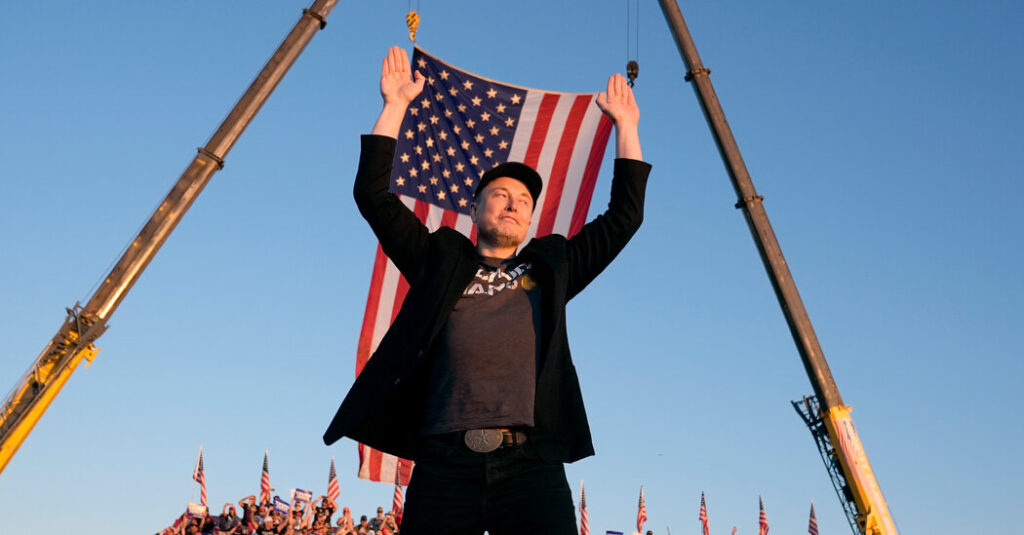
Before a nearly four-hour-long documentary by Alex Gibney about Elon Musk had its world premiere on Tuesday at the Venice Film Festival, prospective viewers could be forgiven for wondering: What could it possibly say that hasn’t already been widely talked about?
Ever since Tesla and SpaceX became household names — if not fodder for “Saturday Night Live” — the world’s first trillionaire has been the subject of perennial waves of news and images, as well as discussion on social media. Now, not even an Italian island has proved to be a place to escape from it.
And isn’t all publicity good publicity? Certainly the supposedly attention-hungry tech titan would love nothing more than an epic monument to his power, proof that both his admirers and his haters can’t get enough of him.
An Oscar- and Emmy-winning documentarian, Gibney is known for pulling the curtain back on the wizards of Silicon Valley, Wall Street and Washington. If most of what he presents here about Musk isn’t particularly new, there is a fearsome power to the way the director brings it all together. Musk isn’t just a pesky fixture in the news cycle. Gibney’s mega-portrait asks us to look at the sum of his actions and take him seriously as a threat to democracy.
“So many incidents have happened; there are so many trees,” Gibney told a news conference on Tuesday. “Sometimes its useful to see the forest and stitch together a narrative.”
Going to Mars used to be a romantic aspiration, but Gibney sees Musk as the curdling of that dream. The opening sequence takes us floating through the cosmos, where we hear a voice that sounds like Musk’s explaining his mission to understand the universe. It comes off like generic “genius” chat until he starts discussing his love of video games: “like, maybe we’re in a simulation,” an ideal version of reality created by artificial intelligence of the future.
Musk then appears as a talking head in Gibney’s film — not the living, breathing Musk, but a waxy, dead-eyed (and significantly more chiseled) A.I.-generated one whose words are drawn entirely from his past interviews and public comments.
Musk has said that video games “calm his demons,” Gibney said, but the director said they were “also a mechanism for him to invest in an unreality.” Gibney added, “We wanted to convey the reality of what he’s done as well as the unreality of his narrative.”
One of the film’s primary voices, Ashley St. Clair, the right-leaning writer who revealed in 2025 that she had had a relationship with Musk, told Tuesday’s news conference: “His most complicated relationship is with the truth.”
The film, for which Musk declined to be interviewed, first covers the entrepreneur’s early years as just another millionaire in a sea of Steve Jobs wannabes, riding the wave of the ’90s tech boom. Musk initially comes off as an ambitious entrepreneur with what Gibney described as admirable goals. “He was going to start a car company that would prioritize electric vehicles that would help address global warming,” the director said. “He was going to revive the space industry by making it cheaper.” Then things started getting ugly. And weird.
“He was imbued with ‘noble cause corruption,’” Gibney said — the ends justifying the means when it comes to realizing his particular vision for a better world.
Although there is a case to be made about the value of big-thinking visionaries, Gibney argues that Musk’s promises — like his missions to Mars and self-driving vehicles — have often been smoke and mirrors to elevate his own brand. “His wealth and power comes from inflated stock,” the director said.
Now add to this Musk’s pronatalist views and his determination to perpetuate his own bloodline; the powerful data collection ability of his Tesla technology and his satellite venture, Starlink; and his takeover of Twitter, renamed X, where his algorithm adjusting resulted in a boost to hate speech as well as his own content.
Gibney had more than enough for one feature film when he finalized his first cut in 2024. But then Musk became involved in politics, and President Trump was re-elected. Musk then found himself attending Oval Office news conferences, and dismantling federal agencies with his Department of Government Efficiency.
More widely, Musk is “involved with right-wing political parties all over the globe,” Gibney said of the tech giant’s relationships with current and former heads of state, such as Presidents Javier Milei of Argentina and Jair Bolsonaro of Brazil.
The film’s many interview subjects — including his first wife, Justine Musk; former colleagues at SpaceX, Tesla and X; and a smattering of prominent tech journalists — made one thing clear: Musk wants everyone onboard with his peculiar vision for the world.
“He’s constantly trying to optimize us,” St. Clair said. “Is there anything that you like about humans, that you aren’t trying to optimize?”
I don’t love Gibney’s choice to insert abrasive video game sequences throughout the film, which gives a giddy quality to the idea of Musk’s world domination. But it’s an effective metaphor. He’s like a video game protagonist that can’t be defeated.
The post How Much Elon Musk Is Too Much? A Four-Hour Film Weighs In. appeared first on New York Times.