With only weeks to go before the midterms, the Trump administration continues to try to press forward with plans to restrict voting by mail, even as its new rules remain frozen by the courts.
Prompted by an executive order by President Trump, the U.S. Postal Service adopted new rules for states that allow voting by mail — rules that some states have warned would be nearly impossible to comply with in time for the midterms.
The proposed limits on mail-in voting are the latest effort by Mr. Trump to sow doubt about voter fraud in American elections. Since his loss in the 2020 presidential election, he has repeatedly claimed, without evidence, that fraud is rampant among mail votes.
The new rules remain blocked as of Tuesday, while the Supreme Court considers the legality of the plan. But the scramble over the proposal has left local officials and voters confused less than two months before the midterms.
What would the Postal Service do under Trump’s plan, if it is allowed?
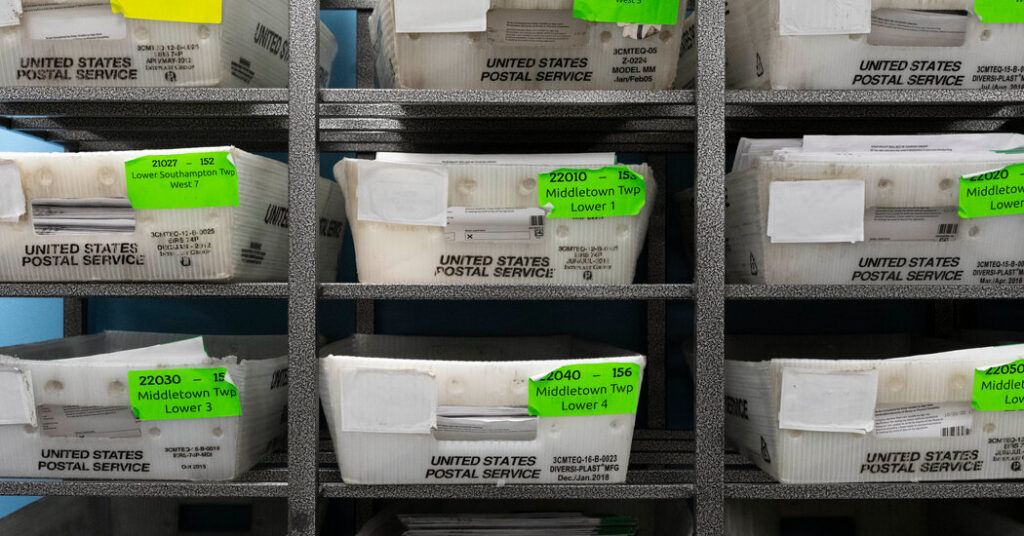
If the Postal Service plan is allowed to go into effect before the midterms, the agency would not deliver mail ballots in states that do not give voter data to the Postal Service, and it would deliver only ballots that meet certain criteria.
The new rules would force states to send lists of voters who receive mail-in ballots to the Postal Service. Although the Postal Service has said that the lists must be uploaded through a government portal, the portal is not yet live and online.
The rules also require that states use an approved envelope with a special bar code for ballots submitted by voters through the mail. This requirement would force counties and municipalities to get special printers to newly prepare the ballots.
Under the plan, the Postal Service would scan a few ballots out of batches prepared by election officials to be sent to voters, seeking to ensure sure the bar code on each ballot matches one included on a list of voters provided by the state.
If one of those ballots fails to match, the entire batch would be returned to election officials to fix the discrepancy, potentially causing delays.
Where do things stand for the Trump plan?
The Trump administration has unrolled a plan to potentially restrict voting by mail by placing new requirements on states, just before the election. That plan remains frozen by the courts, at least for now.
Since the administration announced the proposal, a legal fight over the plan has made its way through the federal courts. The legal developments have been dizzying, confusing both voters and local officials. But the legal fight may now be coming to a head.
On Sunday morning, the Trump administration asked the Supreme Court to weigh in yet again on the plan, the third time that administration lawyers have asked the justices to clear the way for the new rules.
The case is an emergency application, which means it will be heard on what the court’s critics call “the shadow docket,” a truncated process in which the justices hear cases on a fast-tracked schedule, typically without full briefing or oral argument. A ruling could come later this week.
What is the central legal question the Supreme Court will resolve?
The Supreme Court is considering whether the Postal Service plan violates the Constitution.
In an executive order in March, President Trump directed the Postal Service to impose new requirements on voting by mail. Several Democratic state attorneys general and voting rights groups challenged the president’s order in court. Eventually, after a series of legal twists and turns, the Postal Service finalized its new rules in late August.
The groups challenging the new rules argue that the plan violates the Constitution’s division of power, which gives states and Congress, not the executive branch, responsibility for elections.
Lawyers for the Trump administration contend that the Postal Service rules are only modest changes and fall within the agency’s discretion to manage the mail under federal law.
Why does the Trump plan concern critics?
The Postal Service plan has raised alarms among critics concerned that a rushed rollout in the weeks before the midterms could lead to chaos and confusion, potentially disenfranchising voters.
For now, it is unclear how states would even be able to transfer voter data to the Postal Service. The agency has said that states would upload data through an online portal, but, so far, none is available.
A whistle-blower report filed last week raised questions about whether the push to roll out the plan before the midterms would lead to errors with large batches of ballots being rejected.
Challengers have also raised fears about a part of the plan that mandates the Department of Homeland Security to draft lists of citizens and send those names to the states, arguing that those lists could be filled with errors, potentially disenfranchising valid voters.
That part of the executive order has also faced court challenges, and the Trump administration asked the Supreme Court on Tuesday to clear the way for it to make an online tool available for states to compare their voter rolls against federal citizenship and Social Security data.
Critics have also argued that the plan is an illegal move by the executive branch, which is overstepping its bounds and interfering in the role of states and Congress to run elections.
When does it become too late to enact the plan? When do ballots go out to voters?
Some states have already begun sending mail-in ballots to voters. Two — North Carolina and Delaware — started mailing ballots on Friday.
Sixteen more are set to distribute ballots in the next two weeks.
It is not clear whether the Postal Service will process ballots without delay if jurisdictions do not abide by the new rules.
Reid J. Epstein, Eileen Sullivan and Nick Corasaniti contributed reporting.
The post Trump’s Mail Voting Plan Is Coming to a Head. Here’s What to Know. appeared first on New York Times.