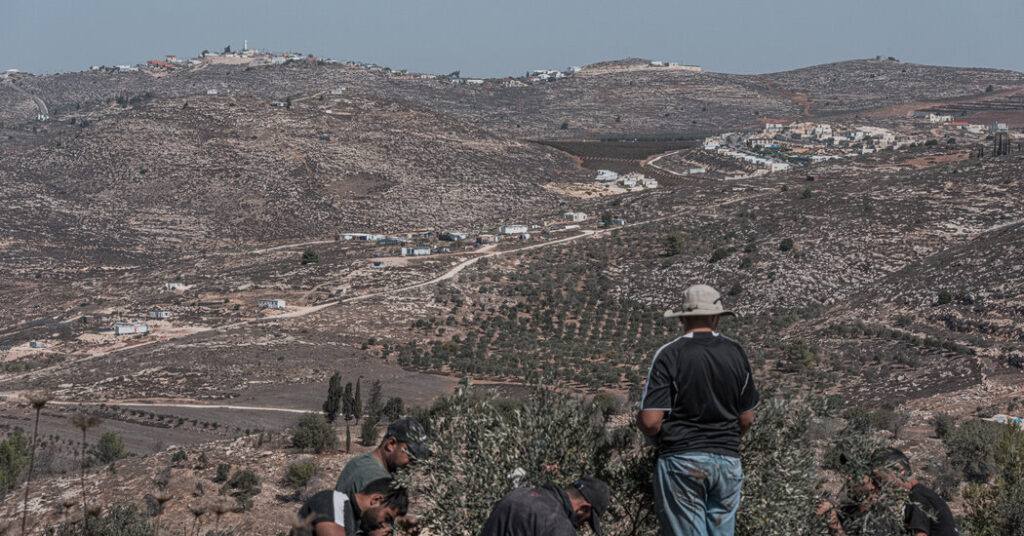
Britain, Canada and France on Tuesday announced sanctions on Israeli settlements in the occupied West Bank, a symbolic step by three once-staunch allies illustrating Israel’s deepening isolation after the devastating war in Gaza and settler violence in the West Bank.
Israel has been increasingly ostracized over its conduct of the war in Gaza, in which tens of thousands of Palestinians have been killed. International attention is now focused on its tightening grip on the West Bank and its expansion of illegal settlements there. In recent weeks, Israeli extremist settlers have repeatedly attacked Palestinians as the military has stood by.
Israel responded to Britain’s announcement with fury and indignation and announced countermeasures. Israel said it would close the British Consulate General in East Jerusalem. The institution, founded in 1839, represents the British government in Jerusalem, the occupied West Bank and Gaza.
The coordinated move by the three nations risks further souring their relationship with the Trump administration, which has been a staunch supporter of Israel both diplomatically and militarily, although the U.S. ambassador to Israel, Mike Huckabee, has spoken out against settler violence.
Britain’s package of measures was announced on Tuesday in Parliament by Ed Miliband, who became foreign secretary in July. It represents the clearest shift in British foreign policy since Andy Burnham became prime minister that month.
“Today marks the beginning of a new approach,” Mr. Miliband told lawmakers. He said that the British government “agrees that there is ethnic cleansing of Palestinians in areas of the West Bank — perpetrated by settler terrorists.” All too often, he added, “the Israeli government has turned a blind eye to this and worse.”
In a speech with an often deeply personal tone, Mr. Miliband said that he had made his announcement as a “proud British Jew” who was “unwavering” in his support for the state of Israel. He added, however, that Britain had concluded that the occupation was unlawful in line with a ruling by the International Court of Justice.
“So I can announce today that we will introduce an import ban on goods from illegal settlements in the occupied territories,” he said, adding that the measures would also cover those who provide services to settlements, including “construction, infrastructure, financing or real estate for settlement expansion.”
The U.S. secretary of state, Marco Rubio, cast the move as potentially undermining efforts toward de-escalating tensions in the West Bank.
“We don’t want to see anything destabilizing going on right now in the West Bank with so much going on in the region,” he told reporters when asked about the British announcement.
Before the British statement, Mr. Huckabee warned that the plans would stoke tensions with Washington and that possible countermeasures from the United States could have a “huge economic impact on British businesses.”
Mr. Huckabee told the BBC that Britain’s firms might face restrictions on business in some U.S. states that penalize boycotts on Israel, citing Florida as an example. “It’s like throwing a stone and not having an idea where it’s going to land,” he said.
Mr. Miliband also announced that Britain would refuse applications for the sale of arms that would “materially contribute to the occupation.” The scope of that pledge was initially unclear. Britain provides only a tiny fraction of arms imports to Israel, which are mostly sourced from the United States and Germany.
In 2024, the previous Labour government suspended around 30 licenses to export parts for fighter aircraft and military radar in protest of their potential use in the war in Gaza. The new policy would extend those suspensions for as long as Israel maintains its occupation, Mr. Miliband said.
The British, Canadian and French foreign ministers issued a joint statement promising “national measures” to ban trade in settlement goods and supporting other nations that have done so. Britain’s restrictions are expected to take six to nine months to come into force.
Pat McFadden, a senior British cabinet minister, said that the overriding drive behind the plan was to keep alive the possibility of a two-state solution, a proposed framework to resolve the Israeli-Palestinian conflict by establishing an independent Palestinian state alongside Israel.
“It’s also important to say that Israel is an important trading partner for the U.K.,” Mr. McFadden said. “This isn’t intended to be a boycott of all Israeli goods.”
A longtime ally of Israel, Britain has repeatedly condemned Israeli settlements in the West Bank, which are considered illegal under international law. In Israel, a number of former generals, intelligence officials and prime ministers recently accused armed settlers in the West Bank of ethnic cleansing after they raided Palestinian homes, mosques and villages.
In his speech, Mr. Miliband quoted one of them, Ephraim Sneh, a retired brigadier general and former minister of health, who said in a New York Times interview, “This is ethnic cleansing, to put it simply.”
Prime Minister Benjamin Netanyahu of Israel has shrugged off international and domestic criticism and promoted building more settlements at a breakneck pace.
Husam Zomlot, the Palestinian ambassador to the United Kingdom, welcomed Mr. Miliband’s announcement, describing it as a “turning point in every sense.”
“The U.K. has finally matched its values with its actions,” he said in a phone interview. “What happened today is the beginning, not the end. But it is a very, very powerful beginning.”
In addition to closing Britain’s consulate in Jerusalem, Israel’s foreign minister, Gideon Saar, announced restrictions on the activities of some British officials in the West Bank and a ban on the entry to Israel of 12 British lawmakers and other citizens who, he said, had been “involved in antisemitic and anti-Israel activities,” including Jeremy Corbyn, former leader of the Labour Party.
Bezalel Smotrich, Israel’s far-right finance minister and chief settlement promoter, suggested Israel should expel the British ambassador. Itamar Ben-Gvir, Israel’s national security minister, also said Israel should recognize that the Falkland Islands, a British territory in the south Atlantic, belonged to Argentina.
Other critics warned that Mr. Netanyahu could use the sanctions to galvanize his supporters ahead of elections next month. The centrist leader of Israel’s parliamentary opposition, Yair Lapid, called the British move “a grave mistake” that came “at the wrong time for the wrong reasons.” He added in a statement that it “strengthens the extremist voices in Israel a moment before the elections.”
At the same time, Mr. Netanyahu’s political opponents argued that he had brought the sanctions upon Israel because of the conduct of his government.
He was already on the defensive after accusations in the Haaretz newspaper that he had received an explicit warning from Mohammed bin Zayed al-Nahyan, the ruler of the United Arab Emirates, that Hamas was planning a major attack on Israel in the weeks before the deadly assault of Oct. 7, 2023, and had failed to act on it. The assault, which the Israeli authorities said had led to the deaths of about 1,200 people in Israel and the abduction of about 250 people, was the catalyst for the war in Gaza.
Mr. Netanyahu’s office denied the newspaper’s report, calling it “false.”
Around the time he became prime minister in Britain, Mr. Burnham apologized for the government’s initial reaction to Israel’s conduct in Gaza, saying that his Labour Party “didn’t get it right” and adding, “There’s increasing evidence that war crimes appear to have been committed.” He did not say genocide had been committed, saying that only the international courts could determine accountability.
The debate over Gaza has had domestic political consequences in Britain, with an insurgent Green Party capitalizing on misgivings over Labour’s initial caution among more left-leaning voters.
While Britain’s chief rabbi publicly opposed the move on Tuesday, calling it “truly a dark day,” some British Jews welcomed the tougher measures. Yachad, a pro-Israel group that opposes Israel’s occupation, said in a statement that the “announcement is not anti-Israel, and it is certainly not antisemitic.” The organization said that “Israel’s current extremist government has crossed almost every red line” in entrenching its occupation.
Last month, Britain condemned the Israeli government’s decision to move ahead with plans for new homes for settlers in E1, part of the West Bank near Jerusalem, in a joint statement with countries including France, Germany, Italy, the Netherlands, Canada, Norway and Australia.
The statement urged Israel “to retract these plans immediately and end its expansion of settlements in the West Bank.” It added, “Not only will they take us further from peace, but they further undermine Israel’s international standing.”
The post Israeli Allies Ban Trade With Settlements as U.K. Cites ‘Ethnic Cleansing’ appeared first on New York Times.