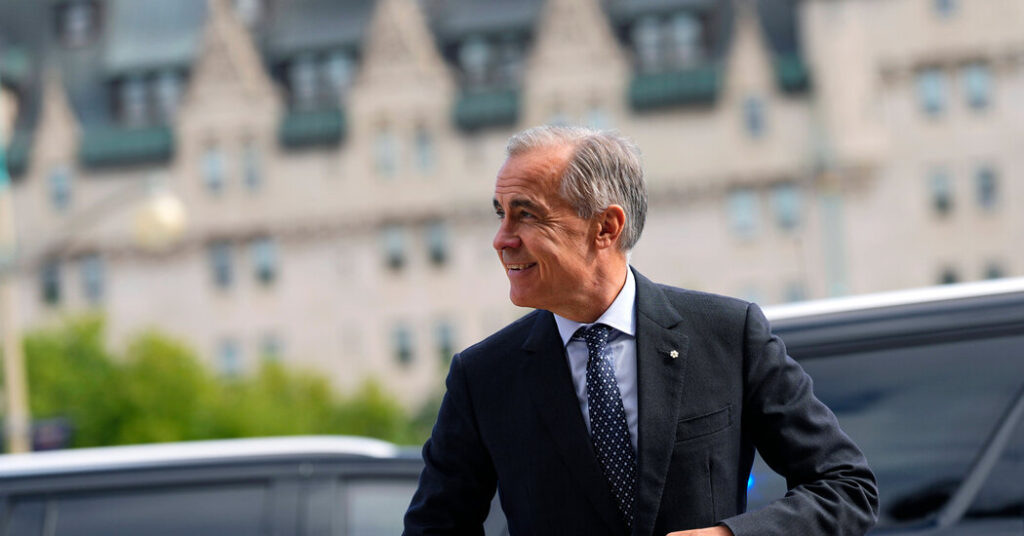
Hours after his government imposed retaliatory tariffs on $20 billion of imports from the United States, Prime Minister Mark Carney said on Tuesday that Canada’s response had been unavoidable.
“I don’t believe in escalating the conflict; that’s not constructive,” Mr. Carney said in a recorded video address to Canadians that was posted online. “But our tariffs are necessary to protect our workers, protect our companies and our communities. We can’t let American goods into Canada tariff free while they charge our companies to export them.”
The Canadian tariffs of 15, 25 and 50 percent depending on the product, which came into effect just after midnight on Tuesday, were Mr. Carney’s response to tariffs of up to 50 percent imposed by President Trump after the end of trade talks between the two countries last month. They targeted roughly the same level of Canadian exports, $20 billion. The new Canadian levies also boosted counter-tariffs that Canada adopted last year.
Mr. Trump has threatened repeatedly to respond to any further retaliation. On Monday, he said that the United States might block the purchase of business jets made by the Montreal-based manufacturer Bombardier unless the company shifted production of its aircraft to the United States.
The consensus among economists is that because of Canada’s comparatively small economic size, its tariffs, which apply to goods like rolls of aluminum foil and diesel locomotives, will have relatively little effect on the American economy. But they do have the potential to inflict pain on some businesses and regions. Canadian officials say they picked many of the items now under tariffs because they are produced in states that backed Mr. Trump.
With retaliation, Mr. Carney appears to be responding to two political forces. Polls show that Canadians overwhelming want him to strike back. At the same time, not doing so might be taken by the Trump White House as a sign of weakness.
In his speech, part of a regular series Mr. Carney calls “Forward Guidance,” the prime minister acknowledged that his plan to reduce Canada’s economic dependence on the United States would be difficult.
“There’s always a cost to action,” he said, seated in a prefabricated house factory lined with chipboard. “But it doesn’t come close to the cost of standing still. This is about who we are as Canadians.”
Mr. Carney, who has described the trade situation as “war,” added, “The truth is adversity only makes us stronger; it always has.”
He repeated that the trade negotiations had failed over a variety of issues, including demands by the American side that would “undermine some of the most important industries in our country, including automobiles, steel and forest products.” He also said that U.S. negotiators had continued to press on Canadian laws covering culture and the French language, which is protected under Canada’s Constitution.
“The cumulative U.S. demands revealed that they wanted us to become even more reliant on them, not less.” Mr. Carney said. “They wanted dependency, not a true economic partnership. In the spring of last year, I warned that America is trying to break us so they can own us. And I promised that will never, ever happen.”
Mr. Carney did say that a trade agreement between the countries remained possible. Gabriel Brunet, a spokesman for Dominic LeBlanc, the minister handling trade between the countries, said in a statement that “Canadian and American officials have maintained ongoing discussions on a range of issues, although formal trade negotiations are not taking place at this stage.”
In the 15-minute speech, Mr. Carney characterized Canada’s history as a running response to American aggression and trade actions, with the exception of the high degree of integration that followed the first Canada-United States trade agreement in 1989.
In particular, he focused on President William McKinley, who was in office in the United States from 1897 until his assassination in 1901 and who is admired by Mr. Trump.
“McKinley championed the Tariff Act of 1890,” Mr. Carney said, referring to Mr. McKinley’s time as a senator, when he sponsored the legislation that would take his name. “It put 50 percent tariffs on our exports to the U.S. — sound familiar? McKinley’s 50 percent tariff was meant to pressure us into dependence and, eventually, annexation by the United States. In reality, it did just the opposite.”
The post Carney Tells Canadians: Retaliation Against U.S. Tariffs Was Unavoidable appeared first on New York Times.