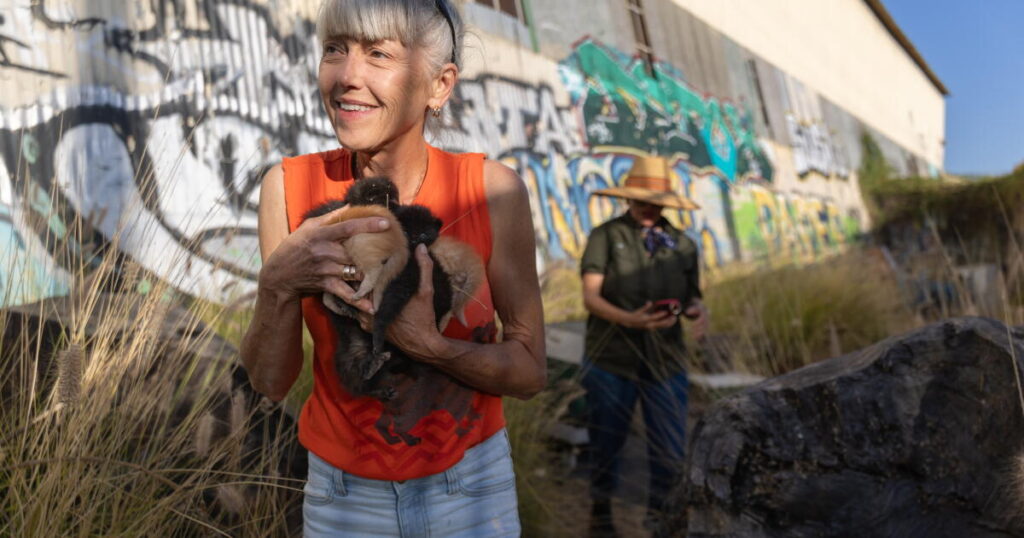

When Jacquie Navratil rolls up to Angel City Lumber in an all-but-deserted stretch of industrial Boyle Heights on a summer Sunday, her white Dodge Caravan SE loaded with cat-trapping gear, she’s been in cat rescue mode for hours.
“Caltrans called this morning,” she says out the window as she parks the van. “There was a kitten on the 5 Freeway.”
Those kinds of phone calls are why her dedicated white van — which has more than 216,000 cat-trapping miles on it — is always stocked with multiple cat traps, cages and carriers, a long-handled net, puppy pee pads, flat-folded cardboard, blankets and cases of Fancy Feast cat food. She’s ready to roll at a moment’s notice.
After a decade of volunteering with L.A. trap-neuter-return (TNR) groups, Navratil, whose day job is in medical fundraising, founded her own, Luxe Paws, in 2012. The all-volunteer network of cat trappers and kitten rescuers centers on five L.A. ZIP Codes that encompass Silver Lake, Echo Park, Los Feliz and parts of downtown. She estimates her organization has trapped, fixed and released 19,000 cats and the current rate of trapping is somewhere around 50 a week, 10 of which she traps herself. And it’s not the only group doing this kind of tireless work.
L.A. Animal Services’ website estimates the city is home to 960,000 “unowned community cats,” though Navratil thinks it’s likely much higher.
The city doesn’t do TNR work itself (partly the result of long-running legal challenges), but instead offers, through its Citywide Cat Program spay/neuter vouchers to TNR volunteers like Navratil. (The city also offers vouchers for residents’ pets.)
But the number that really underscores why groups like Luxe Paws do what they do is the euthanasia rate of cats and kittens in L.A. animal shelters, up 32% and 43%, respectively, in the first six months of 2026. Navratil says L.A. cat kind deserves better. “I’m an animal lover,” she says. “And I love dogs, I really do. But for some odd reason, cats just are not viewed in the same way, especially free-roaming cats. I looked at [the situation] and I said, ‘We need to even the playing field here because their lives do matter.’”
So she soldiers on, hoping that by inspiring more volunteer groups like hers, educating pet parents and increasing funding for and access to spay/neuter services, the quality of life for the city’s cats will increase and its population will decrease.
Those are long-term goals, though. The immediate one is trapping a colony of cats in the log-jumbled lot next to Angel City. Unlike this morning’s last-minute rescue, this trapping has been in the works for a week and planned out with military-like precision.
Navratil has tried to trap this colony unsuccessfully twice before. Angel City employees, who have been feeding and caring for the cats, have given them wood-themed names. Doug (as in Douglas fir) is an older orange male; Maple is a dusky silver almost brown domestic medium hair female who has just had a litter of kittens; and Cypress, later renamed Natalie Wood, is a gray tabby female.
For this attempt, Navratil picked late Sunday afternoon as the usually busy spot would be at its quietest and warmest. In preparation, Angel City folks stopped feeding the cats on Friday so they’d take the bait.
“They really have to be desperate and hungry because, I hate to say it, but they’re smarter than humans,” Navratil says.
Luxe Paws won’t organize a trapping until available low-cost spay/neuter slots are lined-up at a clinic — and there are 25 such slots up for grabs the next morning at Simi Valley Non-Profit Spay and Neuter Clinic. The cost of a spay/neuter procedure at most local nonprofit clinics run in the $100-$150 range, she says (about one-fifth of the cost at a private-practice vet).
Also in the mix this afternoon is Luxe Paws TNR volunteer and animal rescue content creator Nathan Kehn (a.k.a @Nathanthecatlady). Like Navratil’s white van, his Toyota Tacoma pickup truck in front of the lumberyard gate is filled with tools of the cat-trapping trade; drop traps, gravity traps and kitten traps, a net and a 12-gallon tote filled with cat food, cardboard food bowls, bite-resistant cat-handling gloves and a tool kit.
“You never know when you might get a call from Jacquie,” he says of his gear-stocked truck.
On today’s bait menu: a tin of Wild Planet sardines, a bag of tuna flakes and a clamshell container of roasted chicken wings Navratil picked up from 7-Eleven on the way. “The stinkier the better,” Kehn explains. “Sardines or mackerel are good. And we seem to have good luck with the chicken.”
Once the drop trap — a simple wire cage triggered by yanking on a cord — is set up with an enticing mix of sardines and shards of roast chicken on a cardboard tray inside, everyone moves out of sight behind massive logs a few yards away. Kehn holds the trap’s pull cord in his clenched fist.
Less than three minutes pass before someone whispers “There she is!” as Maple saunters into the clearing. Halfway to the trap, she stops, sits back on her hind legs and warily eyes the bowl of food. A few seconds later, she enters the enclosure. Kehn yanks the cord, trapping the mama.
Natalie Wood is trapped next, and Kehn discovers she has a bad leg. With sunset less than an hour away, the trappers give up on Doug and pivot to finding the clutch of kittens. This time the secret weapon comes by way of smartphone; Navratil and Kehn hold them aloft and play YouTube videos of mother cats meowing to their kittens, hoping the ones they’re searching for will mewl in response.
Eventually they do and Navratil plunges into a thicket of grass next to a corrugated metal wall, emerging with six tiny kittens clutched to her chest. “They’re about 3 weeks old,” she says. “We’re lucky because at 4 or 5 weeks [old] they’d be mobile and we’d be up a creek.”
Even before she’s handed off the kittens to Kehn she makes a phone call. “Ester — my go-to bottle-baby foster — is on her way from Glendale,” she says after hanging up.
She’s referring to Ester Moran, another volunteer who keeps the Luxe Paws TNR train rolling. By her own estimation, Moran’s bottle-fed more than 300 animals over the last decade and a half. “Mostly cats,” she says, “with puppies and a few exotics mixed in there too.” She’ll foster these kittens until they no longer need to be bottle fed.
Navratil will feed and care for Maple and Natalie Wood overnight before meeting longtime driver Augustus Hoovestal at 6:30 a.m. the next day in a CVS parking lot. He will take them, along with other cats trapped over the weekend, to the next stage in their TNR journey.
For Maple, that’s the Simi Valley clinic. After she’s spayed and vaccinated, the cost covered by L.A.-based nonprofit FixNation, Navratil holds her at home for another overnight before returning her to the lumber yard.
Natalie Wood is taken to the Fillmore Animal Hospital for amputation surgery due to her extensively fractured back leg, which would have cost at least $8,000 to try to heal. After that, she’ll spend five weeks recovering with a specialized medical foster volunteer before moving to a long-term foster. This time that will be Angel City Lumber employee Madeline Paterson, who helped care for her in the wild. Once the cat has been spayed, Navratil will work to find her a forever home.
In early August, the six rescued kittens, all christened with wood-related names (Cedar, Ash, Mahogany, Ebony, Walnut and Cherry) have grown beyond bottle-feeding stage and are moved to a long-term volunteer foster. Once they’ve been spayed/neutered, they’ll be put up for adoption.
Moving the two cats and six kittens from the lumberyard through the TNR process required the work of at least seven volunteers and the total minimum cost of spaying/neutering will be between $800 and $1,200. (That doesn’t include the $876 for Natalie Wood’s amputation surgery, covered by a Luxe Paws fundraising event in Chinatown.) Facing an outdoor cat population the size of L.A.’s, those numbers may make the problem seem unsolvable.
But Navratil is undeterred, even as her cat-trapping van broke down for the final time recently. While she thinks funding is crucial, she says education — and leading by example — are key. She hopes one day every L.A. neighborhood will have a network of volunteer-driven TNR groups like hers.
“I just want everybody to do something,” she says.
The post She helps trap 50 feral cats a week. Her dream? Cat rescuers in every L.A. neighborhood appeared first on Los Angeles Times.