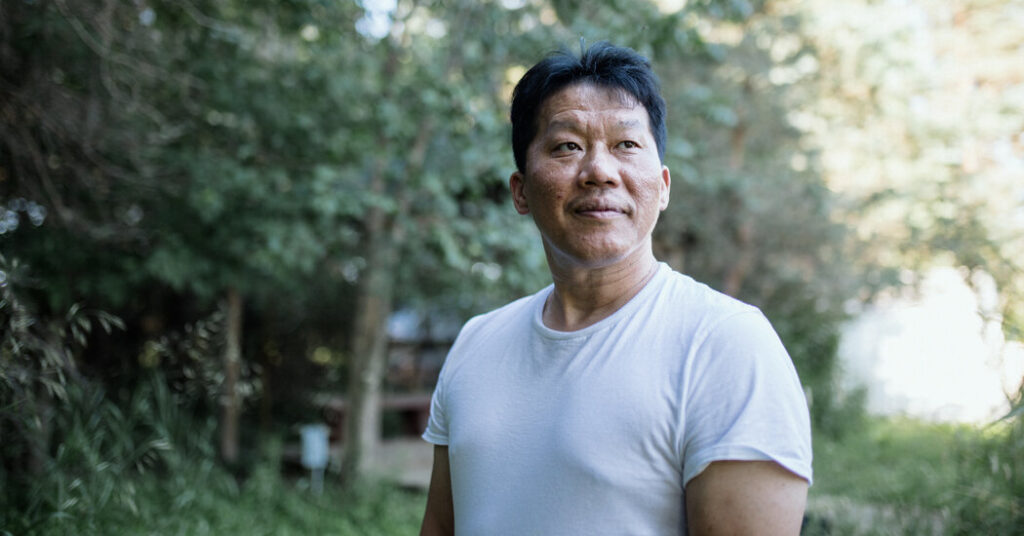
Lue Yang had just finished his overnight shift at a Michigan automotive plant when two unmarked cars with tinted windows pulled into the parking lot and blocked him in.
A man in body armor approached him. Mr. Yang knew that it was Immigration and Customs Enforcement. And, in those early morning hours of July 15, 2025, he knew why the agent was there.
Nearly three decades earlier, as a teenager, Mr. Yang had spent 10 months in jail after he and three friends were caught with stolen cash, electronics and cameras in the trunk of their car.
The consequences had not ended there. Mr. Yang was living in the United States as a war refugee. After his conviction, he lost his permanent residency status and was ordered deported to Laos, the country his family had fled.
For 23 years, the government did not enforce the final removal order. Mr. Yang went back to school, got married, had six children, built a career and became a leader in the Hmong community in Lansing. He checked in with ICE as required. He was never arrested again, said his lawyer, Nancy Xiong.
Now ICE had come for him as part of President Trump’s deportation campaign.
The agent agreed to escort Mr. Yang to his home in St. Johns, Mich., north of Lansing, so he could drop off his motorcycle before being locked up. Mr. Yang gripped the handlebars and tried to stay under the speed limit during the 35-minute ride through verdant fields of corn and soybeans.
As he approached home, he called his wife, Ann Vue, and asked her to come outside. Their children, the younger ones still dressed in their pajamas, trudged down the long gravel driveway alongside her. Mr. Yang hugged each child, and then, before agents placed him in handcuffs, he turned to his wife.
“Look for me,” Mr. Yang said as they embraced. “Don’t let me disappear.”
Those words reflected the start of a race that would stretch over 100 days. Somehow they had to get the deportation order lifted before a government plane flew Mr. Yang to Laos, a country he barely knew. And it would all come down to the last minute.
In a recent interview at her home, Ms. Vue, a U.S. citizen whose parents were also Hmong refugees, exuded the multitasking energy of a full-time working mother of a large brood. She zipped around the house, locating a lost phone charger for her youngest son, checking on Mr. Yang’s 100-year-old grandmother, finalizing details for the family’s upcoming weekend trip to Wisconsin, tending to the chickens milling around the front yard — all while answering a reporter’s questions.
Those juggling skills were put to the test during the months she fought to keep her husband in the country. She persisted even as some Hmong elders advised her not to resurface the shameful memory of Mr. Yang’s conviction and to let him go.
“Just thinking about a life without him was unbearable,” Ms. Vue said.
Mr. Yang spent his first night in detention in Baldwin, Mich., about two hours from home. Soon after, Ms. Vue and her children set up a gamer-style workstation in the basement — a laptop and five computer screens — so she could simultaneously read legal documents and monitor immigration-related news developments.
Her cellphone became a fifth limb. Her notes became a compendium. She took calls from Mr. Yang. She consulted immigration lawyers and advocacy groups for strategies and advice. She lobbied the staff of elected representatives.
But there were obstacles all around.
A lawyer explained that Mr. Yang did not qualify for release on bond since he already had a final removal order. But perhaps they could persuade local officials to vacate his criminal conviction, which would mean effectively erasing the original offense.
So Ms. Vue and her lawyers reached out to the local prosecutor in Clinton County, where Mr. Yang was arrested decades ago. They argued that his Sixth Amendment rights were violated because he was not told that pleading guilty could lead to deportation. But the prosecutor, Tony Spagnuolo, who ran as a Republican, was unwilling to budge. (Mr. Spagnuolo did not respond to a request for comment.)
In early August 2025, Ms. Vue sent a message to the office of Gretchen Whitmer, the Democratic governor, asking for a pardon. On its own, a pardon would not free Mr. Yang, but it could help reopen his federal immigration case and get his removal order lifted.
“Governor Whitmer, my husband is not a danger to anyone,” Ms. Vue pleaded in the letter. “We are asking for mercy. For compassion. For humanity.”
By then, Mr. Yang had been detained for three weeks.
Mr. Yang’s life story has its roots in the Vietnam War and the surrounding regional conflicts.
In Laos, the C.I.A. recruited Hmong to join the fight against communism in a campaign that became known as the “secret war.” Among the recruits was Lo Yang, Mr. Yang’s father, whose job included rescuing downed American pilots. To this day, the elder Mr. Yang still has shrapnel lodged in his skull from that time, Ms. Vue said.
After the United States withdrew, the Laotian government persecuted Hmong people for taking the other side in the war. In 1978, Lo Yang and his family fled to Thailand, where Lue Yang was born in Nong Khai, a refugee camp.
The next year, the family came to the United States as part of the resettlement of more than one million Southeast Asian refugees, an effort that many Americans saw as a moral obligation for the country’s role in the Vietnam War. They joined the tens of thousands of Hmong refugees resettling in cities like Lansing; St. Paul, Minn.; and Fresno, Calif. A black-and-white photo from a local Michigan newspaper in 1980 shows Mr. Yang’s parents posing alongside a patterned wall hanging they had woven as a thank-you gift to the church that had sponsored them.
Six more children came along, all American citizens by virtue of their birth in the United States. Mr. Yang’s parents worked constantly. His mother made doughnuts at a local convenience store chain. His father worked as a church janitor and, later, opened a small bait shop.
Through middle school, Mr. Yang excelled academically, particularly in math. But in 1997, his sophomore year of high school, he started to ditch class with a group of Hmong kids, some of whom were involved in gangs.
“It was like, ‘We’ll do some break-ins, but not when anyone’s home,” Mr. Yang recalled. “It was stupid.”
That spring, he sat in a car while three friends broke into an empty house. They tried to drive away with the goods, but the driver, Mr. Yang recalled, didn’t know how to work a stick shift.
A police officer stopped to help, and then realized the car matched a burglary alert, Mr. Yang said. Mr. Yang went to jail, and in 2002, the U.S. government ordered his deportation to Laos. At the time, though, the Laotian government was refusing to accept large numbers of U.S. deportees.
That diplomatic tussle allowed Mr. Yang to remain in the United States on supervised release for 23 years.
In 2025, with President Trump back in office and applying pressure, Laos and other countries began accepting much larger numbers of deportees. That is how Mr. Yang became locked up and faced the prospect of a one-way trip to Laos.
Ms. Whitmer’s office seemed receptive to a pardon. Her staff emailed Ms. Vue a blank application.
Ms. Vue scrambled to complete the forms. Yes, Mr. Yang was married. Yes, he had children — five sons and a daughter. Yes, the state had expunged his conviction in 2018 because his crime was old and he had demonstrated rehabilitation. Yes, he had paid all fines and restitution.
Was he a changed man? On that point, there was much to say. After getting out of jail, Mr. Yang had earned his G.E.D. and enrolled in community college. He had gone on to hold a series of jobs in car manufacturing facilities. To make ends meet, he had also worked at a McDonald’s flipping burgers.
By the time ICE arrested him, he had worked at the same automotive parts manufacturer for nearly a decade. He had worked his way up to becoming a torque technician, which requires meticulous precision to ensure that every nut and bolt is fitted to the exact specifications. He served as the president of the Hmong Family Association of Lansing, which provided translation, social services and food assistance for community members in need. And he was a Hmong spiritual healer, performing traditional blessings at births and other important life events.
The governor’s office needed more than just Mr. Yang’s word. So Ms. Vue sent a mass text that reached the Hmong community and beyond. More than 200 people from California to Michigan wrote letters testifying to the man they knew.
A relative said that Mr. Yang had given him and their younger cousins “endless talks” about making good choices and staying in school, rewarding them $25 for each “A” that they received. A colleague wrote that Mr. Yang had risen at their company with his “bright attitude” and “natural leadership abilities,” even receiving an award for perfect attendance, a “stark contrast to his current absence.”
The president of a Hmong veterans association emphasized the risk of persecution that Mr. Yang could face as the son of a C.I.A.-allied fighter if he were deported to Laos.
In public and behind the scenes, Mai Xiong and Stephanie Chang, both Democratic state lawmakers in Michigan, lobbied for Mr. Yang’s release. And in a rare show of bipartisan support, United States Representative Tom Barrett, a Republican and an Army veteran, also joined the campaign to free Mr. Yang.
Still, the pardon application felt like a Hail Mary. Michigan rarely granted pardons. And requests typically took months to process.
But for Mr. Yang, having a team fighting for his release helped push him through some dark moments.
“That was pretty much what gave me a lot of strength in there,” Mr. Yang said. “Because otherwise it felt like the system was made to break people down.”
During their almost daily phone calls, Ms. Vue updated her husband on the status of his pardon application, even as they made plans for his deportation to Laos. Their children, who had never traveled abroad, had to get passports so they could visit. And they needed to find someone, perhaps a distant family friend, who could sponsor Mr. Yang’s release from the government-run detention facility once he arrived in Laos.
Mr. Yang told of his experiences in detention. An elderly Vietnamese man fainted because he had not received his medication for days. A young Indian guy, Sahil, paced in his cell and struggled to find enough food that complied with his vegetarian diet.On another day, Mr. Yang and a few others put together a birthday cake for another detainee with items from the commissary — white cake with jelly and a sprinkling of crushed Lemonhead candy.
Ms. Vue wrote down all the details. Mr. Yang was keeping his own journal, but he also wanted her to keep a record, partly so he could track his friends as they were separated, transferred around and ultimately deported.
The Department of Homeland Security has long insisted that detainees receive adequate care. In a recent emailed statement, Chandler Rebel, a department spokesman, said that detainees were given “three nutritious meals a day” with special religious accommodations and “comprehensive medical care from the moment an alien enters ICE custody.”
At the end of August, Mr. Yang was moved to a staging facility in Arizona, where some detainees are taken before being deported. He was shackled at the wrists, waist and ankles and led onto the tarmac with the other detainees, where a plane they were told was bound for Asia waited in the desert sun.
By the time Mr. Yang shuffled to the front of the line to board the plane, he was sweating from the heat. He had worn all the clothes he had with him, including four layers of socks to pad the ankle shackles. He was unsure if he would ever return to the United States and didn’t know when he might see his family again.
An officer patted Mr. Yang down to look for sharp objects and to check that the shackles were secure. Then the officer looked for Mr. Yang’s name on the list. It was missing.
Mr. Yang was pulled aside and then walked back to a holding cell, where he waited until he was loaded into a van with several other detainees who had also been removed from the plane at the last minute.
“I felt like I had dodged a bullet,” Mr. Yang recalled.
It wasn’t until nearly two months later that he was put on a plane that actually took off.
It was Oct. 22, 2025: 99 days into Mr. Yang’s detention. A deportation flight bound for Asia was scheduled to leave the next day.
Mr. Yang called Ms. Vue, this time from a staging facility in Louisiana. When Ms. Vue saw the “Prison” caller ID flash across the phone, she picked up immediately.
She couldn’t wait to share the news. Mr. Yang had been pardoned by Governor Whitmer.
From his holding cell, Mr. Yang flagged down an officer and explained the situation. His lawyers were at that very moment appealing to D.H.S. to stop his removal, he said.
The officer left and came back with a sheaf of papers. She had to follow orders, and Mr. Yang’s name was still on the deportation list.
His heart sank.
He was flown from Louisiana to Baltimore, where the plane was scheduled to stop for refueling before heading the next morning to Asia.
There was no way for Mr. Yang’s wife and lawyers to get in touch with him now. All they could do was watch the little plane icon on the online flight tracker as they worked into the night to draft motions to stay Mr. Yang’s removal.
The motions had to be filed in person at the Board of Immigration Appeals in Virginia. But the courier could not make it until the afternoon of Oct. 23, after the flight to Asia was scheduled to leave. If Mr. Yang were deported, it would be much more difficult for him to return to the United States.
On the morning of Oct. 23, Ms. Chang stood in the Michigan Senate chamber and pleaded with ICE to release Mr. Yang. Mr. Yang’s flight had been scheduled to take off from Baltimore two hours earlier, but his exact whereabouts at that moment were unknown.
“This morning, we believe Lue Yang is still in the United States,” Ms. Chang said, sniffling as she held back tears. “We still have a chance.”
On a large airliner, Mr. Yang shivered in the frigid cabin air and prayed. He had recited the Hmong soul-calling prayer countless times for relatives and friends who had looked to him for spiritual guidance in times of distress. Now, as his airplane hurtled down the runway, he found himself saying those familiar, comforting words for himself.
“Hey spirit, I’m leaving the United States now,” Mr. Yang remembered whispering to himself. “So if you are still behind, follow your body.”
Across the plane, Mr. Yang heard another deportee yell that he could see the ocean. This was it, Mr. Yang thought.
As the plane continued its journey, Mr. Yang’s thoughts turned toward his children. Had he been too hard on his youngest son when he took away his screen time for acting out on the school bus? Why hadn’t he taken his only daughter, Lily, a die-hard Hulk Hogan fan, to a wrestling event, as she had asked?
And what would he do in Laos?
Suddenly, Mr. Yang felt the aircraft tilting sharply. The other passengers on the plane — deportees from India, Sri Lanka, Vietnam, Laos and Cambodia — cried out in confusion.
They were turning around.
Soon they were back in Louisiana, at the staging facility near the airport. Rumors spread that the plane had run into trouble getting clearance over international airspace.
That night, officials lined up the detainees once more and called out their names by country to shackle them again so they could re-board the plane. Mr. Yang listened as they made their way through the list of those going to Laos.
“You didn’t call my name,” Mr. Yang told the immigration officer.
The officer looked at his clipboard. “Are you from Detroit?” Mr. Yang recalled him asking.
“Yes,” Mr. Yang replied.
“We can’t send you anymore,” the officer said. He didn’t seem to know why.
As soon as he could, Mr. Yang called his wife. For 24 hours, she had been anxiously tracking the plane. Their three youngest kids were sleeping around her, as they had taken to doing ever since their father had been detained.
“Everyone’s gone,” Mr. Yang told her. “I’m still here.”
She heard a roar in the background. The plane was taking off again for Asia — without Mr. Yang.
It took more than a month for Mr. Yang to reopen his immigration case, get the removal order lifted, return home and reunite with his family. Once home, Mr. Yang went back to his old job, putting in extra hours so he could start paying back his legal fees. Last month, he finally had his permanent residency status restored.
But the joy of returning to familiar routines has been tempered by lingering uncertainty. The Department of Homeland Security maintains that Mr. Yang should have been deported and accused Ms. Whitmer in a recent emailed statement to The Times of endangering Michiganders with her decision to pardon Mr. Yang, whom the department called a “public safety threat.”
There is also the survivor’s guilt. During his time in detention, Mr. Yang became close to many people who, like him, were child war refugees who had committed crimes decades ago. Unlike him, they were still deported.
Since he has left detention, he and Ms. Vue have continued to help others in the Hmong community facing imminent deportation, offering advice about the pardon application process and emotional support for worried relatives. It was a way to pay forward the camaraderie that had sustained Mr. Yang through his months in detention.
“I miss the guys,” Mr. Yang wrote in his journal, not long after he was pulled off the plane some of his friends were still on. “Hope they are doing good.”
The post ‘Don’t Let Me Disappear’: The 100-Day Scramble to Free Lue Yang appeared first on New York Times.