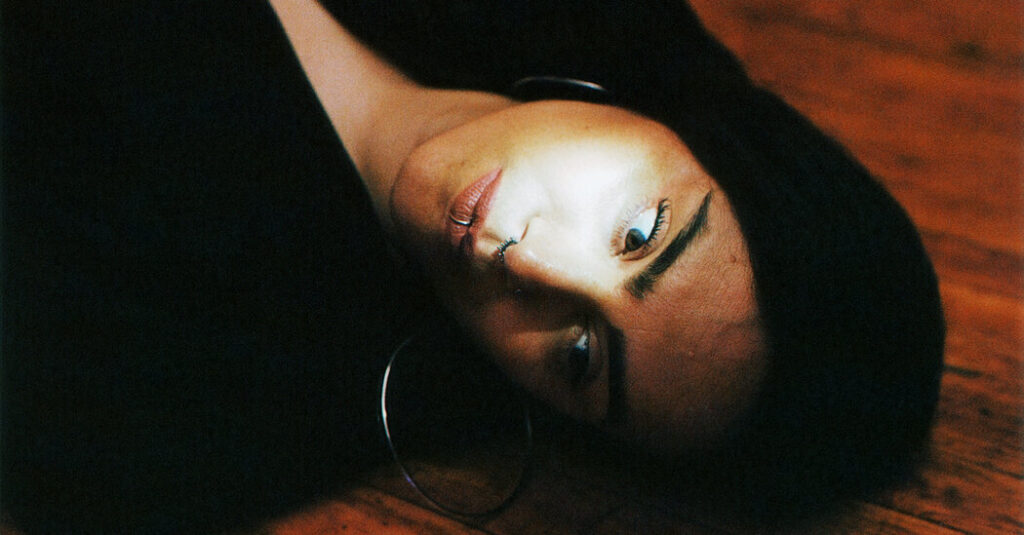
The theater is dark. Sinead O’Connor’s voice fills the room softly.
“Songs are a lonely person’s occupation,” she says. “Songs are ghosts. I’ll be a ghost-delivery woman.”
The ghosts of O’Connor’s life — grief, joy, rage, mental breakdown, spiritual seeking — permeate Sonya Tayeh’s dance work “The Surge,” set to songs and spoken extracts from the autobiography of O’Connor, the Irish singer-songwriter, who died at 56 in 2023.
“The Surge,” which opens at the Joyce Theater on Sept. 16, was a direct outcome of O’Connor’s sudden death, said Tayeh, the Tony Award-winning choreographer of “Moulin Rouge! The Musical.”
“I was overwhelmed by that loss,” Tayeh said in a video call. “I was in my house, grieving, blaring her music, and I visualized a straight line of women in motion, going toward something.” That image became the backbone of “The Surge.”
Tayeh, 49, first heard O’Connor’s music in her teens. Back then, Tayeh, the child of a Lebanese mother and Palestinian father, was an enthusiastic member of the underground music and dance scene in Detroit, where she grew up. “I think you hear your guides, you recognize some sort of calling,” she said. Throughout her life, she added, “Sinead has been a force for me, what I call a power tether.”
With a style that combines sharpness and clarity with wild abandon, Tayeh established herself as a force in the commercial dance world. She has been a guest choreographer on “So You Think You Can Dance”; created movement for pop stars Madonna, Miley Cyrus, Kylie Minogue and Florence Welch; and become an in-demand collaborator on theatrical works (“Spring Awakening,” “The Last Goodbye”).
But she also kept a toe in concert dance waters, choreographing for the Martha Graham company among others. Around the time O’Connor died, Tayeh was talking to the Joyce Theater about making a piece, “but it wasn’t clicking yet,” she said. “Then this lightbulb turned on. They said, ‘Dream it up.’”
Tayeh also talked about the O’Connor idea with John McGrath, the artistic director of Factory International, the arts organization that produces the Manchester International Festival in England. “What struck me was that Sonya had a deeply felt, personal connection to O’Connor,” McGrath said, adding that “growing up as a marginalized girl in Detroit,” she had related deeply to the emotions in the songs. “It wasn’t just a choreographer wanting to make a work to some songs they like.”
The Joyce and Factory International agreed to produce the show together (its premiere took place in Manchester in June, earning positive reviews), but the substantial task of clearing the music rights had to be accomplished first.
Worried that some songs wouldn’t be approved, Tayeh put together “a huge shortlist” and was happily surprised when most of her choices were cleared. (O’Connor’s first husband, the music producer John Reynolds, was “a huge help,” she said.)
As she danced alone in the studio to O’Connor’s songs, Tayeh said she started “to feel a path in terms of places I wanted to live with in the music.” Sometimes, she said, “magic things would happen,” and her iPad would spontaneously start to play an O’Connor song. “I would say, OK Sinead, I’ll try that one!”
Eventually, Tayeh chose 14 songs from O’Connor’s first four albums. “I think that must be because they are a link to when I first discovered her music and the impact it had on me,” she said. “It tethered me back home, to Detroit, to a time of self-discovery.”
The choices are “a really great selection,” said Sonya Huber, an editor of “Nothing Compares to You: What Sinead O’Connor Means to Us” (Simon & Schuster). “You are getting a beautiful range of everything she was able to do,” Huber added. “She always returned to themes of spirituality, similarly to folk and a cappella — and to bringing her own deepest questions to her music.”
O’Connor’s life was turbulent. Born in a suburb of Dublin, she later spoke and wrote openly about the physical and mental abuse she endured from her mother, a trauma that permeated her art. Success came early with her first album, “The Lion and the Cobra” (1987), and so did controversy; she rejected conventional feminine pop-star tropes by shaving her head, refused a Grammy Award and ripped up a photograph of Pope John Paul II on “Saturday Night Live” to protest sexual abuse in the Catholic Church.
Her private life was stormy, too; she married four times, had four children (her son Shane died by suicide in 2022), struggled with mental health, admitted to her own suicide attempts and had several spells in psychiatric hospitals.
Tayeh knew that “The Surge” wouldn’t be biographical. “I am not a literal, linear storyteller,” she said, adding, “It’s not a dance piece about her life, but about what ties me to her.” But there were central themes she used to navigate. “I have such a deep curiosity about spirituality, identity and religion,” Tayeh said, “and all of those curiosities are wrapped up in the music.”
Tayeh also knew that she wanted to use older dancers. So she sent out a video asking women over 40 to audition for the project. “I will be 48, God willing, in a month,” she says in the video, speaking directly to the camera. “This is the most powerful time for me, and I want to be in rooms with people like that.” She adds, “I want that person who has been told they are done to come and play at this audition and see.”
The response was overwhelming. Around 70 women — one in her 80s — turned up to the five-hour-long audition in New York. Tayeh continued with a second round, she said, “because I just wanted to keep being in the space and surround myself with that beautiful energy.”
She chose 11 dancers (10 and an understudy), ranging in age from their early 40s to late 60s, and last October they began to work together.
“It was one of the most meaningful collaborations I have ever been in,” said Karine Plantadit, 56, who danced with Alvin Ailey American Dance Theater and Twyla Tharp. “Most of the people in the room hadn’t been dancing full-time for a while, and Sonya created a space where we could explore, be safe, fall apart and be deeply honest about what we could or couldn’t do.”
Their conversations about their lives and experiences, Plantadit added, became building blocks for the work, as did the dancers’ connections to “the emotions and feelings and directions” of O’Connor’s songs. Gradually the work began to shape itself around its central themes.
“The Surge” begins in darkness, with O’Connor’s voice (from the audiobook of her 2021 autobiography, “Rememberings”), describing her first encounter with the piano (“I don’t mind if you play me badly, I just need to be touched”). When the lights come up onstage and the first notes of “Just Like U Said It Would B” begin, we see the women sitting on church pews, arranged in rows.
Throughout, the women move the pews around, forming borders and barriers, enclosures and openings as they roll, slide, bend and propel themselves over the benches and their backs.
They move through well-known songs (“Troy,” “Red Football,” Mandinka” and “I Do Not Want What I Haven’t Got”) and some of the quieter, more haunting ones (“All Apologies,” “Tiny Grief Song,” “I Am Stretched on Your Grave”) before ending on the slow, meditative “In This Heart.” The women undertake a passage, Tayeh said, from “a grappling with spirituality into questions of identity, into grief and what I call ‘jrage’: joy and rage.”
The piece is emotionally as well as physically demanding, said the dancer Betsy Cooper, 64. “To be able to really connect to these beautiful songs that Sinead wrote — her bravery and honesty, her unleashed passion and rage and tenderness — you need to be fully present,” she said.
Asked what kept O’Connor such a resonant presence in people’s minds, Martha Bayne, who co-editor of “Nothing Compares to You” with Huber, said something similar. “Of course she was a blazing talent, an absolutely incredible voice,” Bayne said, “but I think for me and my peers, it had to do with the uncompromising way she presented herself to the world, ignoring ideas about how women should look and behave.”
O’Connor was also an activist, Bayne added, “an outspoken advocate for women and children, the Black community, the gay community. Twenty-year-old girls weren’t doing that then. Her affect was punk, but her voice wasn’t, and that tension was riveting.”
“The Surge” isn’t exactly a tribute show, Tayeh said, adding: “But how is it not a tribute? I will tribute her forever.”
Tayeh thought about it. “It’s a love letter,” she said. “This is the only way I know how to write them.”
The post Nothing Compares to Her: A Dance Love Letter to Sinead O’Connor appeared first on New York Times.