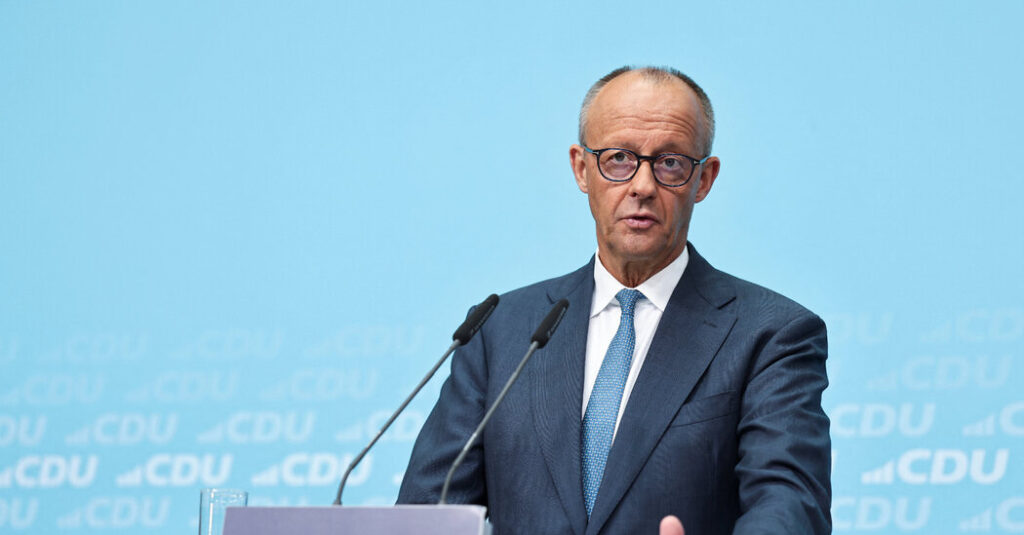
A far-right electoral victory in a small eastern state has plunged Friedrich Merz, the German chancellor, into a fight for his political survival with no surefire paths to prevail.
Mr. Merz was not on the ballot in the state of Saxony-Anhalt, where the Alternative for Germany party, or AfD, won nearly 44 percent of the vote and now sits on the cusp of becoming the first far-right party to govern a German state since the end of World War II. But Mr. Merz, a mainstream conservative, was very much on voters’ minds, post-election analyses show — and not fondly.
Now, with two more key regional elections set for this month — in Berlin and in the coastal state of Mecklenburg-Western Pomerania — Mr. Merz is struggling to reassure restless party stalwarts that he remains the leader that they and Germany need.
Mr. Merz has promised to improve a much-criticized communication style. But he insists he will not change course on crucial policy areas, particularly measures meant to boost the German economy at a time of crisis in its hallowed automotive industry. Volkswagen, the iconic automaker, said this month it would cut 50,000 jobs as part of an aggressive restructuring to combat Chinese competition and other challenges, compounding anxieties over the state of German manufacturing.
“The approval ratings for the work of the federal government in all of Germany are exceptionally low,” Mr. Merz conceded in a solemn news conference on Monday.
Germany’s economy, he added, “is treading on thin ice, and people feel that too.”
Mr. Merz vowed to work harder to reach dissatisfied voters, in an effort to blunt the momentum of the AfD, a populist party that he has called a threat to democracy. He also promised to pitch change-hungry Germans on the virtues of building consensus, a defining feature of Germany’s postwar democratic system.
“There is this yearning for disruption, for fundamental change,” Mr. Merz said. But implementing it, he added, “requires compromises. Perhaps we need to emphasize, explain and advocate for that more strongly.”
In Saxony-Anhalt, voters expressed antipathy toward Mr. Merz and his policies. Voters were asked in exit polling how the chancellor affected their view of his center-right Christian Democrats. Three-quarters said Mr. Merz had harmed his party’s case.
In interviews, some voters in Saxony-Anhalt — a part of the former communist East Germany, where affection for Russia lingers — criticized Mr. Merz for spending taxpayer money to help Ukraine defend itself against Moscow’s invasion.
Others complained about his government’s plan to cut some pensions and other benefits as part of a legislative package aiming to boost Germany’s economic competitiveness that is set for a vote this fall.
Dissatisfaction is “entrenched now with Mr. Merz, because he cuts a lot,” said Ursula Projahn, 74, a retiree, who once voted for the Christian Democrats but backed the AfD on Sunday. “He makes many cuts, especially right now in the social sector and everything,” she said.
Those dynamics helped to raise the importance of the off-year election in Saxony-Anhalt, a state of 2.1 million people that lies in the heart of the AfD’s power base in East Germany.
The results unleashed new waves of complaints from the already dissatisfied ranks of Mr. Merz’s party and his coalition partners in Berlin. They reignited discussions about whether the Christian Democrats should reconsider the “firewall” that mainstream parties have built against cooperation with the AfD and other parties deemed extreme.
And they amplified what has been for months a low hum of speculation in political circles that Mr. Merz could step down or be pushed out.
Some Christian Democrats pine for a younger and fresher face to replace Mr. Merz, who is 70, and a longtime fixture in German politics. One often-cited possibility is Hendrik Wüst, the 51-year-old leader of North Rhine-Westphalia, Germany’s most populated state.
Mr. Wüst has brushed aside such speculation. But in Berlin on Monday, campaigning for the Christian Democrats’ candidate to lead the city in elections this month, Mr. Wüst was forceful when asked about the vote in Saxony-Anhalt.
“To all the people who could no longer vote for the parties that have held responsibility so far, I say, we will fight to win you back,” Mr. Wüst said. “We will fight for your trust. We will offer to talk to you. There is no way around it.”
Mr. Merz could yet fight back, if his party rebounds to perform better than expected in Berlin and Mecklenburg-Western Pomerania. But the stakes are high and his margins are thin.
Roger Stöcker, a political scientist at Otto von Guericke University in Magdeburg, said he did not expect an immediate challenge to Mr. Merz’s leadership. But he called the Saxony-Anhalt elections “a disaster” for Mr. Merz’s party, which is also known by its initials, the C.D.U.
“Friedrich Merz took office with the goal of cutting the AfD’s vote in half,” he said. Instead, “we have a result in Saxony-Anhalt where the C.D.U.’s support has been cut in half.”
Mr. Merz acknowledged as much on Monday.
“I ask myself the question,” he said, “of how it could have come this far.”
Tatiana Firsova contributed reporting.
The post A Far-Right Win Puts New Pressure on Germany’s Leader appeared first on New York Times.