At the Champion House Food Pantry in Newark, organizers noticed that some people would sift through prepackaged aid bags, then toss some of the food on the sidewalks. They took it as a sign that the traditional food bank model wasn’t working in the city’s West Ward.
“We’re wasting more food by giving everybody something, and some of the time they don’t need it all,” said Craig Mainor, executive director of the United Community Corporation, the nonprofit that runs the pantry.
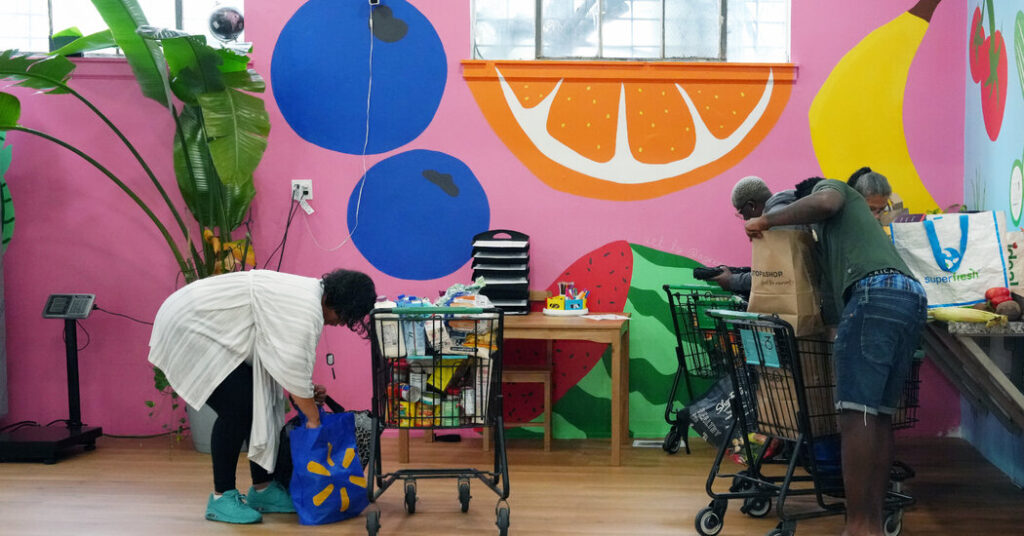
In July, the organization transformed the Champion House into the Market at UCC, a pantry modeled after Trader Joe’s — swapping pre-filled bags for carts that patrons could fill with stock they choose from aisles similar to those in a grocery store.
As people turn to food pantries amid rising grocery prices and cuts to federal food stamp benefits, choice-based models like United Community Corporation’s can be a way to help both newcomers and regulars feel a sense of autonomy.
“What we’re trying to do, and hopefully we are, is creating an opportunity for folks to get what they need, not necessarily what we want them to get,” Mr. Mainor said. “Also, to be able to present to them an opportunity to shop with some dignity, as opposed to just the proverbial handout.”
The Market at UCC, at 409 South 18th Street, operates three days a week and serves about 60 households daily, said Sarah Allen, a program coordinator. The conversion was her idea; she wanted to mirror similar programs she visited, like the Store in Nashville. It’s open from 10 a.m. to 2 p.m., by appointment.
The Market stocks the basics — dairy, grains, meats and produce — while also supplying nonessentials like candy, coconut water and cans of hot sauce. Much of the food is donated by nearby grocers like Trader Joe’s, ShopRite and Stop & Shop. Panera Bread supplies some bagels and baked goods.
On a recent Wednesday, there were diapers and Arizona Iced Tea fruit snacks in one aisle and Bowl and Basket instant mashed potatoes, stocked near toasted oats cereal, in another. The store supplies are based on donations, so the selection regularly changes.
Ms. Allen also drew from her time as a Trader Joe’s crew member in designing the store.
Customers are greeted by smiling staff, hand-painted produce murals and a free flower stand. Once checked in, they’re free to grab a repurposed Dollar Tree cart and stroll the aisles. There are no crew members in Hawaiian shirts like at Trader Joe’s, but volunteers in smocks float around the store ready to assist.
To cement the grocery-store feel, Ms. Allen sourced the gondola shelving and refrigerated display cases from Facebook Marketplace.
“I think people should still be able to have that choice, that dignified environment where they feel comfortable and they can shop for what exactly their family needs,” she said.
The market also aims to be a resource hub, with a free library and resources to navigate federal aid. There are also plans to host nutrition classes and show customers how to prepare produce they may not be familiar with.
Earl Person, 67, of Newark, stacked his shopping cart with produce, meat and candy on a recent Wednesday morning. Mr. Person, a retired U.S. Navy veteran, said he enjoys the atmosphere and autonomy of the UCC market.
“There’s a lot of humanity here,” Mr. Person said.
The free store costs about $500,000 to operate annually, about $200,000 more than the organization’s traditional pantry model, according to Tom Wiedmann, United Community Corporation’s head of communications.
While more expensive, Mr. Mainor said the extra cost comes with extra value.
“While this costs a little bit more to operate because you have to organize it as opposed to just grabbing it from a box and putting it in a bag, this is the dignity that I think we don’t talk about with the community that needs this kind of service,” he said.
About 15.3 percent of residents in Essex County (which includes Newark) faced food insecurity in 2024, according to the state’s Department of Health. Thousands of New Jersey residents have lost food stamp benefits under the Trump administration’s new work rules for the Supplemental Nutrition Assistance Program.
Katie S. Martin, author of “Reinventing Food Banks and Pantries,” said the pivot to choice-model food pantries is a growing trend nationally and helps reduce food waste. The West Side Campaign Against Hunger has one in Manhattan, and there are community-led free stores across New York and New Jersey.
“When we think about how hard it is to ask for help in the first place, we want to make it a more welcoming environment and more dignified,” Ms. Martin said. “And a key criteria for that is letting people choose their own food.”
The post To Avoid Waste, This Food Pantry Recast Itself to Look Like Trader Joe’s appeared first on New York Times.