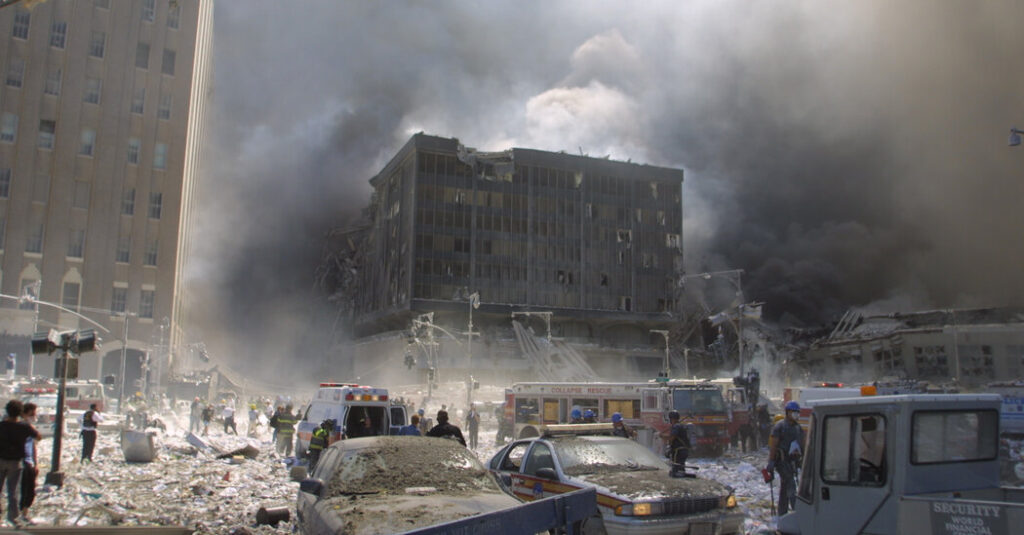
In the harrowing months that followed the attacks on the World Trade Center, New Yorkers were repeatedly assured that the air around the fallen towers was safe to breathe.
But 10 months later, health officials were still finding evidence of asbestos as much as half a mile away, according to a sample of air quality records being released on Tuesday.
The documents, reviewed by The New York Times in advance of their release, include among more than 170,000 pages of air quality reports, contamination records and correspondence among city officials that were stored in 68 boxes in a city office, shielded from public view for more than two decades and, according to city officials, only discovered last year.
Mayor Zohran Mamdani has directed his administration to release the records to the public through an online portal, timing it to the commemoration of the 25th anniversary of the attacks in Lower Manhattan.
Over the course of the next year, his administration intends to review, redact and publicize many more papers, found in municipal and insurance offices, that relate to the environmental toxins brought about by Sept. 11.
The records being released on Tuesday provide a snapshot of the frenzied months following the attacks, when New York City and its leaders were struggling to balance the city’s recovery with fears of terrorism and lingering toxins.
The documents are limited in scope, offering only a fraction of the air quality reports taken around ground zero. And while they also include a smattering of internal memos — including the so-called Harding memo, in which the city discussed its potential liability stemming from the Sept. 11 air quality — many more are presumably absent.
But even in a scattershot way, the records seem to strengthen the notion that New Yorkers were instructed to return to the ground zero area before it was safe to do so, potentially exposing workers and residents to dangerous toxins.
“The very least our city owes the families, survivors and first responders whose lives were forever changed by the horrific terror attack of Sept. 11 is transparency and accountability,” Mr. Mamdani said in a statement.
Releasing the documents was both a massive logistical hurdle, for which the mayor budgeted $34 million, and an acknowledgment that, even after so many years, as fewer Americans remember the attacks, the health effects persist. More people are believed to have died from illnesses related to the attacks than the nearly 3,000 people who were killed on Sept. 11. They are succumbing to lung and blood cancers and heart and respiratory diseases.
Records related to 15 John Street, a building less than a mile from the World Trade Center, offer a glimpse into the prolonged, frenzied and often confusing cleanup work that took place around ground zero.
On July 13, 2002, with New Yorkers still reeling from the attacks on the World Trade Center that blanketed Lower Manhattan in debris, inspectors were busy collecting dust samples from the building.
Each report echoed the last: Asbestos present on the facade ledge. Asbestos present on the west side roof. Asbestos present on the top electrical cable.
Some reports show that asbestos levels appeared to stay under limits set by environmental and worker protection agencies; others indicate they may have been too high, though many of the papers are not accompanied by written analysis.
The documents show that the asbestos found at 15 John St. was not an outlier: Lists of environmental quality measurements taken by city agencies, the Environmental Protection Agency and privately contracted laboratories demonstrate the presence of asbestos and other contaminants, sometimes at levels exceeding acceptable limits, in dust and air in other parts of Lower Manhattan after Sept. 11.
They include records preserved by the Giuliani administration, as well as documents related to 7 World Trade Center, which collapsed on the afternoon of Sept. 11.
A letter to the city’s Department of Environmental Protection from a New Yorker in February 2002 underscores how isolated and frightened people felt at that time.
A resident of 333 Rector Place detailed what she viewed as extensive missteps by city officials and her building’s property manager in attempting to remove asbestos and other contaminants from the premises.
“Sept. 11, 2001. Felt I had to do something,” the resident, Marisa Ramírez de Arellano wrote, describing how she had “scooped up dust from coffee table into a paper bag. Also started to clean the floor with wet paper towels,” an effort she acknowledged was “mostly futile.”
Reached on Monday, Ms. Ramírez de Arellano, 80, said she had spent several years after the attacks under the care of an allergist and a pulmonologist. She was prescribed steroids and other medications because respiratory tests led doctors to fear she had suffered lung damage, she said.
She said she spent several hours in her apartment on Sept. 11 because she “didn’t realize that very lightweight dust that was coming in was as bad for human beings as it turned out to be.” She left the apartment when firefighters came to evacuate her.
By the time she returned several weeks later, officials said the air was safe to breathe, but she had doubts, especially one night when a hazmat team came to dig up the grass from a small roundabout in the neighborhood.
“They dug several inches down and took it all away and replaced it with new dirt, new sod, new grass,” Ms. Ramírez de Arellano said. “And I thought, if they were thinking the grass is contaminated, then what are we all breathing?”
A draft document of data collected by the city’s D.E.P. listed locations throughout Lower Manhattan where asbestos levels in some dust samples exceeded hazardous limits in the days immediately after the attacks. Another undated document lists ambient samples that were also above acceptable asbestos limits.
An audit from November 2001, prepared by a private firm and submitted to the federal E.P.A. based on data collected by New York City and state agencies, showed other troubling findings. That audit demonstrated that air concentration of the carcinogen benzene was still spiking near the towers’ footprint, and that the concentration of asbestos in the air at the Fresh Kills landfill on Staten Island had increased after the attacks.
But the uncertainty about the air quality in residential and commercial buildings in Lower Manhattan was already raising concern among public officials like Representative Jerrold Nadler, a Manhattan Democrat whose district included ground zero at the time.
“Congressman Nadler believes that the E.P.A. has neglected its responsibility for monitoring indoor air quality around ground zero,” according to a memo from a city official, Ester Fuchs, sent to six others including the city’s top lawyer, Michael Cardozo, on Feb. 28, 2002, two months after Michael R. Bloomberg took office as mayor, replacing Rudolph W. Giuliani.
She noted that Mr. Nadler said that the federal Environmental Protection Agency “handed over responsibility for measuring indoor air quality to the city without putting in place proper oversight measures,” a responsibility the city passed on to property owners.
The city’s health department instructed citizens to “clean their buildings with wet mops and rags,” Ms. Fuchs said, and summarized the agency’s position that air quality testing, while painting an incomplete picture, had not shown results “that would indicate long-term health impacts.”
In an interview this week, Mr. Nadler recalled trying to persuade the administrations of Mr. Giuliani and Mr. Bloomberg to release whatever information they had collected on air quality around the site of the attacks.
“They knew about the air quality and they essentially did nothing about it,” Mr. Nadler said. “I suspect that all they cared about was getting Wall Street reopened, and they didn’t give a damn about the health of the people down there.”
Indeed, city and federal officials, most memorably Christine Todd Whitman, the administrator of the E.P.A. at the time, reassured Americans that the air around ground zero was safe to breathe. Ms. Whitman has since apologized.
A review of news articles and interview transcripts in the days and weeks following Sept. 11 show that Mr. Giuliani continued to vouch for the safety of the air quality.
“I come down here in the morning and sometimes the odor is terrible,” he said in late October 2001, according to an article in The New York Daily News, which had reported on toxic chemicals and metals that had been released into the environment around ground zero. “You smell it and you feel there must be something wrong with it. But what I’m told is that it is not dangerous to your health.”
In February 2002, Mr. Bloomberg said, “Every test that has been done says the air quality was in acceptable limits. I think some people are just never going to want to believe that.”
A spokesman for Mr. Bloomberg declined to comment. A spokesman for Mr. Giuliani did not respond to a request for comment.
Correspondence between Deutsche Bank, located at 130 Liberty St., and the city D.E.P. discusses testing from September 2001 through April 2002 that found asbestos in dust samples exceeding the 1 percent threshold for harm throughout the building, as well as the presence of carcinogenic organic contaminants, heavy metals, fungi and bacteria.
The bank’s experts “have recommended a systematic testing program” to quantify the hazard and identify appropriate methods for handling and disposing of the materials, the company’s managing director for corporate real estate wrote in a June 2002 letter to the D.E.P. commissioner. The building would eventually be demolished.
Asbestos exposure can cause lung tissue scarring, mesothelioma and lung cancer. Dust, smoke and other pollutants from the site have also been associated with lymphoma, leukemia and other cancers.
The release of the documents resolves litigation brought by 9/11 Health Watch, an advocacy organization that sued to force the publication of the documents.
“For 25 years, four different mayoral administrations kept from the public, the U.S. Congress, and the City Council documents showing what the city actually knew about the danger of the toxic chemicals in Lower Manhattan and Western Brooklyn after the World Trade Center collapse, even as city officials continued messaging to the public that the air was ‘safe and acceptable,’” Ben Chevat, the executive director of the 9/11 Health Watch, said in a statement.
But the documents’ release may expose the city to new or amended lawsuits. The information could also help those sickened in the years after Sept. 11 with their applications for federal victim compensation funds. The mayor and the city’s chief lawyer, Steven Banks, agreed that it was important to make the documents public, Mr. Banks recalled in a recent interview.
“For years, families, city workers, and survivors have been crying out for more transparency from their government,” Mr. Banks wrote in an introductory letter contained in the document release.
In a recent interview, Denise Verzi discussed losing her husband, Michael Verzi, a New York City firefighter, to lymphoma that was linked to his time working at ground zero.
“He truly loved being a firefighter. That was his calling,” Ms. Verzi said of her husband, who died in 2022. “All that being said, now years later we’re finding out that there’s all these files.”
She said her husband and his colleagues had been assured that “the air quality is fine, you can be down there.” And while they would have gone to the site regardless, she said, “maybe different precautions would have been taken.”
“I don’t understand hiding it to begin with,” Ms. Verzi said. “That was horrific. But 25 years in, there’s people that are still getting sick.”
Reporting was contributed by Andrew Chavez, Alain Delaquérière, Will Houp and Liam Stack.
The post After 9/11, Documents Suggest New Yorkers Were Misled About Air Quality appeared first on New York Times.