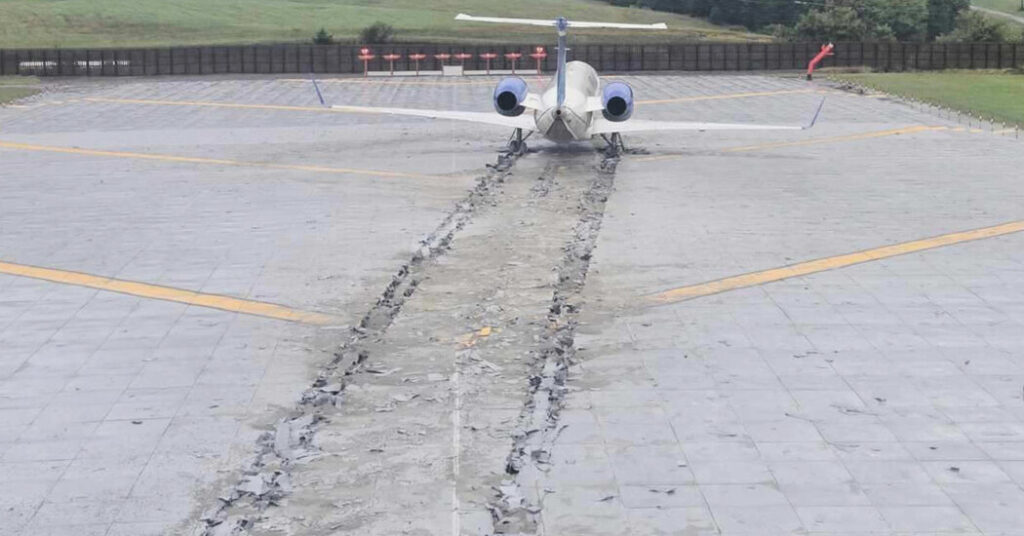
Over the past 30 years, an increasing number of airports in the United States have installed buffer areas of crushable concrete at the end of their runways to help stop planes that overshoot their landings before they can crash into anything.
Miami International Airport, where an Amazon cargo jet overran the runway’s terminus on Sunday, killing five people and injuring five more, does not have such a buffer.
Engineered materials arresting systems, referred to in the industry as EMAS, have been installed in at least 70 U.S. airports since the 1990s and are credited with successfully halting 26 airplanes that overshot runways, carrying a total of 497 passengers, according to the Federal Aviation Administration.
The F.A.A. has recommended that airports install the buffers for at least two decades, stating in a 2005 advisory circular that the system had “demonstrated its effectiveness in arresting aircraft overruns.” The agency said last year that “EMAS has performed successfully every time, resulting in no loss of life and minimal damage.”
Nonetheless, the F.A.A. has stopped short of requiring all airports to install the technology, determining that paved areas at least 1,000 feet long and 500 feet wide at each end of runways provide enough room to mitigate the risks.
In a statement, the F.A.A. said Miami International met the required length and width specifications for runway safety areas.
Sunday’s accident is raising new questions about whether that standard ought to be reviewed.
“Should EMAS be everywhere at every airport? That will be a key part of our investigation,” Jennifer Homendy, chair of the National Transportation Safety Board, told reporters on Monday.
“I don’t know that I’ve seen any airport that has a 1,000-foot runway safety area and an EMAS bed,” Michael O’Donnell, an aviation consultant who previously oversaw air traffic safety and airport safety for the F.A.A., and signed the agency’s most recent update to its buffer technology recommendations in 2012, said in an interview. “Now this drives the immediate question: Was 1,000 feet enough in an accident like this?”
The crushable material that constitutes these buffers helps decelerate aircraft by collapsing under the weight of the plane, slowing its momentum until it comes to a stop. They take up less space than traditional runway safety areas, with minimum requirements that they be as wide as the runway and, in most cases, that the part containing crushable material extend out 600 feet from the runway’s endpoint.
The F.A.A. has likened the system to offramps that appear along steep highways to help stop runaway trucks.
Federal funding initiatives have helped eligible airports defray the considerable expense of installing the technology, which costs several million dollars per runway. Since the F.A.A. began exploring the technology, airports with geographical limitations preventing them from building long buffer zones have been prioritized for installation.
In New York, for example, where airports are tucked into urban areas, the buffers are a common feature. Kennedy International Airport became the first U.S. airport to install the system in 1996, and LaGuardia Airport followed suit, finishing its installation in 2015 with the help of a federal grant program.
The system most recently helped to prevent a potentially catastrophic event this year, at Teterboro Airport in New Jersey, where it stopped a Learjet 60 that overran the runway.
But at some more sprawling airports like Miami International, where physical obstacles are comparatively distant from the runways, managers have not viewed the technology as a necessary element to improve safety.
“No U.S. airport has EMAS at a runway end that also maintains the full, unobstructed 1,000-foot safety area,” Gregory Chin, a spokesman for the Miami-Dade Aviation Department, said in an emailed statement. “EMAS is intended as an alternative, not as an additional layer on top of one.”
He added that Miami International undergoes a comprehensive F.A.A. safety inspection every year and has consistently met federal airfield safety requirements.
“The priority for the deployment of EMAS is going to be to those airports where the risks are greatest, and Miami would not be one of them,” said Michael McCormick, a professor at Embry-Riddle Aeronautical University who previously led the F.A.A.’s air traffic operation.
He noted, however, that airports like Miami International could still apply for federal Airport Improvement Program grants, which are funded through taxes on airline tickets and fuel, to assist with a buffer installation or simply absorb the cost.
Experts were not in full agreement about how the system would have performed in Sunday’s accident at Miami International.
“Looking at the speed the aircraft went off the end at, EMAS might not even have worked,” said Scott Dunham, a former air safety investigator for the N.T.S.B. He said Sunday’s catastrophic cargo jet landing was “way beyond anything you’d expect to be from a minor problem.”
The systems are designed to absorb momentum from most aircraft, assuming they enter the buffer zone at a speed of up to 80.55 miles per hour. But according to the flight tracking website Flightradar24, the Boeing 767-300 cargo plane involved in Sunday’s accident was going nearly 128.9 miles per hour when it exited the runway area — considerably faster than what the buffer technology was designed to counteract.
The cargo plane ended up about 1,300 feet outside the paved area, Ms. Homendy said, after colliding with a van that belonged to an airport cleaning company, going through the airport perimeter fence, and striking a Toyota Corolla traveling on a street near the airport. All of those killed in the accident had been in those vehicles, she added.
But some experts said they believed that had the buffer technology been in place, it might have slowed the plane enough to avoid some of that carnage.
“At a minimum, even if you have a large Boeing 767 barrel down a runway at 100 knots plus, it’s going to at least slow it down,” Mr. McCormick said. “So it’s going to minimize the risk of collision.”
The post Amazon Plane Crash Starts Debate About Requiring a Buffer for Runways appeared first on New York Times.