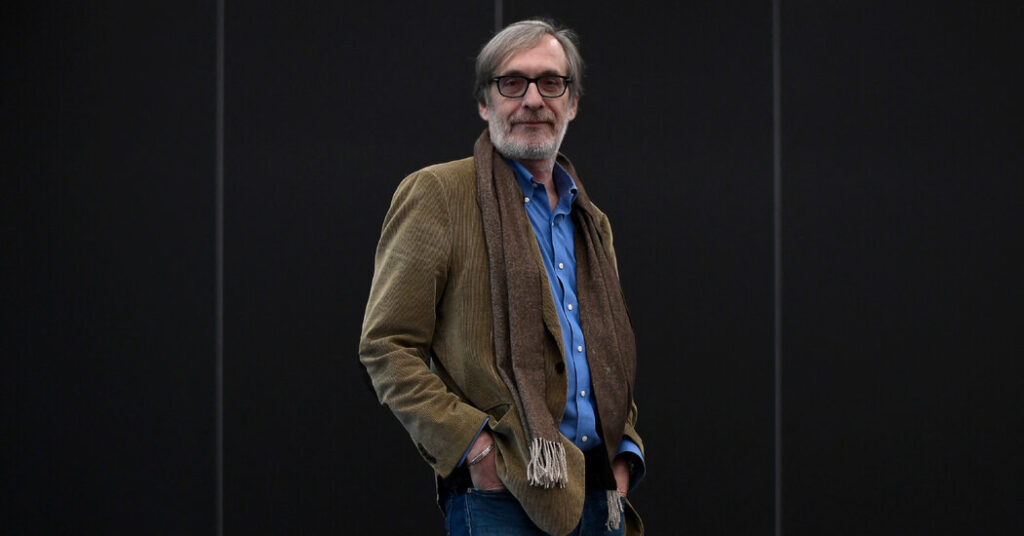
Jean-François Leroy, who co-founded and directed the world’s leading festival of photojournalism, bringing images of conflict to wide attention and shaping the careers of many photographers, died on Aug. 31 at his home in Paris. He was 69.
The cause was cancer, his nephew Vincent Jolly, a journalist, said.
In a statement after the death, President Emmanuel Macron of France called Mr. Leroy’s festival, Visa Pour l’Image, held annually in the southern French city of Perpignan, “a home, a public square, sometimes a refuge for a profession he saw was threatened.”
Mr. Leroy was, Mr. Macron wrote, “a great defender of reality.”
For over 30 years, he was an impassioned cheerleader for a form of journalism that is as risky as it is vital: the photography of war, suffering and environmental disaster.
For a few weeks at the end of each summer, hundreds of photographers — major names like Stanley Greene, Don McCullin, Raymond Depardon and Véronique de Viguerie, as well as young unknowns like Rémi Ochlik, who was killed in Syria in 2012 — descend on Perpignan, a medieval city with crumbling ocher walls, to show their work, argue about it, meet with agents and receive prizes.
Visa, with almost 30 exhibitions each year, draws over 200,000 visitors from around the world. The 2026 installment, which began on Aug. 29, includes David Guttenfelder’s searing images in “The People of Minneapolis vs. ICE,” Elise Blanchard’s disturbing photographs from Afghanistan of child brides sold by their families, and Khames Alrefi’s powerful shot of a boy watching his neighborhood exploding in Gaza.
Mr. Leroy, a self-described “mediocre” photographer, decided his best use was serving the talents of others. In 1989, he helped create Visa Pour l’Image, and for more than three decades, he shaped it around a conviction that exposing his fellow citizens to the worst of what mankind was doing was, in fact, a good thing. A few principles steered him: no altered images, nothing prettified, no aestheticization of suffering and no turning your back on red-hot news.
“Despite all the images that haunt me, I’m above all trying to keep my ability to be shocked, bowled over,” Mr. Leroy wrote in a memoir, “Le Devoir de Regarder,” that is scheduled to be published this month; its English translation is “Never Look Away.”
“I remain persuaded,” he added, “of the power of a photograph, even today, to shake the indifference of our contemporaries.”
His interests extended to the revival of important photographers of the recent past, like Paul Fusco, who recorded the journey of Robert F. Kennedy’s funeral train in 1968; Mr. Leroy exhibited those images in 2000. “You were in the rhythm of the train that went across America,” Mr. Leroy recalled to the radio station France Culture in 2008. In that same interview, he rattled off a list of great female photojournalists, gently chiding his interlocutor for suggesting that men had dominated the profession.
“Jean-François really believed in unfiltered photography, and in photojournalism,” Alison Morley, the chair emerita of the Documentary Practice and Visual Journalism Program at the International Center of Photography in New York, said in an interview.
Ms. Morley praised Mr. Leroy for the “countless conflicts that he brought to light,” noting that he “printed all these pictures people sent to him, so there was no chance they could be altered.”
For Mr. Leroy, the images had to tell a story. In his memoir, he addresses an open letter to young photojournalists, writing: “Before you even begin, ask yourself: ‘What tale do I want to recount? Where do I want to take the spectator?’ What the true photographer does, is the opposite of improvising.”
Mr. Leroy was born on Oct. 3, 1956, in Paris, one of five children of Jean Leroy, a trader at the Paris stock exchange, and Suzanne (Laplagne) Leroy.
To please his father, Jean-François studied medicine for a year, but he had already developed a passion for photography, having hung out as a teenager in the photo lab of the magazine La Vie Catholique (now La Vie), of which his aunt was the editor in chief.
Hired as a photographer by the agency Sipa Press, he shot for magazines, and was editor of Photo Magazine from 1985 to 1987.
In 1989, with his friends Roger Thérond, the editor of the magazine Paris Match, and Michel Decron, of Photo, he founded the Visa festival, having successfully won a bid put out by Perpignan for ideas to extend the city’s summer tourist season.
It started with 150 participants and two photo agencies. By 1995, the festival had grown to include more than 2,000 participants and 174 agencies.
Mr. Leroy was then, as ever, worried about the future of photojournalism — “I don’t know how you’re going to make a living doing this,” he wrote to young photographers in his memoir — and yet “ever sanguine,” Alan Riding wrote in 1999 in The New York Times.
He is survived by three sisters, Dominique, Pascale and Béatrice Leroy.
In an interview in Le Figaro after this year’s festival had opened — for the first time without Mr. Leroy — Mr. Depardon, the eminent photographer, said that “thanks to the relentlessness of Jean-François Leroy, its founder, we have all become respectable.”
Mr. Leroy, for his part, aimed for something more than respectability. “A photographer who doesn’t know why they are shooting something or someone might make pretty images, technically,” he wrote in his memoir. “But they will be hollow.”
Daphné Anglès contributed reporting.
The post Jean-François Leroy, Champion of Photography at Its Rawest, Dies at 69 appeared first on New York Times.