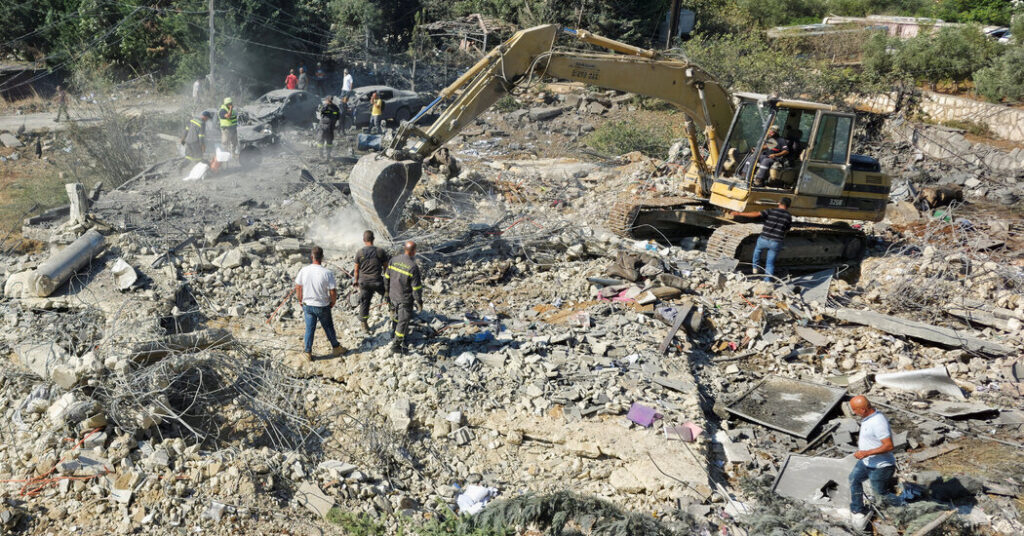
The Israeli military launched a new wave of deadly strikes in southern Lebanon on Monday, part of an intensifying bombardment in recent days that has fueled fears that Israel could push deeper into Lebanese territory as it entrenches control of land it has seized.
Over the past three days, the strikes have killed 27 people and wounded 69 others, according to the Lebanese health ministry, one of the deadliest waves of attacks since a U.S.-brokered cease-fire with Lebanon was announced in June. The bombardments occurred days after Israeli officials announced that the military had captured a strategic ridge that Israel had sought to control for months.
On Monday, Israeli strikes in the village of Kfar Roummane in southern Lebanon killed at least 11 people, including two children and four women, the Lebanese health ministry said. Eight others, including three children, were injured.
The Israeli military said it had launched the strikes in response to drone attacks by Hezbollah, the Iran-backed Lebanese militant group, and targeted what it described as Hezbollah infrastructure, including a weapons storage facility.
The latest escalation in the conflict began after Israel said on Friday that it had seized the ridge near the Lebanese city of Nabatieh, about six miles from the border.
The ridge, known as Ali al-Taher, had become a focal point in the conflict, which reignited in March when Hezbollah fired on Israel after the U.S.-Israeli assault on Iran. Ali al-Taher sits above a sprawling underground Hezbollah base, and offers a commanding view across the valleys and roads of southeastern Lebanon.
The Israeli defense minister, Israel Katz, said in a video statement on Friday that the capture of the ridge marked “the completion of the process of consolidating our hold on the security zone in southern Lebanon,” referring to an Israeli-occupied strip of Lebanese territory along the border.
Israeli officials have issued evacuation warnings for two villages over the past two days, both of which are outside that swath of southern Lebanon, which Israel has occupied since the latest war broke out. Israel has issued only one other evacuation warning since the U.S.-brokered cease-fire in June.
On Sunday, Israeli strikes killed seven people, including two women, in southern Lebanon, according to the Lebanese health ministry.
Since June, the truce has frayed, with fighting continuing between Hezbollah and Israel across southern Lebanon. Hezbollah was not involved in the cease-fire and does not answer to the Lebanese government, raising questions about how it would be enforced.
On Saturday, Hezbollah condemned the escalating Israeli bombardment and said it was aimed at pressuring the Lebanese government — which has been engaged in U.S.-brokered talks with Israel — to capitulate to Israel’s demands.
The office of President Joseph Aoun of Lebanon said on Sunday that the new Israeli bombardment represented “a dangerous escalation.”
“President Aoun held the Israeli side fully responsible for this ongoing escalation, calling on the United States and the international community to take immediate action to stop these violations and hold the perpetrators accountable,” it said.
The Israeli military has entrenched its control of the swath of Lebanese territory it holds, which stretches as deep as about six miles into the country, prompting increasing uncertainty in the south. Israel has insisted that its forces will remain until Hezbollah is disarmed.
Since the cease-fire was declared, Lebanon and Israel have been engaged in direct, U.S.-brokered talks to end the conflict. The discussions led the two sides to agree in principle to a phased arrangement, under which the Lebanese military would disarm Hezbollah and move in to secure areas in southern Lebanon as Israeli forces withdrew.
But that process has largely stalled, with Israel and Hezbollah at odds over which side must act first. Hezbollah has consistently rejected demands to put down its weapons.
The lack of progress has led to frustration among residents of southern Lebanon, who have been displaced from their homes during the war. On Monday, mayors and municipal officials from dozens of occupied towns and villages in the area gathered in the city of Tyre to condemn the Israeli destruction and express frustration at the government’s stalled efforts to resolve the conflict.
“The Lebanese government is running after an illusory peace even as the enemy commits crimes,” said Ibrahim Hamza, the mayor of the coastal town of Naqoura.
Sarah Chaayto, Abdi Latif Dahir and Aaron Boxerman contributed reporting.
The post Israel Launches Deadly Strikes in Lebanon as Military Campaign Intensifies appeared first on New York Times.