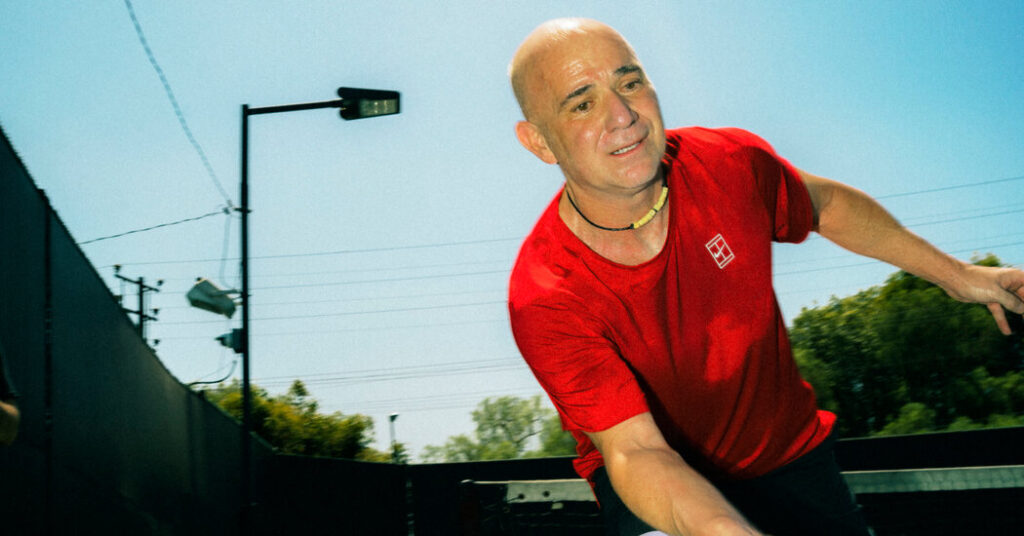
Andre Agassi, 55 years old, was dressed like a college student during finals week: black-and-white plaid pajama pants, Nike Air Force 1s, long-sleeved T-shirt, backpack high on his shoulders. It was a bright morning in April, and he reached his gate at Newark Airport just in time to board the flight. The tennis star was headed south for an ESPN prime-time athletic event with a much-hyped million dollars in prize money: the fourth annual Pickleball Slam, a splashy production held in a casino theater in Hollywood, Fla.
Agassi has taken part every year since its inception. This year, his matches were being billed as a battle of the sexes. He and James Blake, another retired tennis celebrity, would be playing doubles against two female pros: Genie Bouchard (once the top female tennis player in Canada) and the 19-year-old phenom Anna Leigh Waters (the No. 1 female pickleball player in the world, and perhaps the sport’s best-known pro). Before that, singles — Agassi vs. Bouchard, Blake vs. Waters. Matches like these are part of the broad appeal of “pickle,” the fastest-growing sport in the country: People of different generations and genders can play competitively against one another. Compared with tennis, the court is smaller, the net lower, the matches shorter, the pace of the ball slower — all things that level the playing field, making raw strength less of an advantage.
Agassi had spent months preparing for the Slam, but the flight down was testing his resolve. After settling into his business-class seat, he sent me a text, which promptly arrived at my spot back in coach. “Hi Lizzy. Andre here,” he wrote. “A lady just asked me if I was Jeff Bezos. Then followed that up with ‘Do you get that a lot.’ That totally killed my confidence for tomorrow.”
This text was coming from Fun Andre, one of a few personas I came to know over the months I spent shadowing Agassi. Fun Andre is an affable guy whose 40 years in public life have made him both deeply aware of his own image and deeply kind. Fun Andre greets fans with endless patience. Fun Andre will spend 30 minutes helping to locate the car a friend’s aunt has lost in a Palm Springs parking lot. Fun Andre is playful, self-deprecating, hilarious; he’s the one who, in the 2009 memoir “Open,” fantasizes about making a “beautiful toupee” out of his former coach’s bushy eyebrows.
Also regularly present in our time together was Philosopher Andre — a sage, fluent in self-help speak, who talks younger players through crises, analyzes the game with astonishing emotional clarity and cries easily. Philosopher Andre deals in seemingly self-generated aphorisms like “The human condition is undefeated” and “Epiphanies don’t change your life, but what you do with them can.”
Then there was Dark Andre, rarely seen but capable of appearing at any moment. Dark Andre is brooding, prickly, self-loathing and obsessive, with an insatiable need to pursue perfection. Dark Andre will fixate, once we’ve reached Florida, on the poorly designed cup holders in the back seat of a rental Mercedes. Dark Andre is the guy who, after a painful defeat, used to sit in his hotel room lighting things on fire. When a fan tries to engage in some stilted conversation, Fun Andre obliges — but Dark Andre turns to me immediately afterward and says, in an icy monotone, “That’s five minutes of my life I’ll never get back.”
Two decades after Agassi’s retirement from professional tennis — after comparatively quiet years spent at home in Las Vegas with his wife, Steffi Graf, and their two children — all three of these personas are reintroducing themselves to the public. It’s “Andre 2.0,” according to his friend, business partner and de facto manager, the former pro Justin Gimelstob. Agassi’s increasing presence in the pickleball world is one part of this comeback. He has formed a partnership with a pickleball gear manufacturer. He is heavily involved in a pickleball rating organization. He has even announced plans to create a World Series of Pickleball in Las Vegas. “There are still people who think pickleball is an easier version of tennis,” Waters told me by email, “and Andre sharing how strategic and demanding it is helps change that perception.”
The public life he is re-entering, though, is full of highly media-trained athletes — whereas Agassi still seems shockingly self-revealing, conflicted, human. During his tennis days, he was always seen as flamboyant, especially in comparison to his cyborg-cool rival Pete Sampras. But the contrast between him and the rest of the sport has only intensified since then. The men who dominated tennis in his wake — Djokovic, Federer, Nadal — are among the greatest players in history, but it’s hard to imagine any of them, say, dishing about the cheapskate tipping habits of a rival, as Agassi once did with Sampras, or writing about the “tidal wave of euphoria” behind a meth-fueled cleaning spree. (Or driving past the chain restaurant where he and his daughter shared a meal and exclaiming, with genuine enthusiasm: “That’s the Applebee’s me and Jaz went to!”) “For a lot of athletes, and tennis players especially — you’d be surprised at just how kind of dark and crazy their mind goes at times, and most of us don’t want to admit that,” Blake told me. “Andre was willing to admit that, like, These are the thoughts I have.”
Agassi is so candid that he occasionally unnerves people. I saw this the first time I met with him, in February, at a Manhattan event celebrating his collaboration with the Swiss bespoke-watch workshop Artisans de Genève. After hitting some balls for an audience and being interviewed by, for some reason, Spike Lee, Agassi took questions from attendees — including one about his childhood, which consisted mostly of grueling tennis practice under the maniacal direction of his father.
“Think about it,” he said. He turned pro at age 16. His wife played the French Open at 13. Could the audience imagine the relentless daily work that required? “Tennis is a lonely deal,” he said. “In order to excel, you need to have an incredible commitment to it.” He shook his head thoughtfully. “Does that really come from the child itself? I would say that would be a heavy anomaly. It usually comes from a parent who has delusions of grandeur. And doesn’t recognize the children’s life is not theirs.”
This produced a thrilling awkwardness in the room; you could hear people shifting uncomfortably in their chairs. Then one of the Swiss executives exclaimed, “OK!” and reiterated how proud the company was to be working with Agassi on a custom superlight Rolex in his signature “hot lava” colorway.
The made-for-TV version of the Andre 2.0 story might go something like this: A retired, middle-aged tennis great takes up a goofily named, hugely popular new sport and is finally able to exorcise the demons that haunted him throughout his tennis career. This seemed to be the story Agassi was beginning to tell after the watch event, as he sat on an ottoman at the bar of his hotel, holding a dry Belvedere martini with extra olives. He talked about his love of pickle, how it challenged him mentally, how suited his body felt to its movements. He shifted around in his seat, trying to keep his perpetually embattled back from seizing up. “I was on a tennis court today,” he said. “What the [expletive] was I doing on a tennis court?”
But it became apparent, over the months that followed, that it would take more than a new sport to resolve the central question that all three of Agassi’s personas have been wrestling with for a long, long time. He summarized it, wryly, as he ordered another cocktail: “Why do I end up doing so many things that I actually don’t want to do?”
There is at least one way in which Andre Agassi fits the classic stereotype of a pickleballer: He is a retiree who started playing for fun during the pandemic. “That’s the first time I ever picked up a paddle,” he told me in July, when we met in Las Vegas. “The kids played, and they got into it. And I enjoyed the fact that they put their phones down for two hours.”
Agassi’s children were not around for long, though. His son, Jaden, a talented baseball pitcher, started at the University of Southern California in 2020. His daughter, Jaz, later began studying at the University of Las Vegas. Agassi and Graf, tennis’s favorite power couple, were becoming empty-nesters. The kids’ departure wasn’t the only change. Agassi’s longtime business manager, Steve Miller, was fighting cancer. (He died last summer.) And Andre’s father, Mike, died in September 2021.
“I always promised Stef I would never be too busy or too bored,” Agassi said, “because I’m kind of dangerous in both environments.” He was filling his time with enough pickle that when a call arrived, in 2022, asking him to participate in the first Pickleball Slam, he didn’t immediately say no. He was in Idaho snowboarding, he told me, “and I’m talking to the person who’s trying to sell me, and I don’t really know enough about it, and I’m like: When is it? April, oh, god. OK. Who’s it with? ‘You, Roddick, Chang, McEnroe.’ I’m like, Well, they probably know as little about it as I do.”
He considered the plus side. He had gained enough weight that he was separating the clothes in his closet by size. “I was like: It might give me a reason to get into shape. Or at least want to be in shape,” he said. “So I did what I normally do: I feel tortured, I feel on the fence and then I say, Screw it, figure it out, jump in.”
Pickleball and tennis haven’t always had an easy relationship. “There was this big controversy between tennis players and pickleball players,” says Roscoe Bellamy, a pickleball pro and podcaster — “because, you know, pickleball notoriously takes over tennis courts, and there’s kind of this battle between the two sports.” Some pickleballers consider tennis people uptight; some tennis people consider pickleball gauche. There’s even a recent comedy called “The Dink,” produced by Ben Stiller, in which a former tennis prodigy takes up pickleball after an injury while his domineering father leads the charge against the sport at their club. And yet pickle is becoming a common path for retired tennis pros, with Agassi serving as one of the sport’s foremost boosters. At first, Bellamy told me, it seemed as if tennis pros were just there for the money, but he has come to appreciate them: “It was almost like the tennis players were OK with being called out by their community for going and playing pickleball.”
Agassi didn’t think he played very well at that first Slam, but he did lose 12 pounds preparing for it. More important, he found that pickleball didn’t come with the same baggage that tennis did: He didn’t feel obliged to be excellent at it. “I refuse to sabotage my enjoyment by actually competing on any form of a regular basis,” he explained. “I will not access that part of my head anymore. It’s not a happy place to be.”
That part of Agassi’s head is a notoriously intense place; it is the part of him that will fixate, obsessively and unrelentingly, on the smallest details. Those fixations have sometimes been an asset. He struggled to return Boris Becker’s serve until he noticed that Becker pushed his tongue in the direction he was going to hit the ball. (Years later, he shared this observation with an astonished Becker, who said he used to tell his wife that it felt as if Agassi could read his mind.) But the fixations could also be overwhelming. Blake remembers first hearing about Agassi’s desire to “see the court the same way” before every point — “So, like, the ball kid couldn’t be out of position. I was like, Oh, man, that’s weird. But as I got to know him, I realized how much he thought about everything.” Early in Agassi’s career, Blake says, people “thought of him as the hairdo,” not realizing “how he obsessed over just about every detail.”
I saw this in March, when I followed Agassi to the La Quinta Resort & Club in Palm Springs, Calif., where he was scheduled to present the men’s trophy at the BNP Paribas Open. One morning, as he laced up his tennis shoes for some practice, Agassi looked around and said, “This is the court I beat Broderick Dyke on.” The match he was referring to took place in 1986, when he was 15. Forty years later, he could still rattle off the strategy he applied to each of his opponents. Dyke “was a guy that really did well with pace,” Agassi said, “so I treated him like a junior and moonballed him. He just self-destructed. Then I went out and played the next guy, Rill Baxter, on that court down there” — he pointed across a large bank of bougainvillea — “and he didn’t like being dictated against.” For the next match, “I actually don’t know which court — they changed the landscape — but I beat him 3 and 3, and then got a lucky first-round draw against John Austin, Tracy Austin’s brother.” He looked pleased. “Then I played Wilander, in the stadium. He was, like, 2 in the world.” Mats Wilander was actually No. 3 at the time, but he was the No. 1 seed at the tournament, and he destroyed the teenage upstart. Still, Agassi had arrived.
One source of Agassi’s intensity is his father, an ethnic Armenian born in Iran, a former Olympic boxer and, later, a showroom captain at the Tropicana Hotel in Las Vegas. Mike Agassi tried to turn all four of his children into professional tennis players, damaging his relationship with each in the process. With Andre, the youngest, he was convinced that he finally had his champion. At 9 years old, Agassi remembers in “Open,” his father arranged for him to play against the retired football player Jim Brown, then ran home to grab $10,000 in cash to bet with. (He also remembers his older brother warning him not to take the pills their father provided, which turned out to be speed.) Agassi has described his father as “violent by nature” and “forever preparing for battle,” a guy who kept salt and pepper in his pockets in case he needed to blind somebody in a fistfight. “He learned enough with the first few kids to protect me from himself,” Agassi says, “so he sent me away to tennis academy at 13” — the notorious Nick Bollettieri Tennis Academy in Florida, “‘Lord of the Flies’ with forehands and backhands.”
From his father, Agassi inherited both a profound intolerance of losing and what he calls “that rage.” He directed the rage at tennis, “the first thing that caused my life the most amount of pain when I was a child.” A recurring refrain in “Open” is that Agassi hates tennis. He still talks about it with a kind of rueful loathing, describing it as cruel and abusive; he talks this way even in moments when he seems to be obviously enjoying tennis.
Out in Palm Springs, he spent the better part of two hours hitting balls with a couple of friends: Gimelstob and a German coach named Chris Groh, who had questions about the mechanics of Agassi’s footwork. Afterward, he showered and found a seat under an umbrella on the resort’s grounds, eating just the innards from a turkey sandwich and waiting for Gimelstob to drive him to the tournament final, which he would be watching from a luxury box with the media mogul David Ellison. He sometimes chafed at these sorts of obligations, describing himself as a performing monkey. But as he ate, he was cheered by a call from his daughter, who had left Palm Springs that morning to drive back to Las Vegas. Agassi guessed exactly where she was and how much gas she had left; a stopwatch had clearly been running in his head all day, clocking her expected progress. “She’s so infectious!” he said after hanging up. “She makes everything better.” He teared up a little bit. “I think of her more as a friend than a daughter now. It’s so cool.”
He took a sip of Diet Coke and worked his wrist back and forth. “I haven’t played tennis in a month,” he said. Then he noted, a little bashfully, that I seemed impressed while watching him hit. Sure, I said: Standing behind Andre Agassi while he gave Groh a private backhand clinic had been pretty impressive.
Agassi smiled. Philosopher Andre emerged. “When you do it your whole life, it’s like it’s impossible not to be able to do it,” he said. But he was unsatisfied. “I found it a little frustrating,” he said, “because I was talking to Chris and wanting to show him some nuances.” Now Dark Andre took over, dwelling on the way that, as he tried to demonstrate the subtleties of his footwork, he kept hitting the net. “When I’m dialed in, those nuances become so achievable,” he said, suddenly animated. “And it’s like, [expletive], you know? It’s like every time I try to do a nuance. … ”
He trailed off and turned philosophical again. “But then you’re like, Why do I care about this? I seem to be allowing myself to get frustrated.”
“She’s so humble — in 30 seconds, you’d forget everything she’s accomplished.” This was how Agassi described his wife, the 22-time Grand Slam singles champion Steffi Graf. It did not match my experience. After our flight from Newark, we pulled into the welcome circle at the Seminole Hard Rock Hotel & Casino in Hollywood, Fla., where Graf was waiting in a bright blue tennis skirt. Her legs, which are famous for a reason, seemed at first to belong to a body double impersonating Steffi Graf at her peak. The 57-year-old remains a near-exact replica of the 30-year-old who retired in 1999, not long after winning her sixth French Open title. It was impossible, in her presence, to even momentarily forget her accomplishments.
Graf climbed into the S.U.V. with the troublesome cup holders for an hourlong drive to Boca Raton, where both she and Andre would be playing in a pro-am pickleball exhibition at the Polo Club — a kind of warm-up before the main Slam. In the pickleball world, putting pros near amateurs isn’t just a sideshow; it’s part of the broader business model. Amateurs who pay an entry fee can compete in their own brackets of the same events that touring pros do — last year, an estimated 27,000 of them participated in the Carvana PPA Tour, pickleball’s largest.
Agassi had a crush on Graf early in his career. “She looked, somehow, as if she smelled good,” he writes in “Open” — and also as if she were good, morally and fundamentally. When he won Wimbledon in 1992, he thought the main perk would be a closing-ball dance with the women’s champion, Graf, but that tradition was no longer being observed. Later that year, he began dating Brooke Shields, whom he would marry in 1997 — around the time he was entering an emotional tailspin, starting to use methamphetamine and sinking to a career-low ranking of 141. By the end of 1998, he was off drugs and back in the Top 10. The following spring, his marriage ended. He reconnected with Graf, and they started dating in earnest in 1999, just as she was retiring. When Agassi told people he hated tennis, he says in “Open,” they didn’t really believe him — until Graf, who replied with a look he translates as: “Of course. Doesn’t everybody?”
Later, when I asked Agassi how he persuaded a European superstar like Graf to move to Las Vegas, he reminded me that Stef, as he calls her, already had a place in America when they met: She spent part of her career in Florida, training at the Polo Club. Throughout the weekend, she was by Agassi’s side as he worked through his professional obligations, from an awkward cocktail party to a prematch interview. On the day of the Slam, the two of them met for lunch and made their way across the main casino floor, silhouetted from behind, two slightly pigeon-toed jocks in a sea of tourists. The image felt like the answer to a question that keeps coming up as the Andre 2.0 resurgence continues: Where has Agassi been for the last 20 years? He has been with Graf, and with their children.
The other key figure in Agassi’s re-emergence is Gimelstob. The men are longtime friends and former practice partners; years ago, when Agassi was with Shields, Gimelstob would crash with the couple. “He’s seen me in my worst, he’s seen me my best,” Agassi says. They had lost touch, but Gimelstob reached out during the pandemic, after his young son showed an interest in baseball. “I pinged Andre,” Gimelstob told me, “and he was like, ‘Well, Jaden’s pitching today at U.S.C., why don’t you come down and we’ll chat about it?’”
Gimelstob was, at the time, coming out of a rough period. He was charged with assault in 2018, accused of attacking a former friend he encountered while both were trick-or-treating with children. (He pleaded no contest to misdemeanor battery and was sentenced to probation, community service and anger management; he says his record was later expunged.) The altercation led to what he calls his “cancellation,” which cost him, among other things, status in the tennis establishment: Gimelstob resigned from the Association of Tennis Professionals’ board of directors and from a commentating role on the Tennis Channel.
Agassi and Gimelstob started meeting in Los Angeles, where they would watch Jaden pitch and talk about life, children, fathers. (Gimelstob’s died in 2018.) They also started playing pickleball together. As the craze around the sport built, invitations poured in for Agassi to participate in pickleball events — all while his longtime manager, Miller, was fighting cancer. Gimelstob “started taking loads off his plate during his decline,” Agassi says. “We don’t have any contract, nothing, but he just started helping.”
That included encouraging Agassi to consider new projects in Hollywood. Ever since his memoir was published, there had been interest in optioning it for a biopic; he was especially flattered that “Nora Ephron, God rest her soul” wanted to develop it in 2010. Documentary interest came and went. Nothing stuck until Gimelstob started pressing Agassi to take meetings, including one with two uniquely high-profile producers. “What are the royals’ names that aren’t royals anymore?” Agassi asked me — meaning Prince Harry and Meghan Markle, whose production firm works frequently with Netflix.
What finally convinced Agassi was a conversation that Gimelstob engineered for his benefit. They were having drinks with Jaden after one of his baseball games. Gimelstob — the kind of guy who describes himself as not passive-aggressive but “aggressive-aggressive” — asked Jaden directly: What did he and his friends think of his father’s memoir? “And he’s like, ‘Oh, I haven’t read it,’” Gimelstob told me. “So I’m like, ‘What about Jaz and her friends?’ And he’s like, ‘She hasn’t read it either.’ And then I’m like: ‘What if we could make this kick-ass movie or documentary? Is that something you and your friends might be interested in?’ And he’s like: ‘That’d be amazing. That’d be incredible.’ So Jaden leaves and we order another drink and Andre looks at me and he’s like, I know what you did there.” A documentary series about Agassi was secured by Apple in a bidding war and is currently in production; Gimelstob is among the executive producers.
Gimelstob and Agassi have the lovingly grumbly relationship of old friends who perhaps spend too much time together. One morning I watched Gimelstob review their schedule, trying to confirm travel plans and obligations, while Agassi’s interest seemed elsewhere. (When Gimelstob paused to take a call, Agassi started musing on the palm trees outside the window, which he said were like “weeds on steroids,” offering no shade and housing only tarantulas.) Later, as we headed to meet Agassi on the courts, Gimelstob lamented his friend’s occasional moodiness and his resistance to self-promotion, especially when it involved tennis. “He doesn’t understand how much people connect to seeing him hit a tennis ball,” Gimelstob said. “You’ve got to always pay homage to tennis. It can’t all be pickleball.” Hours after that, I would hear Agassi’s gripes about the amount of time Gimelstob spent capturing material for social media. Gimelstob seemed to share one quality with Agassi’s father: a kind of pugnacious hustle that was now helping to organize Agassi’s time and career.
There is another layer to the made-for-TV Andre 2.0 story. A year or two after the death of his father — the domineering man he saw as having forced him into a life in tennis — Agassi dove into a new, slightly different sport, one where any competitive pressure he felt came from within. But he was still surrounded by the same old emotional land mines. He insisted that he would never let pickleball become the source of anguish tennis had been. He described competition — and the obsessiveness and perfectionism that, for him, came with it — almost like an addiction that he had to manage. (At one point he marveled at the way Carlos Alcaraz seemed to enjoy tennis whether or not a match was going well: “Every time you turn on the TV, you can’t tell what the score is by looking at him.”) For Agassi, “I want to be better than whoever I’m playing, when I play.”
It seemed that he was about to describe his efforts to soften that quality, but then he changed his mind. “I mean, do I wish, sometimes, I could feel differently?” he asked. “I guess so. But I’ve been raised who I am, and it’s like — when I see somebody that can treat something so simply, and not stress themselves out? It’s like part of me envies it, but the other part, I’m repelled by it. I don’t understand enjoying something without caring about it.”
The Pickleball Slam can feel more like a rock concert than a sporting event, playing out amid strobe lights and booze in the indoor theater of the Hard Rock’s casino. After the players’ equivalent of a soundcheck — an intense practice session in front of a crowd of insiders — fans seemed to be materializing everywhere, seeking autographs or milling around waiting for the doors to open or placing bets with the conveniently located sportsbook. The oddsmakers had Agassi and Blake as underdogs in their singles matches and significant underdogs in the doubles. If Agassi lost the doubles match, Gimelstob told me, “he will be annoyed” — but if he lost his singles match with Genie Bouchard, “he will be tortured, and we don’t want that.”
When Blake took the court against Anna Leigh Waters for the first singles match, I saw a side of Agassi I recognized from a Laver Cup event I attended in San Francisco last fall, where he was coaching Team World. He was a blend of wise older brother, sports analyst and hype man, pacing courtside in compression leggings, talking intently with Blake during breaks. Blake gave Waters an unexpectedly serious test, taking an early lead. But she soon adjusted to his power, winning the first game 15-13 and then dismantling him, 15-5, in the second.
Then Agassi faced Bouchard, a player more than 20 years his junior. There were glimpses of Dark Andre — a moan of “Oh, god, really?” when a shot caught the net. But Agassi seemed, in the main, both relaxed and extremely dialed-in, as if he really had found some middle ground between obsessive competition and enjoying himself. He won the first game 15-11. Bouchard came back hard to win the second; by its end, Agassi looked visibly gassed, struggling to find consistent shots. While he strategized with Blake about how to win the decisive third game, I received a text from Gimelstob: “Zero doubt in my guy. Zero.” Agassi’s recalibration worked: He took control of the final game, dictating play, expertly moving Bouchard around the court and closing her out 15-5.
Pickleball really is a strategic game. The space called the kitchen, an area near the net where players can’t volley, encourages “dinking,” thrilling cat-and-mouse exchanges of soft hits as players wait for the perfect kill shot. Some tennis stars played pickle for the fun of it, Waters told me later, but Agassi had immediately seemed different, eager to master the subtleties of the game: “He never assumed that he would automatically be great at pickleball. He genuinely wanted to get better.” Bellamy, the pickleball pro and podcaster, told me that Agassi was “still learning the chess game of pickleball,” but was clearly “an obsessive learner” with a “very, very technical” approach.
Agassi had applied just this kind of focus to the doubles match at the Slam. He and Blake recruited pickleball pros to help prepare them for Bouchard’s and Waters’s specific strengths; Blake has talked about getting strategy texts from Agassi at 5 in the morning. “They had clearly done their homework,” Waters said via email. Once the match began, she quickly understood their strategy: “Don’t let me touch the ball.” She took this, she said, as a compliment. After she and Bouchard lost the first game, she lobbed a joke at her opponents: “I think you guys should actually hit me a few balls!” Blake and Agassi both smiled. “Seems like a bad idea!” Blake retorted. Bellamy told me he spent the match glued to his screen: “It was two teams who really, really wanted to beat each other.”
It’s not that the Agassi you see on a pickleball court bears no resemblance to the hot-lava wunderkind of the late 1980s, the one in the mullet and acid-washed denim shorts, the one whose loathing of tennis drove him to greatness and to despair. There are shades of the same intensity, the same competitive focus. But something about the way he plays pickleball, or something about pickleball itself — its more jocular atmosphere, its approachable language of “dinking” and “kitchens,” even the way a struck pickleball sounds like an amplified version of table tennis — seems to have changed the way he competes: It really does look as if he’s having fun.
It helps, of course, if you win — Agassi and Blake took the match in two straight games. The next morning, from the airport, Agassi responded to my congratulatory text. “Let’s go!” he wrote. Then: “Strange how I care but I don’t. The push and pull of my life.”
Lizzy Goodman is a contributing writer for the magazine and the author of “Meet Me in the Bathroom,” an oral history of the rebirth of rock music in New York City from 2001 to 2011.
The post Can Andre Agassi Enjoy Pickleball More Than He Hated Tennis? appeared first on New York Times.