At this point in the Trumpian arc, we’re all too familiar with the president’s methods: Deny everything; apologize for nothing. Hog the spotlight. Counterattack, counterpunch, countersue. Always declare victory, even when you lose (especially when you lose). Resentment sells. Nativism sells. Cruelty, if not yet normal, becomes the norm. Rules and traditions are for suckers; everyone is, if not corrupt, at least corruptible.
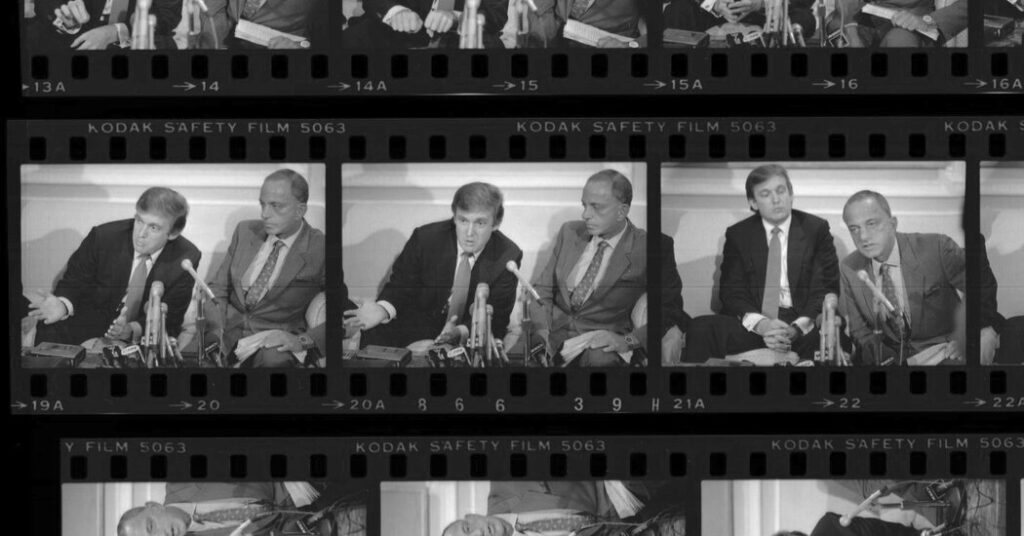
These are President Trump’s instincts, yes. But before they were his, they were Roy Cohn’s.
Kai Bird’s new book, “American Scoundrel,” written with Susan Goldmark (Bird’s wife and chief researcher), is a biography of Cohn, the sinister 20th-century lawyer who served as chief counsel to Joe McCarthy when the junior senator from Wisconsin was Red Scaring America and as lawyer to Trump when the young real estate developer was deflecting allegations of discrimination against prospective Black tenants. “American Scoundrel” is very much a how-we-got-here book, showing how Cohn’s guile, paranoia and shamelessness guided McCarthy, rubbed off on Trump and stuck fast to America.
The day after winning the 2016 election, Trump was on the phone with Roger Stone, his friend and adviser and longtime Cohn ally. “Wouldn’t Roy love to see this moment?” the president-elect said wistfully of Cohn, who died in 1986. “Boy, do we miss him.” And just months later, when the president fumed that Jeff Sessions, then the attorney general, was failing to protect him, an irate Trump demanded, “Where’s my Roy Cohn?”
If he really wanted to find Cohn, all Trump had to do was look in the mirror.
The Cohn-Trump parallels are evident on nearly every page of “American Scoundrel,” so much so that Bird barely needs to point them out. From a young age, for example, Cohn traded on the influence of his father, a New York judge, much as Trump would lean on the wealth and connections of his own father, Fred Trump. At 16, Cohn got one of his high school teachers out of a traffic ticket by calling the police precinct — “I’m sure you know who my father is” — and later relied on paternal clout to secure a job as an assistant U.S. attorney in New York.
Cohn became obsessed with publicizing his accomplishments — “I didn’t count it as winning if the world didn’t know about it” — and cultivated gossip columnists to stay in the headlines. (Not that he needed much help: Cohn’s role in the prosecution of Julius and Ethel Rosenberg established his name in legal and anti-Communist circles, even before his work for McCarthy made him a national figure.) To Cohn, “personal loyalty was everything,” Bird writes, and his disregard for legalities was captured in his maxim “Don’t tell me the law. Tell me the judge.”
He was even terrible at paying his bills, “another lesson Trump learned from Cohn,” Bird writes. Like his protégé, Cohn was indicted several times and was constantly under I.R.S. audit. At his birthday party in 1980, friends presented Cohn with a cake featuring his own scowling visage. (No word if T-shirts were available.) People who knew both men recognized that some of Trump’s verbal tics — “if you want to know the truth” and “I can tell you” — trace back to Cohn.
Cohn also liked to talk about crowd size. In 1963, after pleading not guilty to charges of perjury and obstruction of justice, Cohn stood outside a Manhattan courthouse and told the assembled reporters that it was the “biggest crowd I’ve seen since the Army-McCarthy hearings.” And when he gave a party in Washington celebrating Ronald Reagan’s 1980 election, Cohn boasted about the celebrities in attendance (Barbara Walters and Andy Warhol, among others) and bragged that “we had the biggest crowd.”
Oh, and Cohn sported a permanent tan, too.
Beyond style and temperament, Cohn and Trump shared a political template. Cohn “excelled at performative politics,” Bird writes, purporting to stand for the working class while riding around in a Rolls-Royce or hosting parties aboard his yacht, the Defiance. Both men saw history “through a lens tinted by conspiracy,” branding their rivals as Communists, radicals or denizens of the “deep state.” In a 1978 profile by Ken Auletta, which Bird cites, Cohn assails liberals for believing that “we must be loved by the rest of the world, which happens to hate us,” rather than focusing on national interests. “There’s nothing particularly original about Trump’s macho instincts in foreign policy,” Bird argues. They came from Cohn.
“The McCarthyism of the 1950s,” Bird writes, “morphed into a nativist, America Firster politics that transformed the modern Republican Party into a party of resentments against the old establishment, against multiculturalism, globalization and liberal culture” — with Cohn serving as connective tissue between McCarthy and Trump. Reading “American Scoundrel,” I sometimes wondered why the title wasn’t plural.
A journalist who interviewed Cohn at length offered an assessment that could fit Trump just as well: “He harbored a bundle of thinly concealed prejudices that he’d trot out whenever one or more of them worked for him, whenever they were useful.” The question for our time is: How long might they prove useful?
“Roy Cohn’s McCarthyism would long outlast McCarthy and would poison the American political landscape for decades to come,” Bird writes. Trumpism, too, may mutate and endure, even when Trump himself — weighed down by war, worn down by low public approval, slowed down by age — begins to recede from view.
“Why was McCarthy discredited but not McCarthyism?” Bird asks. In part, he concludes, it was because President Dwight Eisenhower declined to attack the senator directly, no matter the entreaties of Eisenhower’s advisers, including his younger brother Milton Eisenhower, who urged the president to “tear McCarthy to pieces.” Even as McCarthyism split the country and infected the Republican Party, the president “never took the political risk to ridicule McCarthy’s assumptions,” Bird writes. Eisenhower decided that ignoring the senator was better than elevating him through direct confrontation.
How often have we seen such calculations from Republican leaders during the Trump years, with painful and predictable results? The slide from amusement to dismay to toleration and finally to capitulation has been short but steep, and we may be stuck at the bottom for a while. The paranoia of McCarthyism “persisted as a routine feature of American life,” long after McCarthy exited the stage, Bird writes, leaving “a festering wound on the nation’s psyche.” Trump, under the tutelage of McCarthy’s former aide, learned to pick at that wound, making sure it kept bleeding.
Bird is a chronicler of the American establishment; his prior subjects include presidents like Jimmy Carter, advisers like McGeorge Bundy and scientists like Robert Oppenheimer. Cohn lurked around the edges of these stories, the anti-establishment force who both fed off and sabotaged the establishment. Now, with Trump, Cohn’s politics have won; the establishment has been dispatched, co-opted, emasculated. What remains, Bird writes, is a “subversive counternarrative” of American power.
In an interview with Times reporters early this year, Trump said that the only constraint he felt on his power was, well, himself. “My own morality,” he said. “My own mind. It’s the only thing that can stop me.” Bird does not make this comparison, but Trump’s words evoke Cohn’s, yet again, from a Penthouse interview 45 years ago. “I decided long ago to make my own rules,” he said, “to act according to my own choices, my own judgments and my own conscience.”
Where’s our Roy Cohn? Sitting in the Oval Office.
The post Trump’s Only Teacher appeared first on New York Times.