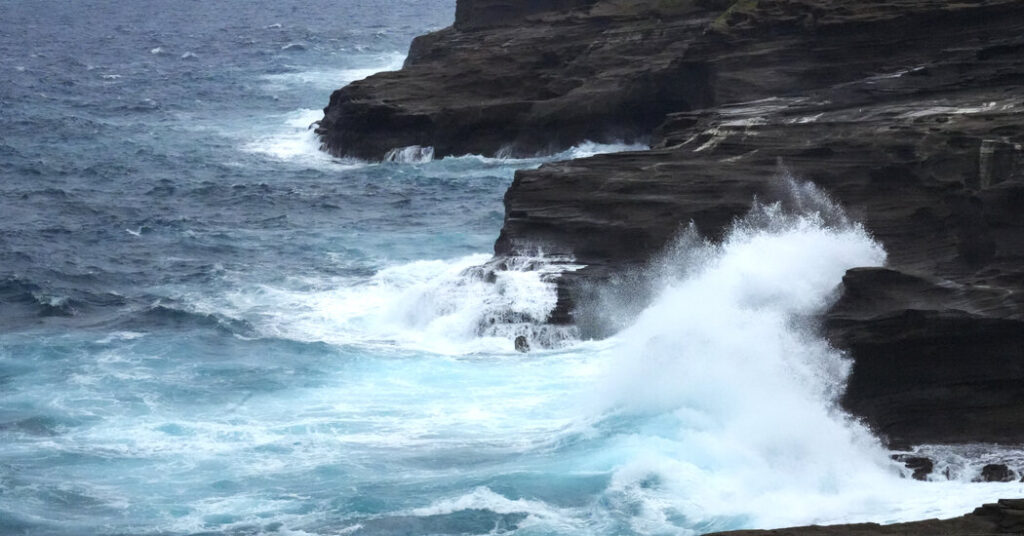
As Hurricane Lowell drew closer to Hawaii on Monday, forecasters warned of a potentially dangerous hazard from the powerful storm: tornadoes.
Forecasters said the main concerns were for heavy rain that could lead to significant flash flooding and mudslides, but the National Hurricane Center also warned on Sunday that tornadoes were possible across the Hawaiian Islands, especially near Kauai and Niihau through Monday night.
According to the National Weather Service, tornadoes can accompany tropical cyclones and hurricanes, and typically occur in rain bands well away from the center of the storm.
In Hawaii, however, tornadoes are extremely rare. Just 42 tornadoes were reported in the state between 1950 to 2018, according to Stephen Parker, a meteorologist with the Weather Service office in Honolulu.
“And compared to Kansas, Oklahoma and Nebraska, our tornadoes are typically on the weaker side,” Mr. Parker said, adding that they usually have the lowest rating of EF0 on the Enhanced Fujita scale, which estimates wind speeds and related damage from a tornado and runs from EF0 to EF5, the strongest category.
Because Hawaii is surrounded by vast ocean waters, waterspouts are more common than tornadoes. Mr. Parker said many of the tornado events reported around the islands typically begin as a waterspout — a whirling column of air and water mist that forms over water — that can sometimes move ashore and then be classified as a tornado. Most tornado events weaken quickly as they move inland, but some can cause damage.
One of the most notable tornado events in Hawaii occurred on Jan. 28, 1971, when a powerful storm, north of Hawaii, helped create conditions for several tornadoes, including one near Kailua-Kona, according to the National Weather Service. The tornado began as a large waterspout over Kailua Bay before moving ashore and traveling inland, damaging and destroying numerous buildings and causing at least $1.5 million in damage. It was rated F2 under the Fujita scale then in use. The scale, which ranged from F0 to F5, was replaced by the Enhanced Fujita or EF scale in 2007.
Despite the rarity of tornadoes in Hawaii, the threat remained on Monday. Mr. Parker said tropical tornadoes tend to form to the right of a hurricane’s path, specifically in the right-front quadrant, where winds can change significantly with height near the ground, creating favorable conditions for tornadoes.
“So because the hurricane is traveling from roughly south to north to the west of Kauai, Kauai and Niihau will be in an area conducive to low-level circulations that can produce brief tornadoes.”
The National Weather Service said the tornado threat would be lower near the other islands, although it could not be ruled out entirely.
The tornado threat is expected to decrease quickly early Tuesday morning.
The post Why Hurricane Lowell Could Produce Rare Tornadoes Across Hawaii appeared first on New York Times.