To the Editor:
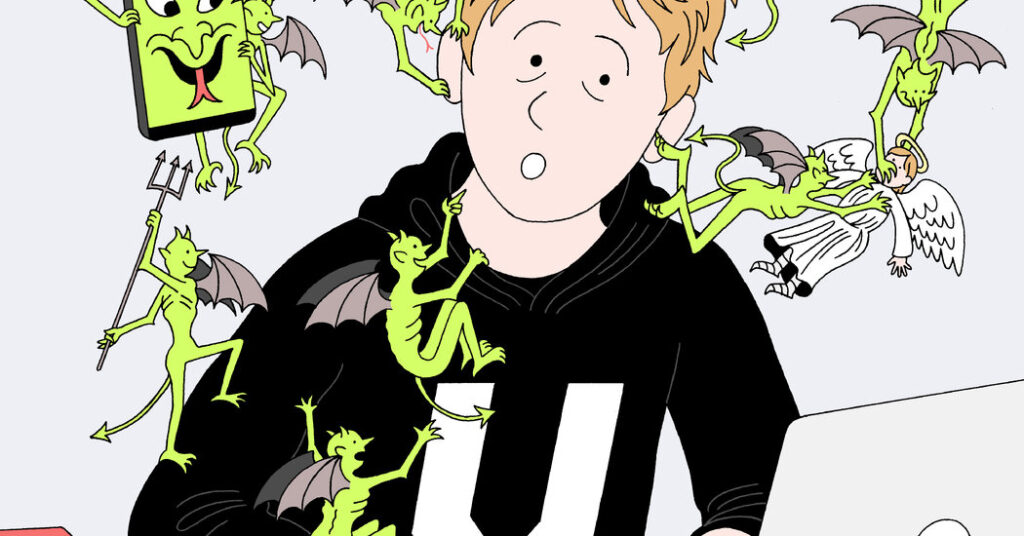
Adam Grant’s Aug. 30 guest essay, “To Stop Cheating in School, Address the Root Cause,” argues that the only way to stop cheating in the A.I. era is to instill moral values that make students not want to cheat. But another way to address A.I.-based cheating is to recognize that A.I. is a tool and allow students to use it to complete exams and assignments.
Before A.I., some take-home exams were open book, allowing students to draw on reference material as they saw fit. Students who understood the material and knew how to use reference sources effectively would generally outperform less capable students. Similarly, students who understand the material are more likely to ask A.I. the right questions and to recognize and correct errors in its output.
In my secondary education in the 1970s, electronic calculators were viewed much as A.I. is today. There were fears that students could simply punch buttons and get correct answers without understanding what they were doing. In hindsight, those fears were overblown.
Consider Dr. Grant’s example of a surgeon who cheated through medical school using A.I. I would welcome a surgeon who knows how to use A.I. to learn the latest techniques and who used it as a tool in medical school. I would not, however, attempt to be my own surgeon, regardless of how much A.I. I was allowed to use.
Robert R. Moore Dallas
To the Editor:
Adam Grant proposes focusing on “moral identity” as a means of addressing the A.I.-fueled cheating epidemic in schools. I applaud this argument. As a lifelong teacher and scholar, though, I fear that the solution has a snowflake’s chance of working.
Moral behavior depends greatly on the behavior of others in the same environment. I witnessed isolated incidents of cheating among my peers in high school and college, and I never felt tempted to copy their choices because they were so isolated. I thought of myself as a good person.
What would I have done if I knew that 10 percent of my classmates were cheating? Or 50 percent? Or more? Would the rewards of a positive self-image have persuaded me to abandon the arms race? I hope so, but many righteous young people have evidently now arrived at a different conclusion.
Moral identity is not binary; it exists along a spectrum. It is also situational. People who are “mostly moral” sometimes make seemingly immoral decisions when threatened, disadvantaged or otherwise harmed by their peers. Game theory suggests that A.I. disarmament based on the principle of academic morality will be exceedingly difficult to achieve.
Andrew Williamson Hong Kong
To the Editor:
Having spent my life teaching at highly selective colleges and universities, I sympathize with Adam Grant’s plea that we do something about the temptation to cheat — greatly exacerbated in recent days by A.I. And I agree with him that establishing moral identities in people will help.
But I quarrel with his suggestion that the lack of moral identity is the root cause of the problem. When elite schools boast about, and get credit for, rejecting 95 percent of applicants, the pressure to cheat becomes overwhelming. When companies boast about getting 500 applicants for every job, the pressure to cheat is overwhelming. When young employees see cheating by their colleagues rewarded with promotions and bonuses, the pressure to cheat is overwhelming.
What is rewarded is return on investment, not honor and integrity.
So let us, by all means, work to nurture moral identities, but let us also work to relieve the pressure on young people. I have proposed using a lottery among the qualified for college admissions and jobs. Under such a system, one needs to be good enough … and lucky.
This is how the system already runs, but people pretend otherwise. It will be a lot easier to encourage people to do the right thing when the price they pay for strong moral identities is made a great deal lower.
Barry Schwartz Oakland, Calif. The writer is a co-author of “Practical Wisdom: The Right Way to Do the Right Thing.”
Disabled and Online
To the Editor:
Re “The App That’s Bringing Disabled Daters Together” (Science Times, Aug. 25):
How refreshing to read about an app that opens the world of romance to disabled people (and unprejudiced able-bodied ones as well).
The digital world in general is a huge boon for disabled people, since if you can move a muscle, you can get online. This illustrates how the anti-digital mind-set is extremely ableist — in effect if not in intent.
Felicia Nimue Ackerman Providence, R.I.
The post How to Stop Cheating in the A.I. Era appeared first on New York Times.