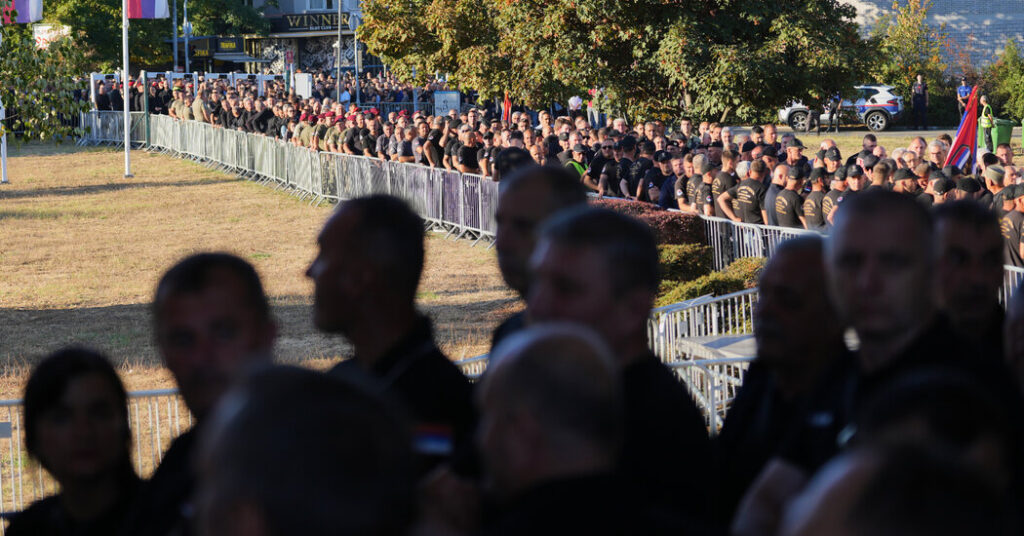
Thousands of mourners gathered in Belgrade, the capital of Serbia, on Monday for the funeral of Ratko Mladic, bowing their heads in respect before the coffin of the former Bosnian Serb general and convicted war criminal known as the “Butcher of Bosnia.”
Serbia’s strongman president, Aleksandar Vucic, a onetime champion of Mr. Mladic, who died Aug. 27 in custody in The Hague, stayed away from what the government insisted was a private, rather than state, event.
But state-controlled television and media outlets close to Mr. Vucic hailed the former general as a hero, without mentioning his conviction by a Hague Tribunal for genocide, crimes against humanity and other offenses. After the service, soldiers in camouflage uniforms and helmets carried the coffin out of St. Luke the Apostle church to a nearby cemetery.
Among those paying their respects at the Orthodox church were Mr. Vucic’s son, Danilo; several ministers, including the head of defense; and Aleksandar Vulin, a longtime ally of the president and former senior official who has pushed for close ties with Russia. The Hague court, Mr. Vulin said, “was created not to seek justice, but to seek revenge against the Serbs.”
The head of the Serbian Orthodox Church, Patriarch Porfirije, led the funeral service.
The death of Mr. Mladic in The Hague, where he was serving a life sentence, exacerbated an already tense political atmosphere in Serbia, where student-led protesters have been staging on-and-off street rallies, often huge, against Mr. Vucic for 20 months and where bitterly divided political parties are gearing up for parliamentary elections next month.
Monday’s funeral added further strain to Serbia’s relations with the European Union, which it has applied to join but whose terms of entry it has often defied. The European mission in Belgrade issued a statement Monday warning that “any glorification of war criminals, denial of genocide and revisionism are contrary to the most basic European values and have no place in the E.U. or in E.U. candidate countries.”
Mr. Mladic’s family said he would be buried next his daughter, Ana, a medical student who killed herself in 1994 with his military pistol, apparently distraught by her father’s actions during the Balkan Wars of the early 1990s following the collapse of Yugoslavia.
Mr. Vucic has sought to balance the demands of his nationalist political base, which reveres Mr. Mladic as a righteous defender of ethnic Serbs, with his desire for money from the European Union, which on Friday said the return of Mr. Mladic’s body to Belgrade “reminds Europe of the darkest pages in our recent history” and condemned “the glorification surrounding his death.”
In 2017, The Hague Tribunal convicted Mr. Mladic on war crimes and genocide charges relating to the 1995 Srebrenica massacre, in which some 8,000 Bosnian men and boys were killed, and the siege of Sarajevo, the capital of Bosnia, in which 10,000 people died, including 1,500 children.
For Serb nationalists, however, he is hero who has been smeared by Serbia’s enemies. Informer, an incendiary tabloid that often echoes Mr. Vucic’s views, claimed that Mr. Mladic had been murdered in The Hague.
Such false claims play into a longstanding Serb nationalist narrative that the country is an eternal and blameless victim and have made it difficult to move beyond the traumas of the 1990s. Ethnic Serbs also suffered, particularly at the hands of ethnic Croats, who are often also highly reluctant to acknowledge past crimes committed in their name.
One of Croatia’s biggest musical stars is Marko Perkovic, better known as Thompson (after the gun), a hard-rock singer and veteran of the Balkan wars who uses nationalist rhetoric at his concerts and has resurrected the military salute of Croatia’s fascist government during World War II.
Serbia, however, has a particularly acute case of denial and amnesia. At a soccer game on Saturday, fans of Belgrade’s two rival teams, Partizan and Red Star, who are usually aggressively hostile to each other, united to chant praise for Mr. Mladic. European football’s governing body, UEFA, last week started disciplinary proceedings against Red Star after the club posted images on its social media feeds of fans holding up banners in praise of Mr. Mladic reading: “General, eternal glory and thanks.”
Some Serbs have been appalled by the tributes lavished on a man held responsible for Europe’s deadliest massacre since World War II.
Marinka Tepic, an opposition leader, issued a statement calling on “all peoples in this region to finally stop running away from the facts, pay respect to the victims and clearly say that a crime has no nationality, and that no one who committed one can be a role model for future generations.”
Dragan Djilas, another opposition leader, said the Srebrenica “crime brought shame upon the entire Serbian people, who have themselves suffered throughout history.”
“No sane person can deny that a crime was committed, But wasn’t Ratko Mladic the commander of the forces whose members committed that crime?” he said.
Serbia applied to join the European Union in 2009 and has already received billions of dollars in aid and investment from the bloc, but Mr. Vucic has shown little interest in recent years in advancing his country’s application. Many nationalists favor close relations with Russia and decry the E.U. as a threat to Orthodox Christian traditions shared with Russia.
The European Union, which accepted Croatia as a member in 2013, has struggled with how to handle Serbia. It is eager to gain access to Serbia’s large deposits of lithium, critical for the E.U.’s green energy ambitions, and sees Serbia as the linchpin of the region’s future stability. But it is alarmed by what it sees as democratic backsliding and Mr. Vucic’s refusal to join sanctions against Russia over the war in Ukraine. In April, the bloc suspended 1.5 billion euros, or about $1.74 billion, in grants and favorable loans.
Alisa Dogramadzieva contributed reporting from Belgrade, Serbia.
The post Thousand of Serbs Gather to Mourn Ratko Mladic, the ‘Butcher of Bosnia’ appeared first on New York Times.