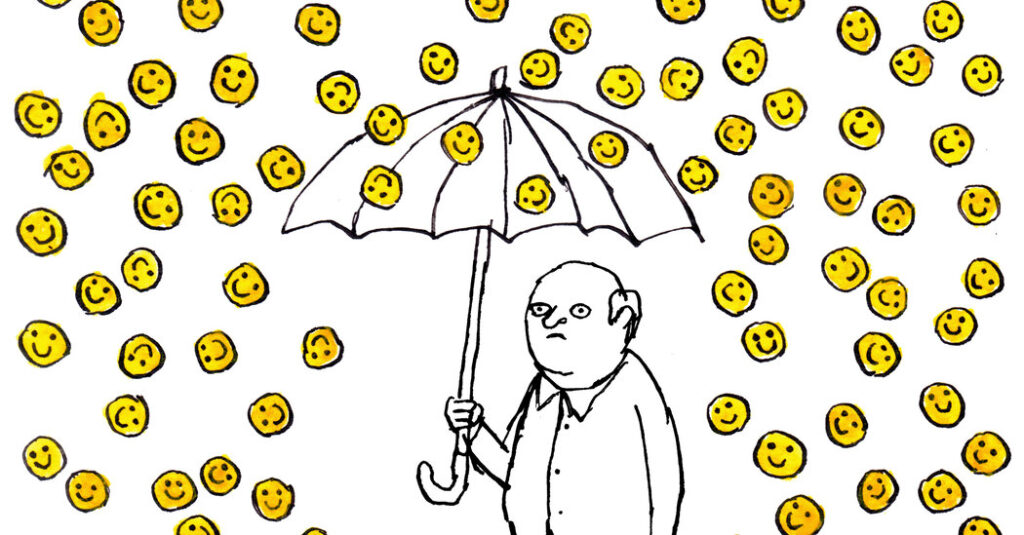
Labor Day is here, and you already miss the lapping waves and subtle breezes. Or maybe you’re missing the forest, where you can think your gentle thoughts in a green shade. You found what therapists and yoga teachers call your happy place.
Nothing against such pleasures, but if they concentrate your vision of ultimate happiness, that’s something you may need to reconsider. Many of us think that the goal of life is to work hard, succeed and live softly for the rest of our days. Get on the sailboat to nowhere. Go to the South of France and sample every wine-paired dish. Float from one music festival to the next.
This, many think, is happiness. And plenty of prominent thinkers would agree. The utilitarian philosopher Jeremy Bentham said we should seek maximum pleasure at all times and do all we can to avoid pain. Oscar Wilde, a lifelong sybarite, wrote in his letter “De Profundis”: “I don’t regret for a single moment having lived for pleasure. I did it to the full, as one should do everything that one does. There was no pleasure I did not experience.”
Yet there are others who think that happiness of this sort is, if not to be avoided altogether, then taken in guarded doses.
I’m with them.
The German philosopher Arthur Schopenhauer warns us that human beings have two main enemies: pain and boredom. We use our intellects to guard ourselves from pain. But once we have escaped it, the mind keeps whirring on, demanding new objectives, new distractions. So off we go into folly. We gamble (and often lose); we have affairs (and fracture our marriages); we provoke quarrels. By their nature, our minds cannot rest. The problem with that happy life we’re pining for is that it will inevitably breed boredom, and boredom begets trouble.
Schopenhauer wrote that against boredom, a man has “a great many fancied remedies, balls, theatres, parties, cards, gambling, horses, women, drinking, traveling.” These are temporary palliatives. Soon we’re bored again.
Schopenhauer’s solution? Find something to occupy your intellect. We can collect coins or stamps, learn about insects and birds, acquire languages, read good books and summarize them in our journals. Do not let the mind succumb to idleness. Most scenes that people associate with happiness — the golden beach, the splashing waterfall — are boredom traps.
Simone de Beauvoir also argues for activity over passive forms of happiness. Like her collaborator Jean Paul Sartre, she thought that the most dangerous temptation was what she called “being-in-itself” (in French, être-en-soi). People who cultivate being-in-itself want to embody a standard of perfection. They strive to show others that they are complete and whole. This is a condition, Beauvoir argues, that is especially tempting for women and girls. Everyone encourages them to be pretty, self-contained, perfect. The girl “must make herself object; she must therefore renounce her autonomy. She is treated like a living doll, and freedom is denied her,” Beauvoir writes in “The Second Sex.”
Boys and men are also tempted by stasis; they’re encouraged to grasp an identity and never leave it. But the boy, if he is willing, “carries out the apprenticeship of his existence as free movement toward the world.”
Being-in-itself is radically confining. You have to conform to the canons of appearance and behavior that society endorses. You must become a replica of a type. Is successful conformity a form of happiness? It can appear to be. But in its sterility and confinement, it’s akin to spending every day sitting on a beach.
As an alternative, Beauvoir commends “being-for-itself” (être-pour-soi) — a commitment to being active in the world. People who embody being-for-itself see that identity alone doesn’t come with a reliable or binding meaning. So they occupy themselves with what Beauvoir calls a “project”; they go off and create their own values and try to use them to shape their lives.
The person Beauvoir commends may not be happy, but she has embraced her freedom, which gives her a life of meaning. I asked my students in a recent seminar if they thought that women and girls were still socialized to be objects, beings in themselves. They said yes, but they added something. They said that women were also socialized to have a project: to succeed, to make a splash. They were asked to enact both being-in-itself and being-for-itself — a difficult, perhaps impossible, task.
Both Beauvoir and Schopenhauer turn away from the life of recumbent happiness and toward something more difficult. Schopenhauer would probably think that Beauvoir asked too much of people, women and men both. To him, most of us don’t have the capacity to embrace authentic self-creation. The best we can manage is studying geography and the lives of insects. I tend to side with Beauvoir: As a teacher, I’m inclined to see the best in my students and have hopes for their futures that go beyond coin collections and amateur astronomy.
The last witness in my case against happiness — at least, happiness as perfect contentment — is interested in the enlightenment of humankind as well as of individuals. Friedrich Nietzsche’s archetype of the “last man” is the type of person who arises in a culture that encourages the pursuit of drone-like happiness. The last man is cautious: He has his “little pleasures for the day” and “little pleasures for the night.” He lives for tiny satisfactions: He never goes all out, never spends for vast returns. “A little poison now and then” — drugs, alcohol and empty entertainment are the last man’s delights. He’s willfully blind to the life of thought and artistic creation, or of being-for-itself, which Beauvoir thinks is necessary for true fulfillment. But he is, after his own fashion, happy.
When Nietzsche’s protagonist in his book “Thus Spoke Zarathustra” tells a crowd of people about the last man, they rise as one and entreat him: “Give us this last man, O Zarathustra … Make us into these last men.” But it is too late. They already are last men and women and so, it appears, they will stay.
I don’t mean to malign every form of contented happiness. I only want to say that overall it may be better to seek meaning rather than pleasure. Of course, even the meaning-seekers need an occasional break, and why shouldn’t it be in a verdant glade or a sun-washed beach? For a while Nietzsche savored a blissfully relaxed life in Turin, Italy. (He felt that the waitress at his trattoria saved the lushest grapes for him.) Perhaps, though, we ought to make it a point not to stay in our happy place for too long and, surely, not to aspire to live in it for the rest of our lives.
Mark Edmundson is a professor at the University of Virginia and the author, most recently, of “The Age of Guilt: The Super-Ego in the Online World.”
The Times is committed to publishing a diversity of letters to the editor. We’d like to hear what you think about this or any of our articles. Here are some tips. And here’s our email: [email protected].
Follow the New York Times Opinion section on Facebook, Instagram, TikTok, Bluesky, WhatsApp and Threads.
The post There’s Something Better Than Happiness appeared first on New York Times.