The far-right Alternative for Germany party fell short of an outright majority in crucial elections in the state of Saxony-Anhalt, according to final results posted on Monday, but it could still take power there if it wins the support of a minor populist party.
All eyes in Germany have now turned to that party, the Alliance Sahra Wagenknecht, which is known by its German initials BSW, ahead of negotiations to form a new state government that could take weeks or even months.
If the Alternative for Germany, known by its initials AfD, does find a way to power in Saxony-Anhalt, it would mark the first time since the end of the Nazi era in 1945 that a part of Germany is ruled by a far-right party, and it would spell the end to the country’s postwar political consensus to keep the extremist far-right out of government.
The BSW had ruled out supporting Ulrich Siegmund, the local leader of Alternative for Germany, as state governor. But it has not ruled out supporting his political party, which mainstream politicians have vowed not to work with.
“The firewall does not interest us and we will speak with all parties,” Thorsten Schulze, a BSW state leader, told German media on Sunday night, referring to the longstanding promise by other parties.
The state elections in Saxony-Anhalt gave AfD its biggest electoral success since its founding in 2013. Having won 43.8 percent of the vote, the AfD now has 39 seats in a state house with 83 seats, meaning they are three short of a full majority.
But there is no straightforward path to a new state government. Both the AfD and the parties who would try to block it now hold an equal number of seats in the state house, where members elect the state governor.
For Chancellor Friedrich Merz of Germany, a conservative whose party suffered a stinging defeat in the state election, the uncertainty contributes to the challenge he faces in getting Germany out of economic doldrums. He is scheduled to meet with state party leaders in Berlin on Monday.
Founded in opposition to Germany’s adoption of the euro, the AfD evolved rightward and developed a strong anti-migration stance after the government of Angela Merkel let over one million refugees into Germany in 2015 and 2016. Some of its leaders are close to Russia, others have questioned Islam’s right to exist in Germany, and some have made dog whistle comments about the Nazi era, including by minimizing the Holocaust and repeating Nazi slogans.
German domestic intelligence has classified the party as “suspected extremist,” giving it wide powers to surveil the party and its leaders. The AfD has rejected that label.
Mr. Siegmund, the AfD leader in Saxony-Anhalt, had campaigned on a promise to rule only if his party got an outright majority. But he moderated his tone after the polls closed, saying on Sunday night that he would at least talk with all parties.
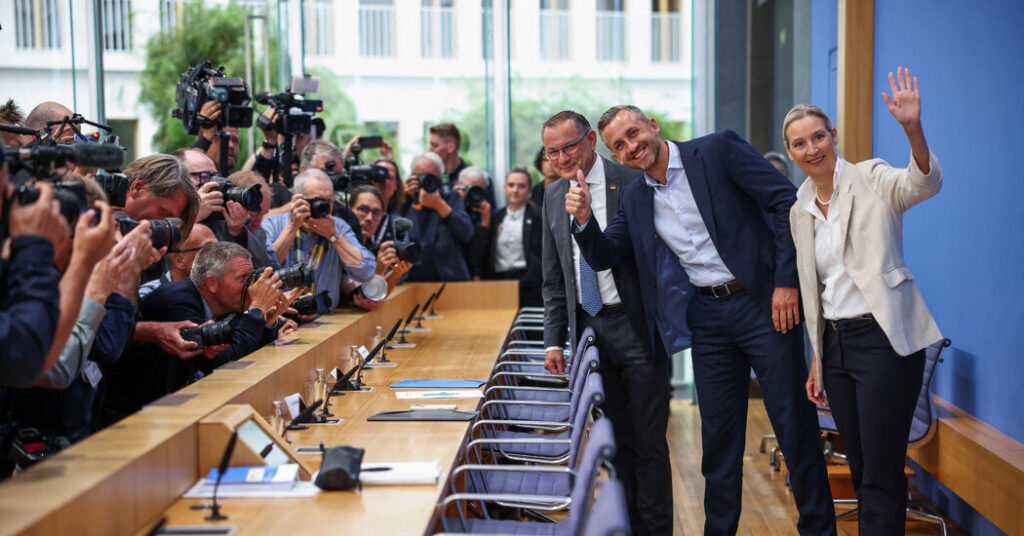
“Of course I will stand as a candidate for Minister-President in Saxony-Anhalt if it becomes apparent that we have established a stable majority,” Mr. Siegmund said on Monday in Berlin at a news conference with other AfD leaders, without elaborating about where the party was seeking support.
Whether that is possible depends on five newly elected state house representatives for the BSW, which was born from a split with the far-left Die Linke party but has veered rightward. Like the AfD, it has an affinity for Russia and advocates for very strict migration controls.
During the campaign in Saxony-Anhalt, the BSW had suggested nominating a nonpartisan state governor. But it had also indicated that it would abstain during a crucial state house vote that requires only a plurality, not a majority, to put Mr. Siegmund into the governor’s seat.
The AfD could also benefit from CDU politicians who could split off and vote for Mr. Siegmund.
A broad anti-AfD coalition stretching from the far left to the right could potentially coalesce around Sven Schulze, the current CDU governor. But that option is hindered by the CDU’s firm pledge never to work with Die Linke. Even if such a coalition forms, it would be several seats shy of being able to vote in a new governor or confirm Mr. Schulze.
The post After Victory in German State, Far Right Needs Help to Take Power appeared first on New York Times.