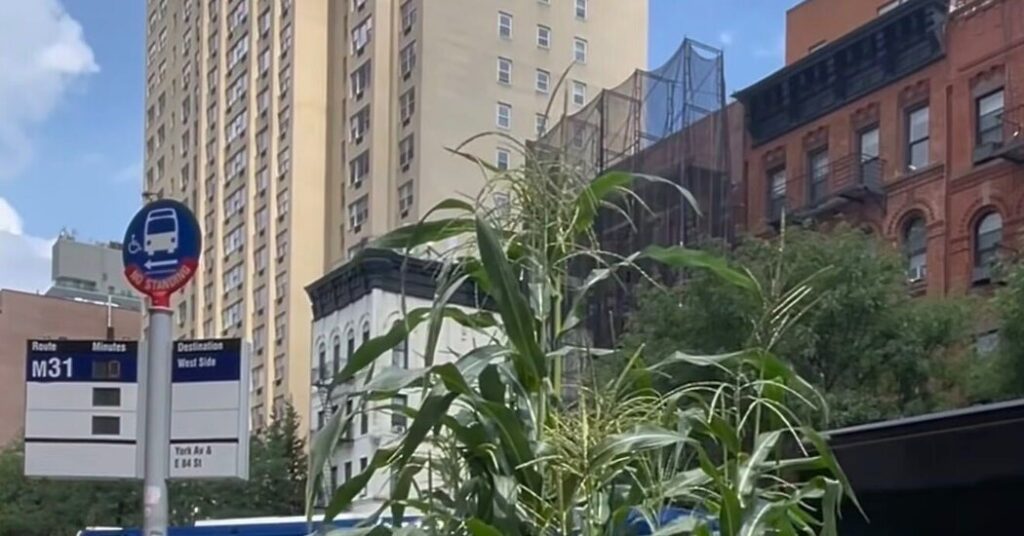
For months, the children at the Mis Amiguitos preschool in Manhattan had tended to a bundle of corn stalks growing from a patch of dirt on a busy Upper East Side sidewalk, watching with pride as they grew to over seven feet tall.
Then, one Monday morning last month, the children arrived at the school on York Avenue between East 83rd and 84th Streets to a crime scene: The corn had been uprooted and scattered across the pavement.
The day before, surveillance video showed, a man on a bike had approached the corn stalks in broad daylight, dismounted and ripped them out before pedaling off. The police are investigating, but there have been no arrests and no word on a motive, leaving the school and the neighborhood grappling with a seemingly nonsensical act of vandalism.
“I was beyond angry,” said Mily Caballero, the chief executive of Mis Amiguitos, a full-immersion Spanish Montessori program, “and the kids, of course, just didn’t understand why someone would do that.”
The episode not only undid months of work by the students and their teachers, it also underscored the importance, and vulnerability, of the city’s more than 660,000 sidewalk tree beds as canvases for novelty and creativity. In a city where few schools have access to ample green space, a tiny patch of dirt had offered a group of children a connection to nature and a place to make something grow amid the concrete — until a vandal took it from them.
An Accident Creates a Learning Opportunity
It was not the first time the patch had been vandalized.
The story began five years ago, when a delivery truck jumped the curb outside the school and uprooted a tree, one of many that offered shade to York Avenue, a bustling street lined with shops and restaurants.
New York City encourages residents to help maintain tree wells on public sidewalks, and the teachers at Mis Amiguitos saw the newly barren plot as a blank canvas.
The students planted flowers, pumpkins and herbs. The school’s neighbors noticed, and were delighted.
“The kids were doing such great things with it,” said Jill Feldmann, who has lived in the neighborhood for 45 years. “They planted flowers, the next year sunflowers.”
But this spring, starting in March, the plants came under attack.
“The flowers we did plant were completely stomped on,” Ms. Caballero said, adding that dog excrement was found on the soil.
The teachers and the students replanted, and this time put up barriers. Again, the plants were flattened. Then they added higher barriers and wire — all told, the school spent about $1,000 on equipment to keep vandals at bay. But on three occasions before the corn was planted, one or more people destroyed the small garden.
Undeterred, in April, the students tried again, this time tucking corn kernels into the soil. By August, the stalks had grown taller than most people.
The school integrated the corn into its curriculum, a hands-on way for students to learn about the crop and how to care for it. They watched as birds, squirrels and bees filtered through the stalks. In the fall, they planned to paint the corn for decoration and teach the students about agriculture.
So when Alexandra Wilcox and her son arrived at the school on Aug. 17 to find the corn uprooted, she, like other parents, struggled to explain to him what had happened.
“He was like, ‘What happened to it?’ And I didn’t have an answer,” she said.
The New York Police Department was notified and is investigating, a spokesperson said.
It seemed to be part of a pattern in the neighborhood. On the night of Aug. 15, a man resembling the person who destroyed the corn stalks was captured in footage from a neighbor’s cellphone yanking sunflowers from a tree well about a block west of the school, according to a resident who tended to the flowers.
Then, on Aug. 20, a doorman witnessed someone using what appeared to be a machete to hack at a patch of begonias not far away, on Park Avenue at 66th Street, said Amy Sheldon, the executive director of the Fund for Park Avenue.
A Community Comes Together
As word of the vandalism spread, Ms. Caballero said, an unexpected influx of generosity emerged. Neighbors and business owners reached out with offers of emotional and material support, including a gift card to Home Depot for supplies to fortify the tree bed. An anonymous neighbor also dropped off a bag of flower seeds.
On Aug. 19, the Balloon Saloon in TriBeCa delivered a handful of smiling corn helium balloons, which Mis Amiguitos placed in the tree well where the real corn stalks had stood. But by the next morning, someone had snipped the strings, either absconding with the balloons or letting them float away.
“Here we were trying to do something kind and make the kids hopeful,” said Sharon Hershkowitz, the owner of the Balloon Saloon. “To be bashed again, what message does that tell them?”
In the early evening on Aug. 20, a flash flood warning was issued as a soaking rain deluged York Avenue. Inside Mis Amiguitos, parents bundled their children in rain gear and opened umbrellas. When asked about the corn, Adrian Wilcox, 3, said he was “sad that it’s in the garbage,” but there were signs of hope. Agreeing with an adult, he said, “It’ll work out.”
Parents and teachers shared his optimism.
“It’s a learning lesson,” said Scott Klipper, whose two children attend the school. “Whether it’s part of being in New York City, or a city, this is something to learn and grow from.”
The Balloon Saloon sent a new batch of vegetable inflatables on Aug. 21. Ms. Caballero said that the students would plant marigolds, the sacred flower of Dia de los Muertos, or Day of the Dead, the Mexican tradition in which people celebrate and mourn the departed. Instead of tying the balloons outside, each student was sent home with one.
The school placed a sign in the tree bed that week thanking the neighborhood for “overwhelming love, kind words and support” that turned a painful experience into “a powerful lesson in community for the children.”
On a table inside the school, a wicker basket held pieces of the corn stalks that had been collected from the sidewalk. Also tucked inside was a magnifying glass that the children could use to closely inspect the kernels and the veins running through the husks — recasting a traumatic episode as a teaching opportunity.
“We took some of the kernels out, we’re going to plant next week,” Ms. Caballero said. “We’re not giving up.”
The post Neighbors Rally After a Manhattan Preschool’s Corn Stalks Are Vandalized appeared first on New York Times.