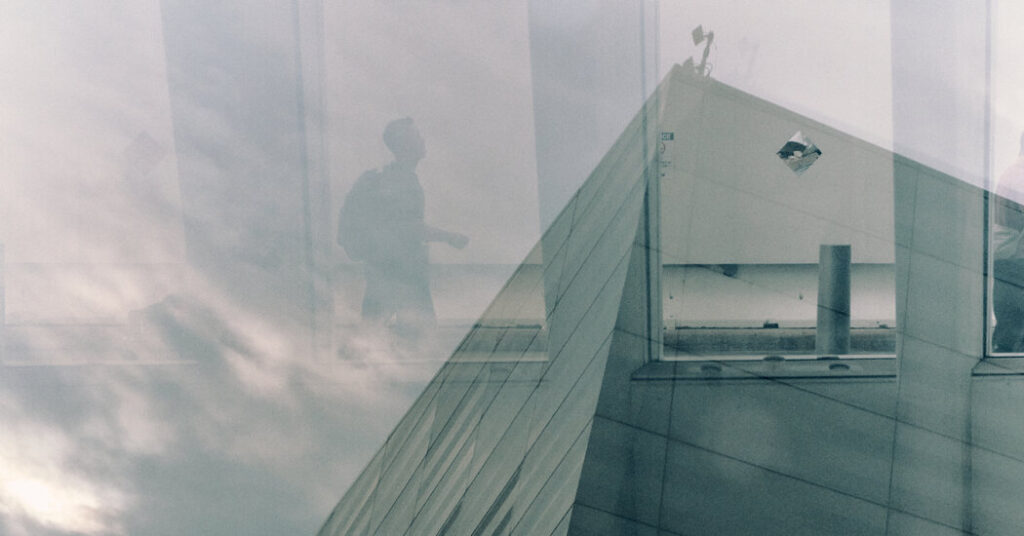
One recent morning I hopped the No. 1 train to revisit the St. Nicholas Greek Orthodox Church and National Shrine. Opened in 2022 to replace a century-old neighborhood sanctuary destroyed when the Twin Towers fell, it’s the tiny, domed, fussily designed marble light box tucked in an elevated pocket park on the south end of the World Trade Center.
A few tourists chatted outside the doors under a canopy of honey locust trees, waiting for the church to open. The sound of waterfalls drifted up from the memorial. It was an odd experience in that part of town. It almost felt like being in a real neighborhood.
At 25 years the World Trade Center is an undeniable feat of urban redevelopment. It has added a quartet of high-gloss commercial behemoths by big-name architects to the city skyline, with another supertall office building on the way.
It has also produced a persistent hollow zone in Lower Manhattan in the sleek, cheerless guise of an office park, surrounding the 9/11 Memorial and Museum — an area that remains alienated, as were the former Twin Towers on their wind-swept superblock, from the city around it. A relic of bygone city-planning ideas, it freezes the site in its moment of trauma.
A quarter-century is an inflection point. Some 100 million Americans have been born since the Sept. 11 attacks. There is an opportunity today to reconsider the development’s bollarded and little-trafficked streets and maybe to resuscitate the idea of building more housing nearby to bring energy, serendipity and 24/7 life to the area. One can imagine a lively mixture of new residents and commuters filling redesigned streets raised to the level of the sidewalks and open plazas buzzing with commerce and cafe tables, buskers and benches. The activity would be yet another enduring rebuke to the terrorist attacks.
I’ve been writing about ground zero since that September day in 2001. When I checked in five years ago, the $85 million, Byzantine-modernist St. Nicholas — a not-quite jewel-box by Santiago Calatrava, made of bone-white Pentelic marble — hadn’t yet arrived.
Its difficult construction was slowed by litigation and ballooning costs. An even more tortured odyssey had delayed the $500 million Perelman Performing Arts Center, designed by REX, at the opposite end of the Trade Center, which I reviewed when it finally opened in 2023. Its sumptuously veined and raised marble cube contains a Chinese box of shape-shifting theaters and a Marcus Samuelsson restaurant.
Perelman, like St. Nicholas, had promised to add new facets to the Trade Center. Aside from the memorial and its museum, these are the only buildings at the site other than office towers and Calatrava’s $4 billion bird-shaped shopping mall and PATH station called the Oculus. A fifth commercial tower, a 1,226-foot-tall design by Norman Foster for American Express, has lately broken ground beside Perelman, with a projected opening in 2031.
So where does that leave the redevelopment?
Summer outdoor movie screenings now take place at the Oculus Plaza. Food carts have appeared at the site’s north end. A farmers market arrives on Tuesdays. And the offices are nearly full, which is obviously good news. Citywide the demand for office space lags, post-pandemic, but Grade A towers like those at the Trade Center or at other high-end developments in town, like Hudson Yards, are in demand.
That said, Perelman and St. Nicholas have not done much to turn the Trade Center into a cultural hub or make it feel like a neighborhood, even while the rest of Lower Manhattan has been morphing in all sorts of promising ways since well before Sept. 11. Its residential population has more than doubled in the last 25 years, with a spate of new apartment towers and the conversion of older office buildings creating a prosperous cohort of people, parks, retail and restaurants.
Perspectives have also changed on what the area needs after Sept. 11. A new documentary about the redevelopment of the 16-acre Trade Center, “9/11: Reclaiming Ground Zero,” recalls a public meeting organized after Sept. 11 at the Javits Convention Center. Five thousand New Yorkers turned up to voice their democratic opinions, ripping into early ideas that planners had put forward.
Citizen attendees ranked priorities that organizers gave them. Remembrance was on the list. So was commercial redevelopment. Housing wasn’t. Neither were measures to protect against rising seas and extreme weather.
Back then politicians and business leaders fixated on keeping Wall Street banks and other big companies critical to the city’s economy from fleeing. Westfield, the mall developer, wanted to turn the site into an aboveground shopping center. Grieving families of victims were understandably demanding a fitting memorial. Everyone was worried about security.
So there was a rush to rebuild, sidelining voices of patience urging mixed-use development and circumspection about the civic wisdom of a new phalanx of glassy office towers. George Pataki, New York’s governor at the time, was considering a White House run and demanded that a tower raised like a middle finger to the terrorists be erected as quickly as possible. Larry Silverstein, who had only just signed a lease on the property six weeks before Sept. 11, wanted to recoup his investment.
Then came the market crash in 2007, followed by Superstorm Sandy in 2012, which drowned much of low-lying Lower Manhattan, shut down subways and turned off the lights. The storm displaced thousands of residents and caused billions of dollars in damage.
Eight years later, the coronavirus pandemic ushered in a universe of remote work.
And today a widening income divide and the lack of lower and middle income housing across the city have further reshaped public preoccupations and fears about what most threatens New York’s future, especially among a younger generation of city residents who weren’t even alive when the Twin Towers were attacked.
To this generation, the battles over the Trade Center’s design belong to history. The project’s disappointments no longer seem as urgent or divisive. Time has also created room for rethinking. Around new housing, for instance. Why has the promise to erect 5 World Trade, a 1,200-unit mixed-income apartment tower announced by Gov. Kathy Hochul three years ago, gone nowhere?
And what about reimagining public space. The original ambition at ground zero to restore streets that the Twin Towers had erased sounded smart and forward-thinking 20 years ago. But it hasn’t panned out as hoped because the streets remain cordoned off and policed like demilitarized zones. Street-level retail in and around ground zero’s office towers is meager. There are few places just to sit and enjoy a sandwich.
The police and the bollards aren’t going anywhere. But in other big cities, from Tokyo to Vienna to Athens to Jerusalem to Mexico City, streets and sidewalks, including around sacred sites and memorials, are sometimes shared by cars, pedestrians and shops. These places can have bollards and security without foreclosing movement. They serve as tourist magnets and attractions for workers and residents with their mix of food, culture, memory and commerce — a recipe still unrealized at the Trade Center, even with Perelman and St. Nicholas.
Creating these zones is a job for landscape architects and urban designers in New York, who elsewhere have transformed many city streets into plazas. I felt just a hint of what is possible standing outside the church the other morning. A few New Yorkers arrived, waiting to pray on their way to work. Some tourists had come to check out the frescoes in St. Nicholas by a monk from Mt. Athos. We chatted in the summer breeze.
It was a rare, welcome experience at ground zero. It was the feeling of normalcy.
The post There Is Still a Void at Ground Zero. Here’s How We Fill It. appeared first on New York Times.