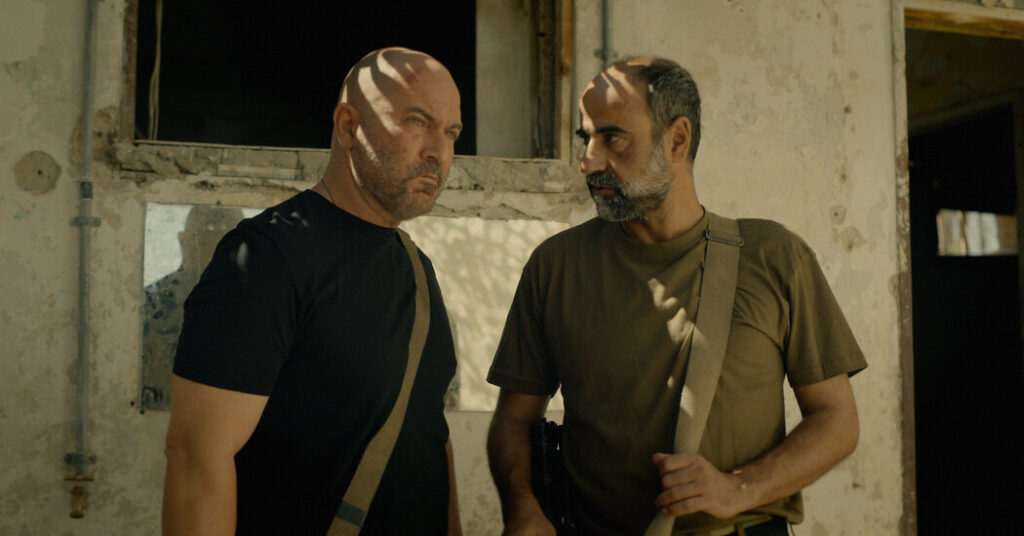
Lior Raz, the star and co-creator of “Fauda,” the hit Netflix series about a team of Israeli undercover anti-terrorist operatives, was in Romania for a speaking engagement when he woke up to a phone call from his sister.
“I need you to save me,” she told him. It was the morning of Oct. 7, 2023, and she was calling from a bomb shelter in a kibbutz along the Gaza border.
She eventually made it to safety on her own. But two nights later, Raz and his writing partner, Avi Issacharoff — veterans of a military unit much like the one the series depicts — were among scores of volunteers lined up at a rendezvous point in southern Israel to receive the names and numbers of people in border communities who still needed evacuating.
It had come to this: As rockets from Gaza continued to bombard the area, attackers remained at large and the Israeli government was M.I.A., the two television writers raced around in the dark rescuing strangers in Raz’s SUV like Uber drivers in the apocalypse.
One woman they picked up took one look at Raz and seemed to momentarily forget what was going on around her, Issacharoff recalled: “She says, ‘Oh my God, it’s Doron from “Fauda!”’ and wants a selfie.”
“Fauda” easily could have ended with the release, nine months earlier, of its fourth season, which had closed on a grim shot of its main characters splayed on the ground, badly wounded, after an entirely fictional battle that went bad. The creators deliberately left the ending ambiguous because they weren’t sure if they wanted the series to continue, they said.
But the Oct. 7 massacre — the deadliest, most traumatic day in Israel’s history — created an urgent new mission for them. In the same way they had felt the urge to do something to help stranded Israelis that Monday night in 2023, they said they quickly got started writing a new season. They believed “Fauda” had to confront Oct. 7 and its aftermath.
Raz, in a phone interview, called it “maybe the most important thing that we ever wrote.”
Issacharoff agreed. “This was something that burned inside us, that we felt we had to spill it out,” he said at his office in North Tel Aviv. “The pain, the sadness, the catastrophe, the loss of people, the loss of close people. The confusion during that day, the impotence of the Israeli public, but also especially the people that were living there in Gaza’s periphery.”
Of course, this season, premiering Tuesday on Netflix, arrives in an entirely different context than the previous four. Israel’s artists and cultural exports are running into resistance overseas, precisely because of how the country responded to Oct. 7: by razing much of Gaza and killing more than 70,000 Palestinians.
The immediate challenge for the writers in the aftermath of Oct. 7 concerned Israeli audiences first and foremost, however.
Whereas “Fauda” in its earlier seasons had offered viewers a kind of conflict voyeurism — peeking at its ugliness, empathizing with Palestinians, but then comforting oneself that it was all make-believe — this new season would be something else entirely. It would require placing the show’s fictional characters inside a series of events that were all too real, that Israeli viewers knew all too well, and from which there was no escape. There would be no happy ending.
And it would still have to be entertaining.
Because the Gaza war was underway as the writers planned the season — and they had no way of knowing how long it would last — they plotted a story that steered clear of Gaza almost entirely, ranging instead from Europe to Israel with stops elsewhere in the Middle East. (They also had no way of knowing that one member of the crew, Matan Meir, would be killed in combat in Gaza and a co-star, Idan Amedi, would be seriously injured.)
But the theme of the new season was unavoidable: revenge, as sought and exacted by characters who also reveal the psychic wounds they are still suffering from Oct. 7.
Two episodes, preceded by a trigger warning, flash back to the team members’ experiences on that day — the shock and scope of the onslaught, the brutality and horror of the atrocities, the collapse of Israeli security and state power, and the way individual Israelis, including many older veterans, raced to help one another.
The hardest part of those episodes was figuring out how much of the carnage to show, Issacharoff said. “You try to be as close to reality as possible. On the other hand, you cannot show everything, because it’s too terrible.”
Other scenes may strike viewers outside Israel as hard to believe, as when a villain is shown coolly admitting his atrocities in an interrogation video. But Israelis saw such confessions on the TV news. The writers said they felt it important to include, as a glimpse of evil.
Season 5, which premiered in May on the Israeli cable network Yes, was the most-watched season of any show in its history, the network said. Einav Schiff, TV critic for Yedioth Ahronoth, one of the country’s leading newspapers, wrote that it managed “to depict what happened to many Israelis after the dimensions of the failure and the disaster became clear: the insane rage, the excruciating insult, the total crisis of trust and the burning desire for revenge even at the cost of moral collapse.”
More mixed reviews elsewhere noted with some disappointment that the series had abandoned its earlier efforts to empathize with both sides of the conflict.
In Time Out, Avishai Sela alluded to the possibility that the emphasis on the desire for revenge could be a tough sell overseas: “The world, as we know, is not very empathetic to Jewish suffering at the moment.”
The writers weren’t in much of a mood to cater to international audiences, either. The leftist, pro-Palestinian westerners who play supporting roles in the show are portrayed as useful idiots who protest and volunteer themselves into being deployed as human cannon fodder.
Asking the writers about pro-Palestinian sentiment abroad clearly touches a nerve, and prompts angry asides about “stupid” people wearing kaffiyehs who don’t know what they really symbolize or “which river and which sea” they are chanting about.
“You can be anti-Israel,” Issacharoff said. “I mean, you can say that Israel is doing the wrong things in Gaza. Sometimes it is doing wrong things in Gaza. But the ones that are criticizing Israel only and are ignoring what Hamas did, or is doing — they don’t have any kind of a proper education about what is going on. And when you say Hamas did this thing on Oct. 7 because of what happened before? OK, so you’re in a way legitimizing the massacring of innocent people.”
Understandably, Raz and Issacharoff are more than a little apprehensive about how the show will do when it begins streaming worldwide on Netflix.
They see their fellow artists facing boycotts and backlash for being Israeli. The war in Gaza made Israel itself a villain in the eyes of many potential viewers. So how big will the audience be for a series about the Israel-Hamas conflict that only focuses on Oct. 7, and exclusively from the Israeli point of view?
To Raz, that is slightly beside the point. He is an artist, he said. “I would just want them to love the show.”
But the truth is, he does hope for more.
“I want them to look in my character’s eyes, and to see what we felt on those days,” he said moments later. “If it would happen in their countries, they would feel exactly like we felt and how we feel about the world. So I hope it would open people’s eyes to see what happened on Oct. 7.”
Heedo Abu Laban contributed reporting.
The post ‘Fauda’ Braves Oct. 7, and Audiences’ Attitudes Toward Israel appeared first on New York Times.