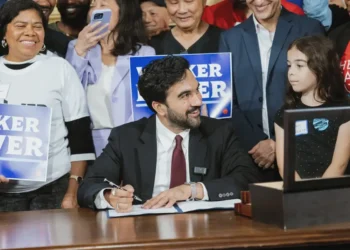
Roy Cooper, the Democratic nominee in the crucial and closely watched Senate race in North Carolina, isn’t just a fierce candidate. He’s a fascinating contradiction.
His enormous strength is his greatest weakness. And his campaign aides fret not that the water is choppy but that the sailing’s too smooth.
Just about everyone I talk to in the state — political science professors, political operatives, neighbors on my street, acquaintances at my gym — assumes Cooper will win. He has the biography, the bona fides: worked on his family’s North Carolina farm as a boy; attended college and law school here; served four terms as the state’s attorney general; served another two as governor, demonstrating his crossover appeal by being elected to that post in years (2016 and 2020) when North Carolinians delivered their votes for president to Donald Trump.
Yes, that’s a heap of time on the inside for a moment that favors outsiders, and it’s perhaps too much politicking in an impolitic age. But Cooper doesn’t come across as entitled, assumptive, out of touch. For all his years in the state capital, you can still hear rural North Carolina in his voice. He looks more comfortable in shirts with the insignia of his beloved Carolina Hurricanes — he’s a hockey nut whose ecstasy over the team’s Stanley Cup victory this year was palpable — than in black tie. And just as Republicans can’t tag him as a snooty elitist, they can’t slam him, at least not credibly, as some lunatic lefty, though they’re trying, with cynically selective ads about his criminal-justice record. Good luck. North Carolinians know him better than that and they know him as a moderate.
They barely know his opponent, Michael Whatley, at all. Whatley has never run for political office before. He spent more than 15 years of his career as (ouch) a lobbyist. He occupied the position that brought him the most public exposure, chair of the Republican National Committee, during a span (March 2024 to August 2025) when that meant that he was more or less the political equivalent of one of the caddies who ooh over President Trump’s golf strokes and guide him toward one of those miraculous scores. In no way whatsoever is Whatley some charismatic populist antonym to Cooper.
And that’s Cooper’s problem. He and Whatley seem so mismatched — I haven’t even mentioned the terrible midterm environment Trump has created for Republican candidates — that it’s dangerously possible that many Democratic donors and North Carolina voters take Cooper’s victory for granted and don’t do what they should, which is pony up generously and cast ballots enthusiastically.
Cooper’s campaign aides have nightmares about that. How do I know? Because I get the emails they blast out. If a recent poll or polls show Cooper up over Whatley by double digits, the emails warn everyone: You can’t believe polls! You know that! This race will be a nail-biter. Act accordingly.
If a new poll has Whatley just four or five percentage points behind Cooper, the emails say: Heed this poll! That’s a margin-of-error difference! It’s irrefutable proof of how desperately we need your help. Act accordingly.
No public poll since Cooper and Whatley became their parties’ nominees in early March has put Whatley less than four points behind Cooper, and the average of public polls since mid-June gives Cooper an eight-point lead that shows no compelling signs of shrinking yet.
But that “yet” is what torments his aides. That “yet” is everything, and it takes into account many precedents and dynamics.
North Carolina’s shade of purple is more reddish than bluish. Its two current senators — one of whom, Thom Tillis, chose not to run for re-election this year — are Republican. The state hasn’t sent a Democrat to the Senate in 18 years. While Cooper was indeed elected governor twice before term limits forced his retirement from that job, he won by small margins; in 2016, little more than 10,000 votes separated him from his rival, Pat McCrory, the incumbent Republican governor.
By the end of June, according to Federal Election Commission filings, Cooper’s campaign had outraised Whatley’s by three to one and had nearly $21 million of cash on hand versus Whatley’s roughly $3.5 million. But national Republican groups have much fatter coffers than Democratic ones; they have already put negative ads about Cooper in heavy circulation and there could be much, much more where that came from.
Emails from the Cooper campaign issue that precise warning incessantly, operatically, ominously, as if they’re narrating the advance of a Carolina-bound Godzilla. “G.O.P. dark money groups have already committed nearly $100 million to lie about Governor Cooper and it looks like they’ll spend hundreds of millions more,” Jeff Allen, Cooper’s campaign manager, wrote in an email in early June. In late July, he wrote that Godzilla was drawing nearer still. Maybe the ill-tempered lizard’s fiery breath explains temperatures that crested 100 degrees in my part of the state last week.
Cooper’s campaign is hardly the first to suffer (and probably exaggerate) the heebie-jeebies about supporters’ complacency, nor is it unique in lavishing much of its public-relations energy on fighting that. But it takes that tack to almost comical lengths.
One recent campaign email quoted an article in Politico quoting an anonymous Republican source saying that if Democrats “think they have a layup” in North Carolina, “they’re out of their minds.” A fund-raising email last week included old newspaper headlines and colorful charts and graphics to remind North Carolinians of what a surprising squeaker that Cooper-McCrory race a full decade ago turned out to be.
If that’s what’s needed to ensure a Cooper victory, I’m all for it, because I want a post-midterms Congress that constrains Trump and I can’t imagine Democrats winning a Senate majority if Cooper loses. A defeat caused by his very dominance would be a sick joke. We’ve already got one of those at the Resolute Desk.
Forward this newsletter to friends …
… and they can sign up for themselves here. It’s published every Monday.
For the Love of Sentences
In The Globe and Mail of Toronto, Shannon Proudfoot examined MapQuest’s announcement that it would not follow President Trump’s decree that Lake Ontario is suddenly Lake America: “With that, the mapping company you didn’t even know was still in business became a mascot of the resistance to the president’s penchant for renaming geographical features in the manner of a dog raising his hind leg next to a fire hydrant.” (Thanks to Stephen Willcock of Ottawa, Ontario, for nominating this.)
In an earlier column, she provided context for the American president’s beef with her country: “It’s worth rewinding your brain to the basic fact that as Mr. Trump whines and rails constantly about how Canada has taken such vicious advantage of the United States, he’s talking about the trade deal he negotiated in his first term. You know, the one he unveiled on a ‘very momentous, historic and joyous occasion’ as ‘the largest, fairest, most balanced and modern trade agreement ever achieved.’ That one.” (Sean Mallen, Toronto, and Peter Schmolka, Ottawa, Ontario, among others)
In The Financial Times, Janan Ganesh beheld a dauntless Trump acolyte: “Who is left of the Trumpsplainers? Who, even after Iran, squints to see order in the bedlam? There is Elbridge Colby, the Pentagon’s policy chief, whose rationalization of his boss’s random doings is creative, as a man who is always spotting faces in clouds is creative.” (Marilyn Pinschmidt, Carrboro, N.C., and Minty Smyth, Tiverton, R.I.)
In The Bulwark. Catherine Rampell interpreted European governments’ recent behavior: “Chatter about reshoring gold reserves from America picked up around Trump’s ‘Liberation Day’ in April 2025, when he first began his arterial spray of global tariffs.” She saw parallels in his domestic and foreign indulgences: “It’s not so hard to imagine how the gilding of his office might align with the gelding of our allies.” (Suzanne M. Stiles, Piscataway, N.J., and Josh Kaplan, Minneapolis)
On the MS NOW website, Anne Kim charted the rising price of toilet paper: “It’s a bad sign for the G.O.P. that consumers feel squeezed by their Charmin — instead of vice versa.” (Mark Weinberg, Wilmington, Del.)
In The Times, David French explained some conservative Christians’ worries about what will happen to their daughters in the progressive clutches of an elite university: “They’ll leave home as Laura Ingalls and come back as Lady Gaga.” (Pete Campbell, La Porte, Ind., and Glenn Jarrett, Burlington, Vt., among others)
Also in The Times, Charles Homans described how the Democratic establishment regarded the Democratic Socialists of America “with wary curiosity, like an oil tanker captain squinting through binoculars at a band of pirates approaching from a great distance on a slow and iffy-looking fishing pontoon.” (Andy Laster, Charlotte, N.C.)
Michael Wilson recounted a couple’s return, days after the terrorist attacks on the World Trade Center in 2001, to a nearby apartment that they’d hurriedly evacuated: “They’d never closed their terrace doors that day, so the living room was coated with debris — bits of paper, receipts, a scrap of a balance sheet. A diorama of things that once mattered.” (Sam Chamberlin, Cincinnati)
And Dwight Garner feasted on the “maximalist’s banquet” of “The Disappearers,” a new 600-page novel by Marlon James: “It is humane, blood-flecked, disturbing and sustaining. It takes James 90 pages to say hello. It’s another 70 pages before his story settles into your guts and begins to twist them. It’s yet another 150 before you fully comprehend his loping authority and the scale of his ambitions. Booster rockets fall away. Disparate coordinates begin to converge.” (Howard Caro, San Francisco)
In The New Yorker, Becca Rothfeld paid tribute to the compelling, sublime awfulness of movies that are “monumental feats of incompetence, inspired in their badness, bad in ways I could never have dreamed a film could be bad, so feverishly and outlandishly bad that they have bodied forth a new aesthetic category.” (Susan Caruso, Glen Head, N.Y.)
And in The Athletic, Spencer Nusbaum chronicled the Los Angeles Dodgers’ helplessness in the face of the Atlanta Braves pitcher Chris Sale: “The Dodgers swung at 57 percent of the pitches Sale threw in the zone and 48 percent of the pitches he threw outside of it, which is about as close as you’ll get to a big-league team closing its eyes and praying.” (Leslie Ferreira, Studio City, Calif.)
To nominate favorite bits of recent writing from The Times or other publications to be mentioned in “For the Love of Sentences,” please email me here and include your name and place of residence.
What I’m Reading, Doing and Listening To
-
As a fan of Jon Ronson’s “So You’ve Been Publicly Shamed,” his 2015 examination of internet mob behavior, I’ve eagerly cracked the cover of his new book, “The Castle: Adventures in a World of Unraveling Men,” which came out last week. The Times published this excellent, widely read article adapted from it. The Times also just published this excellent, widely read essay adapted from my former colleague Lindsay Crouse’s new book, “The Case for Quitting: The Surprising Benefits of Opting Out,” available this week. It seems to me as timely as “So You’ve Been Publicly Shamed” was.
-
One of the most thoughtful, least ideologically hidebound up-and-comers in the Democratic Party is Representative Jake Auchincloss, Democrat of Massachusetts. He was the subject of this episode of the The Ezra Klein Show last year and this column by Bret Stephens in May. He’ll be with me at Duke University on Monday, Oct. 5, when I’ll interview him onstage about the party’s direction, the looming midterms and how America can move past the destructive acrimony that defines our politics today. The in-person-only event is free and open to the public; you can find registration information here.
-
Parting Songs: For an end-of-day chardonnay, “Ceilings,” by Lizzy McAlpine. For the treadmill, “Underwater,” by Rufus Du Sol. For singing in the shower at the top of your lungs, “Left Outside Alone,” by Anastacia.
On a Personal Note
You may have noticed how much publications today love best-of lists and how especially keen they are to showcase restaurants that way. I consider this a civilizational advance. I love lists, I love eating out and I love doing so vicariously through all that plummy prose, all those pretty pictures. Just two weeks ago, Bon Appétit produced such a package, anointing the 19 Best New Restaurants of 2026. Nice touch, that 19. Round numbers are so 2025.
The Bon Appétit list told me that the flavors in the Cambodian papaya salad at Sao in Philadelphia are “like coiled springs.” It told me that the “golden brown skin” of the brioche-stuffed chicken at Maison Bar à Vins in Washington, D.C., “hides a creamy layer stained green with herbs and made all the richer with butter and cheese.” It made me very, very hungry.
But it also got me to thinking (and not for the first time): The innovations, inspirations, daring and decadence that earn a restaurant critical acclaim or cult status aren’t the criteria that most of us use most of the time to decide where to eat, whether that’s on a weeknight, weekend or special occasion. We go where we know the managers and the servers and they know us; that familiarity is a seasoning more transformative than turmeric. We go where there are booths and playlists that suit the mood we’re in and the relaxation we need. We go where Patrick at the bar makes the best version of our favorite cocktail and sets it down with a smile as perfectly calibrated as the spirits. I’ve even picked a given restaurant on a given night because it has the easiest, most reliable parking.
In all of those scenarios, the food had to cross a certain threshold of quality — that’s a given. But the farther I’ve traveled from my years as The Times’s chief restaurant critic (2004 to 2009), the more aware I’ve become of the differences between what a formal appraisal of a restaurant takes into account and what most customers do.
I touched on this twice in essays I wrote after 2009. In this one, from 2013, I discussed the joys of being a regular at a restaurant. And in this one, from 2019, I talked about being on the far side of 50 years old and how “it’s not just sex and sleep that change as you age. It’s supper.” And where you head to have it. Here’s a paragraph from that article:
What you want from restaurants, it turns out, is a proxy for what you want from love and from life. None of these is constant. All reflect the arc that you’ve traveled, the peace that you have or haven’t made. When I was 34, I wanted bling, because it persuaded me that I was special. When I was 44, I wanted blinis, because they made me feel sophisticated. At 54, I just want martinis, because I’m certain of what’s in them and of what that potion can do: blunt the day and polish the night.
When I turn 64 in about two years and two months, I’ll get back to you on my wants then.
The post Is This Democrat Too Good for His Own Good? appeared first on New York Times.