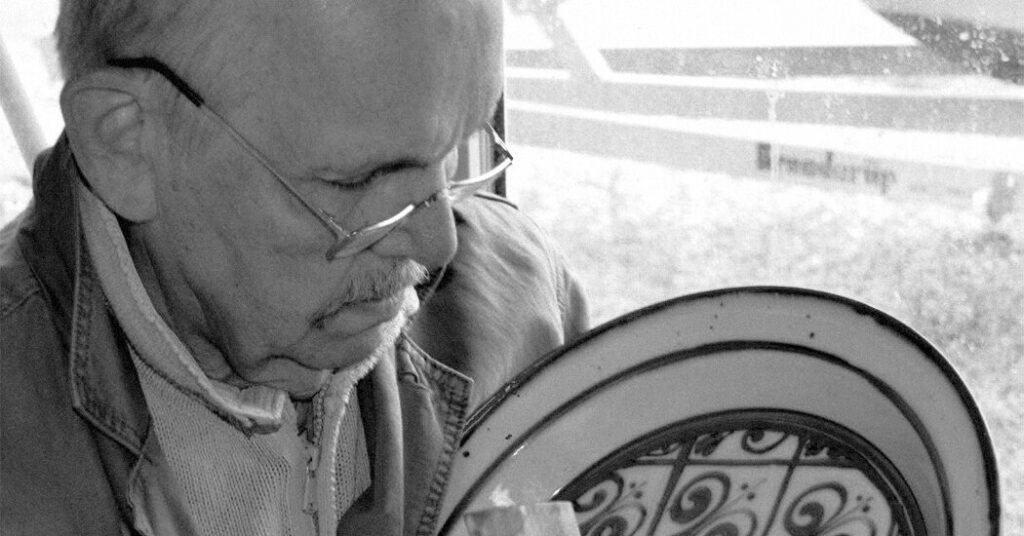
Niels Refsgaard, a Danish ceramist and designer for Dansk, the company that put Scandinavian design on the postwar American table, died on July 14 in Copenhagen. He was 91.
His death, in a hospital, was announced by his daughter Marie Louise Refsgaard.
Despite its name, Dansk — which is Danish for Danish — was an American company founded in the mid-50s by Theodore and Martha Nierenberg, an engineer and a biochemist, out of their garage in Great Neck, N.Y.
They built it around the designs of Jens Quistgaard, a Dane who was known for his handmade flatware. For a decade, it was Mr. Quistgaard’s elegant work that defined the company and fed this country’s appetite for all things Scandinavian: His minimalist stainless-steel cutlery with wooden handles, wooden salad bowls, cutting boards, ice buckets and enameled steel cookware in rainbow colors with lids that doubled as trivets were ubiquitous in some households.
When Mr. Nierenberg wanted to expand, he looked again to Denmark. Mr. Refsgaard was a ceramist collaborating with companies like Saxbo, a noted studio pottery manufacturer in Copenhagen — studio pottery is work that is handmade in small batches — and in the mid-60s he joined Dansk.
He was a devotee of the English potter Bernard Leach, whose “A Potter’s Book” (1940) was a touchstone for generations of artists and who believed that the imperfections and distinct flourishes of handmade clay objects were what made them beautiful.
Mr. Refsgaard had developed an ingenious way of firing stoneware with a glaze flecked with iron. His first designs for Dansk were cannily branded as Generation, a line of dinnerware that looked like it had been made by a hippy potter in Vermont — and yet not. It was both rough and refined, and the speckled glaze meant that no two pieces were exactly alike.
Generation marked a shift in the culture — the dining room had become vestigial and fine china an anachronism. In 1966, the year it appeared, Bob Dylan’s “Blonde on Blonde” album was released, as was the Beatles’ “Revolver.” “That Girl,” a sitcom starring Marlo Thomas as a single woman on her own in New York City, aired on ABC. Craig Claiborne, food editor of The New York Times, was bullish on Chinese and French cooking, and Southern barbecue.
“‘Generation’ is what we call our new dinnerware,” read an early ad. “The gap is that measureless space that yawns between your mother’s table and your own.”
Dansk was already a design powerhouse, yet Generation changed its fortunes. By 1970, the line accounted for 14 percent of all the company’s sales.
“It was groundbreaking,” the design editor Arlene Hirst, who is working on a book about Dansk, said in an interview. “For years, it was Dansk’s most successful product. Niels’ designs changed the way Americans set their tables.”
With Jerrold Ross, who became Dansk’s creative director in the mid-70s, Mr. Refsgaard made a set of hearty-looking dishware called BLT, released in 1976. It was Mr. Ross’s idea to reduce the accouterments of a meal to the essentials: a bowl, a plate and a mug. (The initials stood for breakfast, lunch and tea.) It was sold with all three pieces stacked atop each other and lashed with twine, inspired by the way traditional Japanese pottery was presented for sale in Japan.
“Less is enough,” declared its tagline. “Zany New Dinnerware Watches as Eater Eats,” declared the headline in The Times, reporting on its debut.
It, too, was a best seller, until it was knocked off by umpteen other companies. Bistro, introduced in 1979, was another of Mr. Refsgaard’s greatest hits, though he balked at the assignment initially. Mr. Ross wanted a line of higher-end pieces with a bit of pattern. But Mr. Refsgaard, Mr. Ross said in an interview, was allergic to decoration and vocal on the subject. (By all accounts, Mr. Refsgaard was an appealingly gruff character, a bit mischievous and a bit contrary.)
“I thought, let’s put something in the mirror” — the industry term for the middle bit of a plate; the flange is the edge — “something my salespeople can sell,” Mr. Ross said. “Niels, being Niels, told me, ‘You can’t put pattern there, that’s where the food goes, stupid!’”
He did eventually relent and produced a line of dinnerware edged in delicate, minimalist patterns, including a suave blue stripe and another composed of a trio of dots. The pieces are sophisticated and restrained and, to overuse an overused term, timeless.
“He could do anything,” Mr. Ross said. “Most designers are separate from the manufacturing, but he was always knee-deep in it. And most designers just sketch their ideas. When we talked about doing something new, he’d say, ‘Let me throw a couple of pieces.’”
The Nierenbergs sold Dansk in 1985, and Mr. Refsgaard stayed on for a few more decades, through a number of subsequent sales. In 2021, Dansk was bought by Food52, a recipe and lifestyle company founded by the food journalist Amanda Hesser, who revived a few of Mr. Refsgaard’s designs, which she had been collecting since she was 21.
But when Food52 sold off its assets a few years later, Dansk was on the block again. It was bought by Form, which licenses the designs of midcentury modernists like Jens Risom, and is planning to produce Mr. Refsgaard’s Bistro line.
Niels Refsgaard was born on Aug. 23, 1934, in Copenhagen, the only child of Rigmor Refsgaard, a schoolteacher, and Aksel Refsgaard, a blacksmith who owned a bicycle shop. Niels wanted to be a painter, but his parents worried he wouldn’t be able to support himself. When he broached ceramics as an alternative, they came around.
He attended Copenhagen’s School of Arts and Crafts, now part of the Royal Danish Academy, which trained artisans and designers in ceramics, textiles, graphic design and furniture design.
Mr. Refsgaard produced dozens of designs for Dansk, if not more, according to Ms. Hirst, the design editor. He also designed for companies around the world, including a manufacturer in the Philippines that provided jobs for the families of those afflicted with leprosy, moving his family to the Tala neighborhood of North Caloocan, a city north of Manila, in the early 80s. They stayed on for five years.
In addition to his daughter Marie Louise, he is survived by another daughter, Nanna Refsgaard; his wife, Hanne Refsgaard, whom he married in 1961, and four grandchildren. Their son Jacob Refsgaard died in 1990.
He was still working at his death, including a commission for Ms. Hesser. He made her a small collection of mugs she would sell from her new company, Homeward. Ribbed and with generous swoopy handles, each mug is different, sporting blue patterns on a smoky glaze. The designs look both Japanese — and very Danish. Ms. Hesser and Mr. Refsgaard had a lively collaboration, she said, and he was often in touch by email.
In one of his last notes to her, he wrote, “I love clay and fire more than ever.”
The post Niels Refsgaard, Who Transformed the American Table, Dies at 91 appeared first on New York Times.