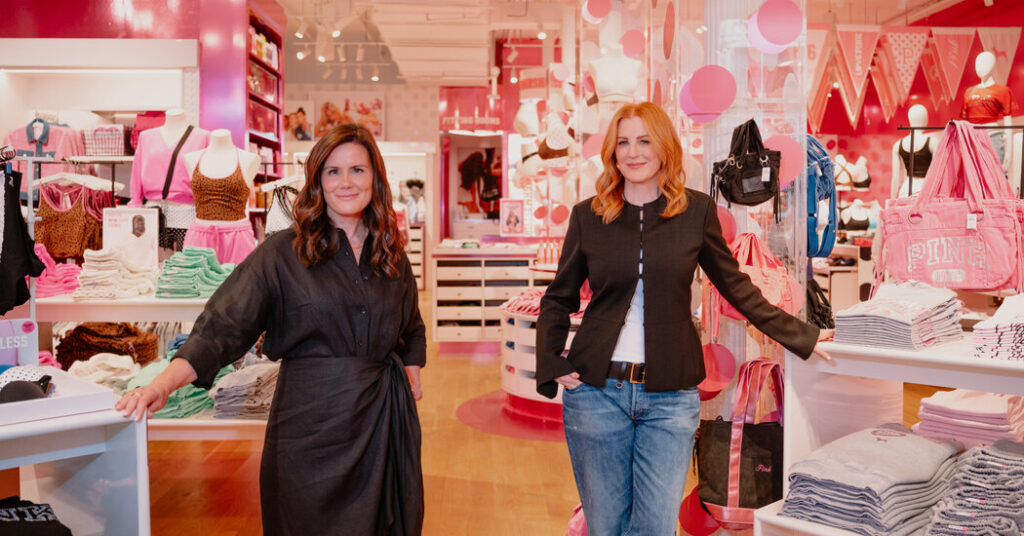
As Hillary Super prepared to become chief executive of Victoria’s Secret two years ago, she couldn’t figure out what had happened to a product line that had once been a critical offering for the world’s largest lingerie retailer.
Pink, its sister brand that sells tank tops, flare leggings and push-up bras to young adult women, had lost half of its total sales volume, a catastrophic decline from its heyday a decade ago.
Once Ms. Super took the role, she looked at the numbers and listened to stories from her new colleagues. They told her that management had stripped Pink of its identity. Instead of building out Pink as its own business, the company used it merely as a cheaper alternative to the main brand, or a “Victoria’s Secret light.”
Pink needed to be distinct again to help dig Victoria’s Secret out of a lengthy sales rut. It had been neglected and ate into the main brand’s sales; therefore, a successful overhaul would make a quick impact on the overall business. So Ms. Super made it a priority: The company would refresh the Pink brand within its stores, redefine the Pink customer and try to revive the struggling label.
“We lost a ton of business,” Ms. Super, 54, said, seated in her office at Victoria’s Secret’s corporate outpost in Manhattan. “So I decided early on that I was going to need to reorganize.”
Victoria’s Secret, with headquarters in Reynoldsburg, Ohio, has endured a decade rife with scandal, management changes, restructuring and weak sales after the company was scrutinized over its treatment of women and ties to Jeffrey Epstein. That led to the departure of Leslie Wexner, its longtime owner, who has since sold his stake.
The brand once dominated the lingerie market in the United States, driven by hypersexualized marketing and the success of its push-up bras and balconette styles with underwire.
But consumer preferences shifted. Women demanded comfortable versions of bras that provided some structure with soft fabrics, like wireless bralettes, and shapes that contoured with seamless foam cups and hidden inner slings. And fallout from the #MeToo movement made Victoria’s Secret’s sex-forward image seem outdated and crass.
The pressure became too much for Victoria’s Secret. In 2020, L Brands reached an agreement to sell a majority stake to Sycamore Partners, a private equity firm, but the deal collapsed when the pandemic hit. A year later, the company spun off Victoria’s Secret and Pink in a move that formed a new publicly traded entity, Victoria’s Secret & Co.
Sales continued to slide, and in 2024 the company hired Ms. Super, who previously ran Savage X Fenty, Rihanna’s lingerie label, to try to spur a turnaround. She presented a plan to return to growth: Revamp the core product lines, rework supply chains and reorient Victoria’s Secret’s provocative branding, though with a more modern and inclusive definition of sexy. And Pink would play a key role.
“Pink is absolutely a needle mover,” Simeon Siegel, an analyst at Guggenheim Securities, said. “We’re talking about a multibillion-dollar business.”
On Thursday, Victoria’s Secret said quarterly sales at Pink grew in the high single digits, marking the brand’s fifth straight quarter of sales gains. The company’s stock price has risen over 39 percent so far this year.
“What can we do best that no one else can do?” Ali Dillon, 42, the new president of Pink, said of the brand. “I want a girl walking down the street and you know that’s a Pink girl, from the styling, from head to toe.”
Think Pink
Victoria’s Secret debuted Pink in 2002 in an effort to attract teenage girls and college-age women, competing with brands such as Abercrombie & Fitch, American Eagle and Aéropostale.
The brand offered a mix of loungewear, sleepwear and underwear: racer-back tank tops, cotton slips, pajama pants, stretchy bras and panties with lace trim.
Management chose the supermodel Alessandra Ambrósio, then 24, to be the face of the brand, and she hosted events in Los Angeles and New York.
“Think fun. Think flirty. Think Pink,” read a tagline on the cover of an early Pink catalog featuring Ms. Ambrósio in a bra and boy shorts. High school girls and college women couldn’t buy enough.
By 2018, Pink had reached its peak, powered by a big-budget marketing engine that promoted fantasy and sex appeal through splashy ad campaigns. Its own segment in Victoria’s Secret’s annual televised fashion show was often headlined by A-list musical artists including Katy Perry, Nicki Minaj and Justin Bieber. The brand maxed out at about $3 billion in annual revenue.
But American culture had shifted away from narrow definitions of sexiness, and Victoria’s Secret had not changed the way it did business. More body-positive and inclusive lingerie brands, such as Aerie and Savage x Fenty, pulled away market share.
In 2019, a scandal erupted when Mr. Epstein, the convicted sex offender, was arrested a second time and faced federal sex-trafficking charges. More connections with Mr. Epstein were made public, including how he used his relationship with Mr. Wexner and Victoria’s Secret to lure aspiring models into situations where they were abused.
Mr. Wexner had been Mr. Epstein’s biggest client and benefactor, and some investors called for a change in leadership. He resigned as chief executive of L Brands, then the parent company of Victoria’s Secret, and later left the board.
The Victoria’s Secret Angels, a group of supermodels who wore wings in their lingerie as they walked the catwalk and were billed as “bombshells” since the 1990s, were replaced with a collective of activists for mental wellness, pay equity, gay rights and women’s sports.
Management found its brands stuck somewhere between the sex-charged concepts of the past and what it called “new dimensions” that marketing executives said would mend Victoria’s Secret’s reputation.
Under Ms. Super, Victoria’s Secret has worked to revive that sexiness, even switching its ticker symbol in June on the New York Stock Exchange from VSCO to VSXY. But this time the company has been taking a broader view of what it means.
“What we will never do is dictate a singular view of sexy,” Ms. Super said. “I feel strongly that there is nuance in being the subject of your sexiness versus the object of your sexiness.”
The new stewards
While Victoria’s Secret has been recast as “sexy, glamorous, luxurious,” Pink has become “bold, playful, irreverent,” Ms. Dillon said.
The distinction is crucial. Throughout Pink’s existence, company executives have worried that the brands would grow too similar and eat into each other’s sales, a problem that has worsened in recent years.
The new stewards of the brand want to ensure that doesn’t happen again.
Victoria’s Secret has about 800 stores in North America, and the majority of Pink’s shops are sectioned off within the larger brand’s stores. About 60 are stand-alone Pink stores. Victoria’s Secret expects to complete the remodeling of about 40 percent of its stores by the end of the year.
Company executives say they’ve refocused on Pink’s target demographic, 18- to 24-year-old women. As those customers get older they’re likely to look to Victoria’s Secret or other brands, so Pink must continually try to attract new young shoppers.
“She’s feminine and flirty, but she’s also mischievous,” Ms. Dillon said of her customers. “She doesn’t take herself too seriously, she has a lot of fun, she’s with her girlfriends all the time, and she’s the girl who’s going to compliment her friend’s shirt.”
The Pink store in Manhattan’s SoHo neighborhood opened in May as a new concept, for executives to explore ideas that can be used across their store network. A panty bar, where shoppers mix and match styles, sat near the checkout line, and sweatpants were displayed on a wall near the front.
Everything was drenched in pink, with the brand’s cutesy dog mascot seen throughout, instead of the glossy black finish of a Victoria’s Secret shop. Pink store employees, who weren’t wearing all-black like their peers, greeted customers with a chipper compliment — “I love your earrings!” or “Those are cool pants!”
As workers remodel the rest of the stores, Pink has begun preparations for its distinct segment at Victoria’s Secret’s annual fashion show, which is set to be held in Los Angeles in October.
“Pink is not V.S. light, or V.S. pretending to be something else,” Ms. Super said. “It’s a different point of view.”
The post Can Pink Become Something More Than Victoria’s Secret’s Little Sister? appeared first on New York Times.