President Trump’s legal and rhetorical assault on voting by mail — and the flurry of contradictory court decisions around it — has left voters confused and local officials scrambling just eight weeks before November’s critical midterm elections.
The contortions have county registrars dusting off Election Day contingency plans developed for natural disasters like floods and wildfires. They have struggled to make it through planning meetings before the latest version of the rules change, and many are encouraging voters to avoid the U.S. Postal Service all together.
Among voters, confusion abounds.
“I don’t trust mail-in or in-person, to be honest with you,” said Lori Woo, a 53-year-old teacher from Wildomar, Calif. She has voted both in person and by mail and now wonders whether any of her votes were counted.
Arizona officials have been encouraging voters like Antonio Bergier, an 83-year-old retired geologist, to drop off ballots in person. But he said he didn’t know whether his hometown, Patagonia, or his county, Santa Cruz, had ballot drop boxes — nor would he use them anyway.
Mail, he said, is “the only way they’re getting my vote this year.”
Twenty states are set to mail ballots to voters by Sept. 19, starting with North Carolina, which began sending out absentee ballots on Friday.
“We plan to proceed as planned,” Sam Hayes, the director of North Carolina’s elections board, said at a news conference on Thursday.
But even election officials were reluctant to issue reassuring encomiums.
“I wish that I could tell my constituents to not worry, and I can’t,” said Gabriella Cázares-Kelly, who oversees elections in Pima County, Ariz., where 85 percent of ballots are delivered early or by mail.
In many places with mail-in voting, the bulk of ballots aren’t scheduled to go out for another month. But the response has already begun.
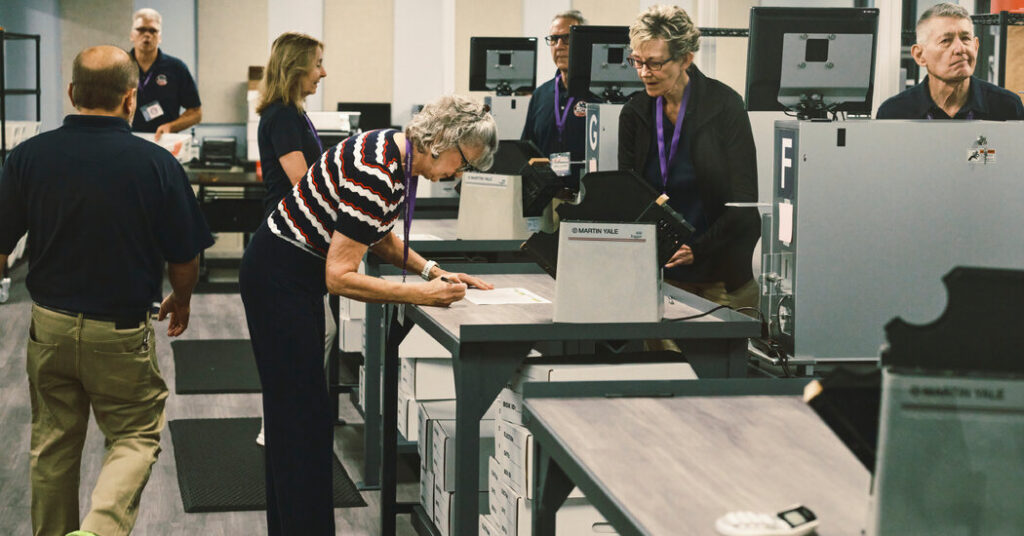
In Los Angeles County, one of the largest voting districts in the nation, elections officers have responded to the uncertainty with ballot distribution and collection plans that were deployed after the devastating Eaton and Palisades wildfires of 2025. Ideas include expanding in-person options like pop-up voting sites, places where people could request and fill out ballots.
“If this is a problem, let’s make it an administrative problem, not a voter problem,” said Dean Logan, the L.A. County registrar. “We do not want voters to be deterred from voting.”
In Arizona, Ms. Cázares-Kelly described a flood of calls from worried voters. During a briefing this week with Arizona’s secretary of state, attorney general and 15 county recorders about the proposed Postal Service mail-ballot rule, news broke of an emergency filing from the Trump administration trying to reinstate parts of the rule a court had blocked.
And in Leon County, Fla., the elections supervisor, Mark Earley, and his team had envelopes with trackable bar codes on every mail ballot, as the Postal Service wanted. But this week, when the county submitted its envelope for inspection, federal officials rejected it. Mr. Earley worries there isn’t enough time to revamp the envelopes, get the Postal Service’s approval and send ballots.
“If the rule goes into effect, we will have tens of thousands, if not hundreds of thousands of disenfranchised voters in Florida,” he said. “And nationwide, millions, without a doubt.”
Aubrey Jewett, a political scientist at the University of Central Florida, predicted there would be “chaos” that Florida hasn’t seen since the hanging chads, butterfly ballots and history-making presidential recount of 2000. He plans to drop his own ballot off at his local polling place rather than rely on the mail.
Nearly one in three Americans voted by mail in the last presidential race, and states have broad authority over how elections are conducted. But since his re-election, Mr. Trump, who voted by mail himself twice this year, has pushed to eliminate or severely restrict the option.
He set the current upheaval in motion in March, when he signed an executive order directing the Postal Service to impose new requirements on mailed ballots, including unique bar codes on ballot envelopes and lists from each state identifying voters eligible to receive ballots by mail. The Postal Service has said it could refuse to deliver ballots that do not comply.
A federal judge in Massachusetts temporarily blocked the requirements nationally on Aug. 28 while she considered whether to issue a longer injunction. That decision came four days after a divided Supreme Court allowed the Trump administration to move forward with its plans.
On Thursday in an emergency appeal, the Trump administration again asked the Supreme Court to let it move ahead, hours after the judge in Massachusetts, Indira Talwani, expressed concern that the plans could cause so much chaos in the coming elections that states would experience “major disenfranchisement.”
On Friday evening, Judge Talwani intervened for a third time, ruling that the administration’s plans are likely illegal and should not be implemented ahead of the midterms.
Meantime, a Postal Service whistle-blower said last week that the agency was rushing to build the computer system needed to enforce the new requirements in violation of court orders.
A White House spokeswoman, Lauren Bis, said any confusion around the fall elections “was caused by radical Democrats’ litigation” over “common-sense measures” to ensure election security. She accused Democrats of refusing to guarantee that “Americans, and only Americans, decide our elections.”
U.S. intelligence agencies and independent election security experts have found no credible evidence that any foreign government has successfully manipulated, altered or intercepted mail-in ballots.
Still, voters across the country are preparing for November without knowing what the rules will be. In Clark County, Wash., part of a swing House district along the state’s southern border, the elections office receives a dozen or so calls and emails a day from anxious constituents.
“The biggest thing they want to know is if things are going to change,” said Rich Cooper, the county elections manager. “We have to tell them we just don’t know yet.”
Mr. Trump has repeatedly claimed, without evidence, that widespread fraud is inherent in voting by mail. He declared in March that “mail-in voting means mail-in cheating.”
Democrats and some election regulators say even if the Postal Service doesn’t succeed with its rules this year, the uncertainty and frustration already created are the point.
“This White House is making it so hard for people to participate in the democratic process,” said Hector Sánchez Barba, who runs Mi Familia Vota, an Arizona nonprofit that helps Latino and immigrant communities engage in politics.
The befuddlement crosses party lines. Yvette Avera, a 62-year-old Republican in Temecula, Calif., usually votes by mail but has already told her family they should vote in person this year. “If I do it in person, I’ve got myself covered,” she said.
Some people have only one option. Michelle Coppadge, 54, of Rancho Santa Margarita, Calif., said she would rather vote at a polling place “where they’re verifying who you are.” But her 94-year-old mother-in-law will not be able to vote if mail-in balloting goes away because “she just doesn’t leave her home.”
The first extensive experiments with mailed ballots were in the 1980s, led by Republican leaders in rural Oregon who wanted to increase participation where voting at a centralized polling place meant long drives, often in rotten weather. Today, some Republicans blame Democratic dominance in West Coast states on the ease of mail-in balloting.
Some of the biggest fights and steepest confusion over remote voting this year are in states that could decide which party controls Congress, such as Michigan, with its heated Senate race, and Pennsylvania with its three tossup House seats.
Adia Harbert, 19, attends the University of Central Florida but is registered to vote back home in Coopersburg, Pa., where Democrats hope to unseat the freshman Representative Ryan Mackenzie, a Republican.
She said she’s eager to vote this fall but can’t fly home for the election and is worried she won’t be able to figure out the vote-by-mail system in time.
“Voting by mail is basically my only option,” she said.
The uncertainty reminds Eric Traibin, a lawyer in Orlando, Fla., of 2000, when Florida left the outcome of the presidential race unresolved for more than a month.
He said he believes mail-in balloting is safe, but still plans to vote at the polls.
“I’m just a very neurotic person,” he said.
Election officials say they’re doing the best they can to ensure the legal fights over mail voting don’t scare off or disenfranchise would-be voters, but compliance with whatever rules the Trump administration settles on has been a struggle.
So some election officials are urging voters to go back to the old ways, mixing their messages of reassurances with pleas to change voting behavior. Oregon’s secretary of state, for example, is asking state legislators for money to add ballot drop boxes and plans to encourage people to use them rather than rely on the mail.
In Alaska, many rural villages count on the Postal Service to deliver full polling places, not just ballots. This year, it’s home to one of the most hotly contested Senate races in the country.
“Even if you want to vote in person, they have to mail the literal ballot box, the voting stands with the flags on them, the pins, the stickers, the ballots, everything,” said Michelle Sparck, director of Get Out the Native Vote, a nonprofit. “This is in places where you can go three weeks without mail if the weather turns or your village clerk gets sick.”
Four years ago, the Postal Service failed to deliver ballots from six western Alaska villages in time to be counted. This year, Ms. Sparck’s organization is urging voters to request ballots early, return them as soon as possible and, when in doubt, ask their local postal clerks to hand-cancel envelopes.
“We are already struggling with some skepticism and apathy,” she said. “It doesn’t seem like any lessons have been learned.”
Reporting was contributed by Eduardo Medina, Eric Adelson and Valerie Crowder.
The post Trump’s War on Mail-In Ballots Has Voters Baffled. That May Be the Point. appeared first on New York Times.