In the White House Rose Garden last week, President Trump gathered some of the most politically endangered House Republicans for a dinner where he promised to make himself the face of the party’s uphill battle to keep control of Congress.
He was with them “100 percent — all the way until November,” Mr. Trump told the roughly two dozen lawmakers as they dined on prime aged beef burgers at tables adorned with bouquets of yellow roses. The president said he would travel to 35 key districts “to see if we can get everyone elected.”
The scene encapsulated the box that G.O.P. lawmakers have found themselves in as they stare down a bleak political environment.
They cannot afford to snub Mr. Trump, needing help from his enormous financial reserves and strong turnout from his base to win their campaigns. But they also do not want the election to be a referendum on the president, whose popularity is at a record low. And so far, he has shown little appetite for focusing on anyone’s political needs besides his own.
Two months before the midterm elections, Mr. Trump and the Republicans who have long tied their political fortunes to him appear to be at cross purposes as the party struggles to keep the House and Senate in G.O.P. hands.
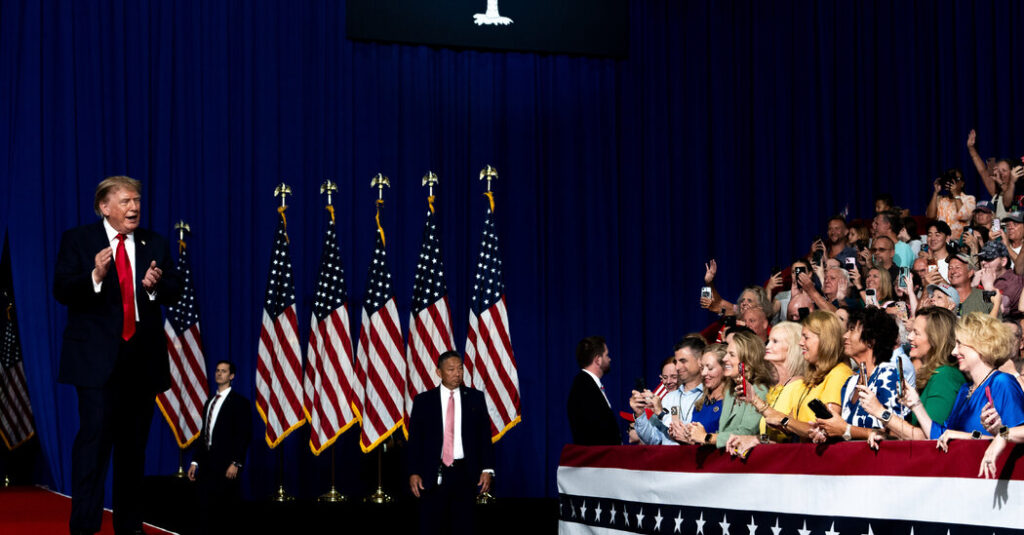
As Republicans work to distance themselves from the president’s unpopular decisions, Mr. Trump is headlining a splashy convention in Dallas this week and has said that voters should “pretend, please, that I’m on the ballot.” As the candidates work to show they are focused on the concerns of everyday Americans, the president is spending much of his time in Washington focused on the construction of a White House ballroom, a 250-foot arch and a golf course on a public park alongside the Potomac River. And as they brace for the final costly weeks of their campaigns, he has yet to dole out hardly any of the nearly $1 billion he says his political action committee has raised.
“This is my money that I control,” Mr. Trump said on Friday, suggesting he would spend between $400 million and $500 million on “Republicans that I think are good.” His political operation reported on Saturday that it had made its first expenditure, to defend a Senate seat in Texas. But beyond that, Republicans have received little information about when or where the money come.
For now, Mr. Trump appears to be focused primarily on promoting himself and boosting his popularity.
The first 30-second television spot released by his political team, the launch of a post-Labor Day ad blitz, was a case in point. It touted the president as “the toughest, most resilient person” and made no mention of Democrats, the midterm elections or any Republican candidates.
And as Mr. Trump gathers Republicans in Dallas on Wednesday for the unprecedented two-day midterm party convention, the festivities will be as much about boosting his own approval ratings and public self-esteem as it is the candidates who are actually on the ballot, a person involved with the planning said.
“The president called me two nights before Thanksgiving last fall and he said, ‘Mike, we gotta do a midterm convention,’” Speaker Mike Johnson said. “And I said, ‘That’s not a thing.’ And he said, ‘Make it a thing.’ OK. So we’re gonna do a midterm convention.”
‘A Ball and Chain’
Many vulnerable Republicans are steering clear of this week’s convention, choosing instead to spend time campaigning in their states and districts. And while some see a benefit in the confab as a way to raise money for the party — tickets cost $25,000, including for lawmakers — they also worry that it will do exactly what candidates most want to avoid: turn the election into a national conversation about Mr. Trump.
After 10 years of tying themselves to Mr. Trump, Republicans have little room to maneuver around him. Candidates up and down the ballot have embraced his lies about American elections, while few have publicly broken with him on signature issues such as spending cuts, tariffs or the war with Iran.
A White House spokeswoman disputed that there was any fissure between the president and his party.
“President Trump is the unequivocal leader of the Republican Party, who is committed to maintaining Republicans’ majority in Congress,” Olivia Wales, the spokeswoman, said.
But some Republicans fear the party has little to campaign on after two years that have yielded few legislative achievements and a spare congressional schedule that involved weeks on end at home. Some of Mr. Trump’s moves, they argue, have made things worse.
“I’m fearful that the president’s numbers are a ball and chain that will be hard to overcome,” said Representative Don Bacon of Nebraska, a moderate Republican who is not running for re-election in his battleground district. “I’m worried that we’ve lost a lot of our swing voters. In the Midwest, tariffs aren’t popular. Ukraine polls at 70 percent — why aren’t we doing more for them? Nebraskans don’t like chaos and all the name calling and treating our allies bad.”
Republicans are banking instead on portraying Democrats as socialist extremists and themselves as the sane and sober alternative. (A handful of democratic socialists have won primaries this year, though their numbers in Congress are likely to remain in the single digits.)
Mr. Johnson, who has raised $135 million this cycle, has been leaning heavily on that contrast.
“Imagine a nightmare scenario with these insurgent, Marxist Democrats taking over the Congress,” Mr. Johnson said last week while campaigning in Texas. “They would impeach the president on the first day.”
Placing Bets, but When?
The biggest question for Republicans has been when — and if — Mr. Trump will begin spending down his political operation’s prodigious resources.
Mr. Trump’s super PAC, MAGA Inc., has so far stayed almost entirely on the sidelines and has not communicated its plans, even privately.
Two of Mr. Trump’s political advisers, James Blair, a former top White House aide, and Tony Fabrizio, a longtime pollster, briefed Republican senators last month and left a strong impression that money was coming imminently, according to two people who attended the private meeting and spoke on the condition of anonymity. But little has been spent as some Republicans are growing anxious that races in North Carolina and Georgia may be falling further out of reach.
Apart from the new investment in Texas, so far Mr. Trump’s super PAC has only spent this year to boost Senator Darline Graham in last month’s Republican primary in South Carolina. The president had put his reputation on the line in that contest by endorsing Ms. Graham, but its outcome in a solidly Republican state was unlikely to affect his party’s chances of holding the Senate.
Mr. Trump’s advisers, people familiar with their thinking said, are reluctant to spend his money when House and Senate leaders have yet to drain their own campaign coffers.
Mr. Blair has been in regular contact with counterparts in the Republican leaders’ political operations to strategize about how to most effectively use the president’s funds in the midterms.
But there have been some major splits. Mr. Trump’s decision to back Ken Paxton, the scandal-tarnished Texas attorney general who defeated Senator John Cornyn in a primary this year, angered Senator John Thune of South Dakota, the majority leader, and other Republicans who saw it as making that state far more costly for the party to defend.
Mr. Thune has all but begged Mr. Trump to put some of his own resources into the race. On Saturday, MAGA Inc. reported it had begun doing so, spending $10 million on television and digital advertising in Texas.
Separation is Hard
A handful of vulnerable Republicans have sought to carefully create some distance between themselves and Mr. Trump. Unlike previous presidents who have made themselves scarce when politics demanded it, Mr. Trump has not made it easy.
Representative Mike Lawler of New York last week aired a digital advertisement that features the president calling him a “pain in the ass” for advocating the repeal of the cap on the state and local tax deduction. But Mr. Lawler is also planning to speak at the convention.
Representative Tom Barrett of Michigan bought ads on Facebook touting his votes to limit Mr. Trump’s war powers in Iran. But in July, Mr. Trump held a rally in his district and called the congressman to the stage alongside him. “I’m proud to stand with you today,” Mr. Barrett said.
A handful of other Republicans, including the party’s nominees for governor of Georgia and Maine and several running for Congress, have quietly scrubbed photos of Mr. Trump from their campaign websites or removed mentions of his endorsement — which they were happy to promote during primary contests.
But there are not many examples of Trump-era Republicans successfully distancing themselves from the president in the eyes of voters. In 2018, the last midterm election with Mr. Trump in office, he celebrated the defeat of House Republicans like then-Representative Mia Love of Utah who had been critical of him.
“The idea that you can run away from him is silly,” said Corry Bliss, who ran the House Republican super PAC in 2018, the last midterm with Mr. Trump in office. “Republicans need to have a thoughtful conversation with their voters about what they’ve accomplished. Some of them won’t have a single thing to say, and they’re the ones who will lose.”
Shane Goldmacher and Theodore Schleifer contributed reporting.
The post As Midterms Approach, Republicans Find There Is No Escape From Trump appeared first on New York Times.