Days after Chandika Shrestha’s family carried out her last rites, expecting never to find her body, a faint noise came from a house along the ravaged riverside in northern Nepal.
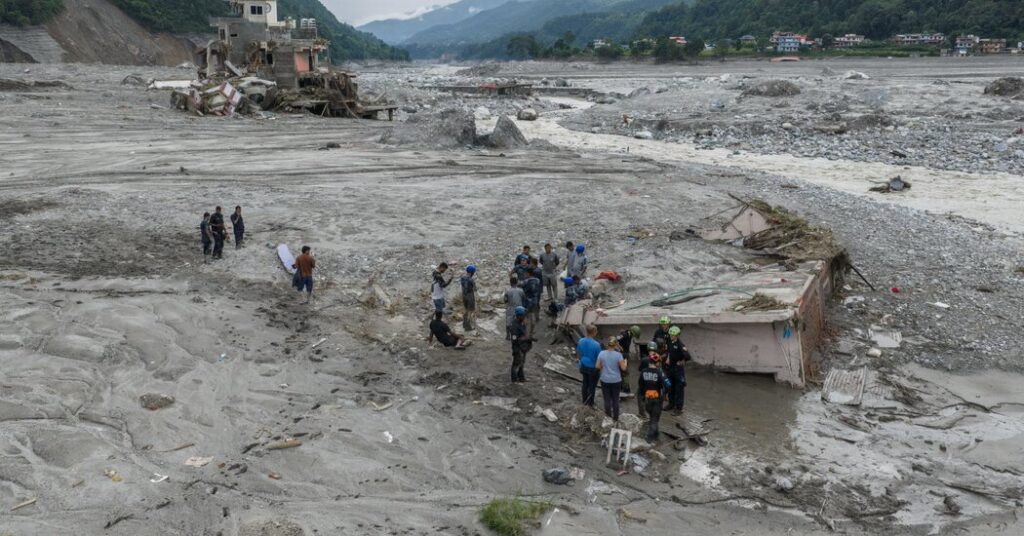
The three-story structure was almost entirely buried, with only its roof and the tip of its top windows peeking out above the sludge. But that wasn’t enough to muffle the defiant plea for help.
Ms. Shrestha was alive.
In the 10 days since devastating floods wiped out the town around her, Ms. Shrestha had clung to life under the debris. The group of locals who heard her cry on Saturday rushed to find emergency workers. Some crawled through the mud to reach an opening in the house. Others cleared a path with shovels. They gave her water, and by early afternoon Ms. Shrestha had been airlifted in a white helicopter to a hospital in Kathmandu, Nepal’s capital.
“We don’t have words to describe what this means, for how happy we are,” her nephew, Surendra Lal Shrestha, said outside the hospital.
Ms. Shrestha’s recovery was the second improbable rescue of the day.
The Nepali Army said earlier on Saturday that a joint rescue team had found a Chinese worker trapped inside a 740-foot tunnel in the Upper Trishuli-1 hydropower project. Both the Chinese worker, whose name the authorities did not immediately confirm, and Ms. Shrestha managed to stay alive well beyond the 72-hour window after which rescuers say the chances of surviving a natural disaster usually drop off.
At least 1,300 people were killed in the floods last week, when a glacial collapse in the Himalayas sent tsunami-like waves through valleys along the border of Nepal and the Tibet region of China. An additional 5,000 people are missing.
Emergency workers have in recent days focused their efforts on the several power stations that make up Nepal’s budding hydropower industry, like the one in which the Chinese man was found, because the workers trapped in them may have been better able to shelter from the force of the floods than were the thousands of people living alongside the rivers, who bore the brunt of the deluge’s force.
Ms. Shrestha — despite living immediately beside the river in one of the towns most devastated by the floods — defied those odds.
Reporters from The New York Times spent much of Friday in the town, Betrawati, which was almost entirely wiped out by the floods. Rescuers there had given up trying to find survivors among most of the ruins.
There is no trace of the bazaar that once comprised about 200 shops on either side of the river. There is nothing of the two bridges that connected both sides, or the Ram temple the locals frequented. The two-story building that once housed the police station was ripped from its roots and deposited on its side.
In the two wards that straddle the river, nearly 300 people are missing, officials said. Ganesh Kumar Nepal, a ward chair, said that workers had been stationed in the area of Ms. Shrestha’s house for search and rescue. They had visited the house earlier but had not found her, perhaps because they did not check properly, he said.
As night fell on the town on Friday, the electricity had not yet been restored to the elevated houses that survived. The town was quiet, with just the sound of crickets and the roaring of the river.
News of Ms. Shrestha’s survival on Saturday injected the town with renewed hope. People rushed to the riverbank opposite the house where Ms. Shrestha was found, eager to observe the rescue operation. Ms. Shrestha’s son Ashish Shrestha, who was at the hospital with her after the rescue, said his mother was being treated for an infection in one leg.
Three generations of the Shrestha family had run a clothing shop in the town before the floods, Shailendra Kumar Shrestha, Ms. Shrestha’s brother, said on Saturday. She had often been the one to make runs to Kathmandu, where the family bought material, Mr. Shrestha said as he waited outside the hospital where his sister was being treated.
But Ms. Shrestha was at home when the floods arrived.
When the walls of water and mud descended on the town, her husband, Ananda Lal Shrestha, ran into the streets, urging people to flee, Ms. Shrestha’s brother said. She made it to a higher floor of the house, but her husband did not have enough time. He is still missing.
Local officials and residents who observed the rescue on Saturday said they believed the house had been carried about 200 meters downstream of its original location.
Exact details of how rescuers first found Ms. Shrestha are unclear, but officials said they had been told that a group of locals were investigating what remained of the house when they heard the faint cry. Mr. Shrestha, Ms. Shrestha’s brother, said the locals had also heard the sound of clanking plates. The notion that someone could have survived inside the house was so far-fetched, he said, that the group had at first taken the noises for evidence of a ghost.
“It is generally not a place with many ghosts,” he said. “But things could have changed since this week, I don’t know.”
Ms. Shrestha’s nephew said that rescue efforts had been complicated by how deep the sludge was. The government had sent a helicopter to survey the town within days of the disaster, but rescuers on the ground had great difficulty navigating the area, with workers sinking into the mud.
He said that many had lost hope when corpses — most in such a damaged state that they were difficult to identify — started appearing in the area a week after the floods. The family had checked morgues even 80 miles downstream, looking for Ms. Shrestha and her husband, but they had not found a trace.
So on Thursday, the family came to a difficult decision. Resigned to the probability that the bodies of Ms. Shrestha and her husband would be forever lost, they gathered for a symbolic cremation, substituting sacred effigies for the loved ones they were sure had died. About 60 relatives came together for the observance.
Hundreds of other Nepali families have similarly turned to the symbolic services, with corporeal bundles of kusha grass standing in for their loved ones. But with Ms. Shrestha’s remarkable rescue, her family will now have to reconvene for a different sort of ceremony.
“Now we have to do other rituals to purify her again,” said Ms. Shrestha’s nephew, “and to undo the effects of already having held her funeral.”
Alex Travelli and Alexandra Stevenson contributed reporting.
The post The Family Had Held Her Funeral, but She Was Clinging to Life appeared first on New York Times.