Missouri’s attorney general on Friday asked the Supreme Court to clear a path for the state to use a congressional map in the November election that was redrawn to benefit Republicans.
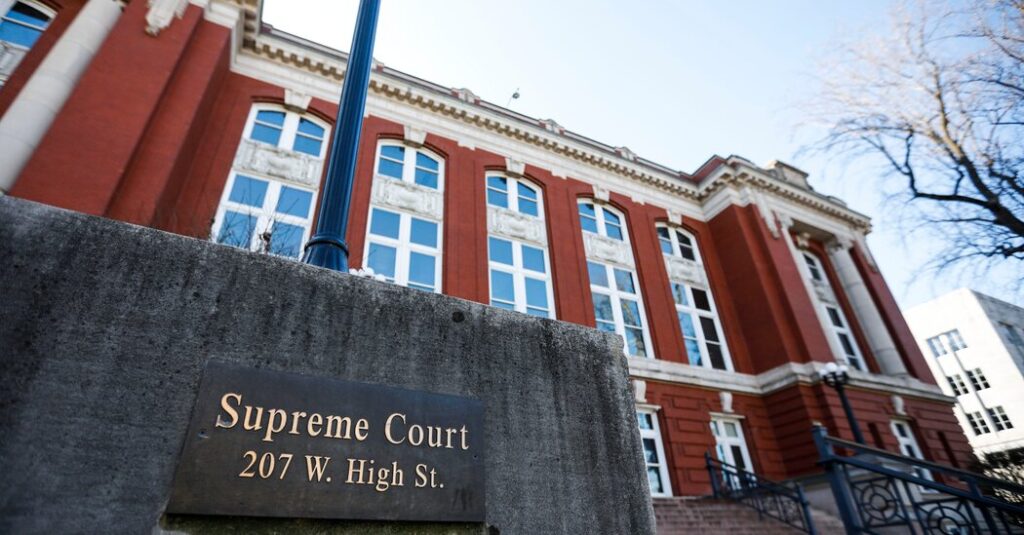
The emergency request from Catherine Hanaway, a Republican, came after the Missouri Supreme Court said that the map used in last month’s primary election was invalid, and that voters should have had an opportunity to weigh in on the new district lines.
The state court’s ruling raised questions about how Missouri could hold a general election using a different map from what was used in the primaries. At least for now, it halted Republican efforts to gain a House seat in the Kansas City area.
Ms. Hanaway urged the justices to block the state court decision, which she said “inflicts unprecedented chaos on Missouri” by disenfranchising hundreds of thousands of voters who would be moved into new districts and “forced to vote for candidates they had no role in selecting.”
”The State is genuinely unsure whether it can switch its governing congressional map in time to run a timely federal election,” she said in the late Friday filing.
Justice Brett M. Kavanaugh, who handles emergency requests from Missouri, set a quick timeline for the court to review the case, requesting a response from challengers by noon on Monday.
The new map was drawn outside the usual redistricting cycle at President Trump’s request, as part of an effort to improve the Republican Party’s chances of holding the House in the 2026 midterms.
The redrawn Missouri map, adopted by the state legislature in September 2025, sliced the core of Kansas City, Mo., the state’s largest city, into several districts in an attempt to unseat Representative Emanuel Cleaver, one of two Democrats in the state’s congressional delegation. The new map did not significantly alter the partisan makeup of the other Democratic-held district, which is in the St. Louis area.
Democrats and state residents opposed to the boundaries began collecting hundreds of thousands of signatures last year seeking a referendum on the issue. But Denny Hoskins, Missouri’s Republican secretary of state, said he did not believe redistricting could legally be subject to a voter referendum, and he declined to add it to November’s ballot.
Redistricting opponents filed lawsuits questioning the legality of the new map, saying that redistricting in the middle of the decade violated the Missouri Constitution. Democrats and their allies also sought to force a referendum, and said the state should revert to the old boundaries until one was held.
But Missouri officials said that redistricting, unlike other laws passed by the legislature, was ineligible for a referendum. They had said they would move ahead with the new boundaries unless blocked by the courts.
In a unanimous decision on Sept. 3, the state Supreme Court said that the referendum on new district lines had been improperly denied a spot on the November ballot, and that voters should have had a chance to decide the new boundaries. The judges found that the redrawn map should have been suspended until a referendum could be held.
The redrawn map “did not go into effect and will not go into effect unless and until approved by the voters,” Judge Ginger K. Gooch, who was appointed by a Republican governor, wrote in the opinion. The prior map, she added, “remains in full force and effect for the November 2026 general election.”
In her Friday filing, Missouri’s attorney general said the state court ruling would disenfranchise voters in violation of the equal protection clause of the U.S. Constitution and election-related provisions.
The post Missouri Asks Supreme Court to Allow Voting Map Benefiting Republicans appeared first on New York Times.