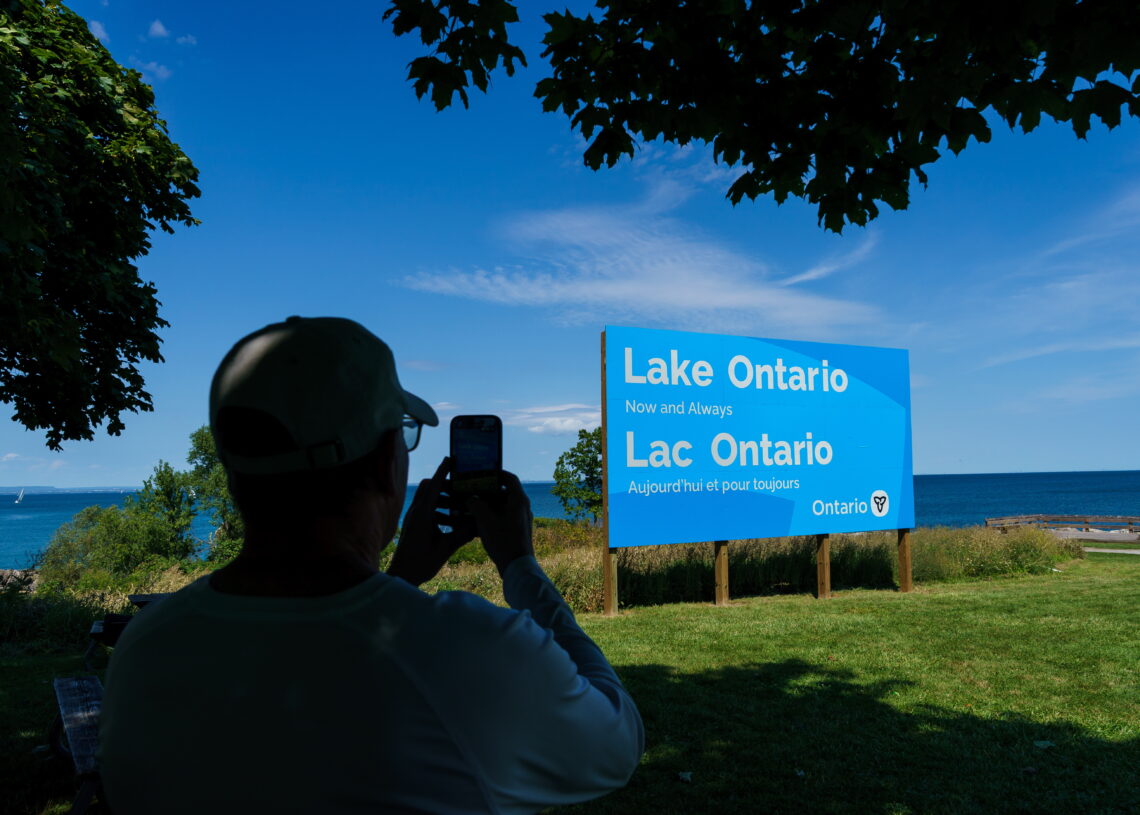
Regarding Daniel Macfarlane’s Aug. 31 op-ed, “Trying to rename Lake Ontario makes waves, little else”:
Indigenous people lived in the Great Lakes region for thousands of years. “Ontario” is an anglicized version of the Huron Indigenous people’s word “oniatarí:io,” which means “lake of shining waters.” And the lake carried a Native-derived name for centuries before the modern province existed.
Lastweek President Donald Trump signed an executive order to strip the name of Lake Ontario in favor of the generic “Lake America.” However, when monuments to Civil War confederate leaders were challenged or removed, Trump denounced it as “the history and culture of our great country being ripped apart.”
Name changes are expensive and emotional. They should be done only to correct errors, not to placate people who revere traitors. Trump’s renaming of Lake Ontario is rewriting history and robbing people of their heritage.
Eileen McClure Nelson, Burke
I was surprised to read The 7’s Aug. 31 newsletter, “Google unveils ‘Lake America’ for U.S. users.” It said the company made a similar move after Trump signed an order to rename the Gulf of Mexico to be Gulf of America.
When the president signed his executive orders, only the federal government was obligated to use the new name. But Google is not the government.
The name “Golphe da Mexique” was used over 100 years before there was a country called the United States of America. And Lake Ontario was named by Indigenous peoples centuries ago.
Places are usually named by geographical societies that follow centuries of tradition. They should not be unilaterally changed by one person with a political agenda.
Roberto Prada, Rolling Meadows, Illinois
Most college students aren’t paying $100,000
Regarding the Sept. 2 news article “More colleges, universities surpass $100,000 price”:
It should be put into perspective that only 15 schools are charging undergraduates over $100,000 for tuition, housing, books and fees this school year. The highest prices are concentrated at wealthy, selective private universities that enroll only a small fraction of U.S. undergraduates. Understanding the true cost of college requires looking beyond those institutions.
According to the American Association of State Colleges and Universities, of the 7 million undergraduate students enrolled at public four-year institutions, nearly 70 percent of them attend regional public universities. These institutions deliver on affordability. Polling conducted by Third Way in April found that nearly 1 in 3 students sampled did not take out loans to pay for school.
That doesn’t mean these students are isolated from the broader affordability challenges facing Americans. In fact, 77 percent of the group polled were worried that a financial emergency could throw them off track, and the students were using public welfare benefits at a higher rate than the general population.
To tackle the college-affordability problem, policymakers must set their sights on the institutions that serve most students — and are often doing more with less — and ensure they provide real pathways to earn a degree without taking on unmanageable debt.
Michelle Dimino, Washington
The writer is director of education at Third Way.
The best tribute to Wendell Berry
Regarding Ryan Zickgraf’s Sept. 3 online op-ed, “Wendell Berry was the prophet of the unplugged”:
There is a sharp irony in the flood of online media mourning Wendell Berry.
He famously rejected modern technologies, not out of romanticized Luddism, but out of concern for the planet’s ecological crisis and a conviction that an economy prioritizing global digital efficiency over local physical resilience is fundamentally self-destructive.
Berry’s work was not a reflection on an idealized past, but rather a blueprint for creating a more sustainable and equitable future.
To honor Berry and his heart-wrenchingly human writing, put your phone on airplane mode and step outside. Then write something, plant something or care for something that strengthens your local community.
Holly Meade-Kennedy, Kildare, Ireland
Where credit is due
The Sept. 3 online obituary for Gloria Steinem, “Gloria Steinem, lodestar of the modern women’s movement, dies at 92,” was remarkable for what it declined to share. It quoted The Post’s former columnist Maxine Cheshire on “the miniskirted pinup girl of the intelligentsia,” and it reported that when Clay Felker met the aspiring journalist, he thought “she had great legs.” But there’s one more entry the obituary should have entered.
It noted that Steinem denied writing the line most frequently attributed to her — “women need men like fish need a bicycle” — but it did not say who did. That was Australian Irina Dunn in 1970. We know Dunn said it first because Steinem said so herself, in writing. When Time magazine credited her with the sentence in its note on her marriage to David Bale, she wrote back in a letter to the editor, crediting Dunn.
To honor Steinem, remember the name she spent at least a quarter-century trying to credit.
David Woodard, Tampere, Finland
Letter submissions
Send letters to [email protected].
Submissions must be exclusive to The Post and should include the writer’s address and day and evening telephone numbers. Letters are subject to editing and abridgment. Please do not send letters as attachments. Because of the volume of material we receive, we are unable to acknowledge submissions; writers whose letters are under consideration for publication will be contacted.
The post Lake Ontario’s Indigenous name should endure appeared first on Washington Post.