PATTAYA, Thailand — Sailors from the USS Abraham Lincoln, a nuclear-powered aircraft carrier with some 5,000 people aboard, came ashore near the Thai beach town of Pattaya this week, amid reports of poor conditions and low morale.
It was their first port call after a record stint for a modern U.S. carrier of more than 260 continuous days at sea, largely in connection with the Iran war.
Locals had expected an infusion into the local economy, driven by scenes of debauchery and wanton excess among service members who had seen few opportunities to spend their earnings for nine months. But on the streets, a sense of anticlimax pervaded.
“One last push and you get to see your family,” said a sailor who had just come ashore, voicing a common sentiment among those more eager to get home than to hit the bars or the beach. He said he had not seen his family for two years.
Thailand “reminds me much of back home,” said the sailor, who is from Puerto Rico. “The weather, the beach, the humble people.”
The U.S. service members interviewed for this story spoke on the condition of anonymity because they were not authorized to talk with reporters.
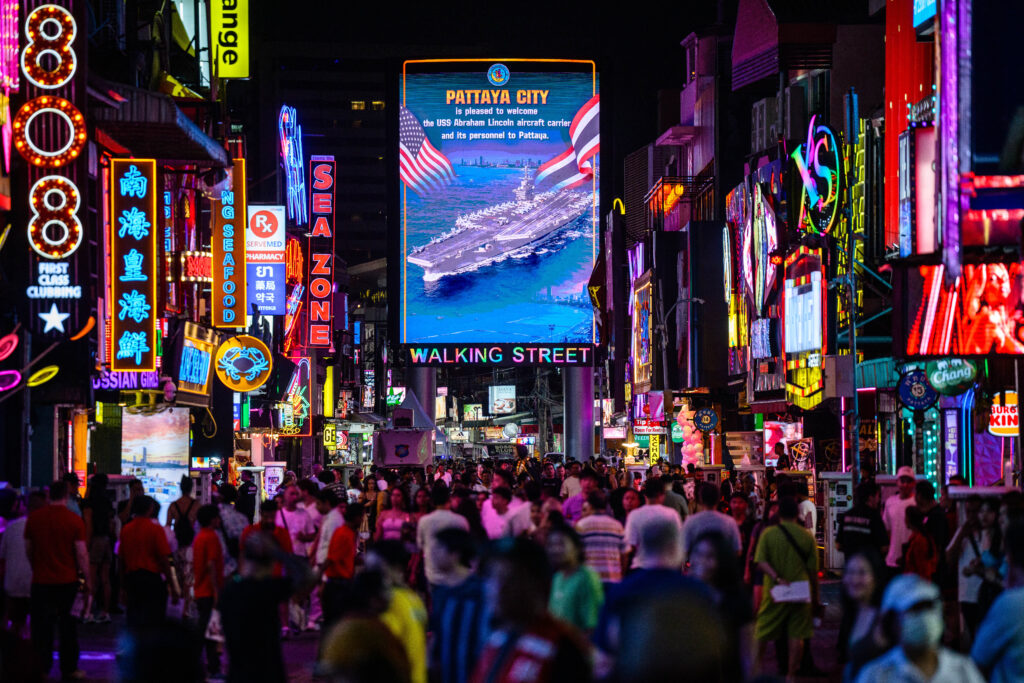
As crew members flowed into town, Pattaya, long a stop for navy port calls with an attendant reputation for vice, was awash with red, white and blue decorations to welcome the visiting vessel. The Pattaya City sign built into a nearby hillside was lit up in a likeness of the star spangled banner, while some bars hung U.S. flags and signs thanking the crew for its service.
The port call “provides a well-deserved opportunity for our Sailors and Marines to rest and recharge,” Rear Adm. Robert E. Loughran, commander of U.S. Carrier Strike Group 3, said in a statement Wednesday.
Paul Cross, an English Donald Trump impersonator, greeted the sailors at the port in nearby Laem Chabang, waving a U.S. flag and replicating the president’s dance move. Cross said he and his friends wanted to show the crew “that we were proud of them, make them smile and feel welcome in Thailand.”
Even in a country known for open, though technically illegal, sex work, Pattaya still manages to stand out — owing in part to a history interlinked with that of the U.S. military in Southeast Asia. The foreigner-facing sex industry began to flourish in the 1960s as the previously quiet beachside town was chosen as a recreation stop for U.S. soldiers fighting in the Vietnam War. When the soldiers left, the infrastructure remained. Experts and advocates estimate there are tens of thousands of sex workers in Pattaya today.
The U.S. State Department has raised concerns about human trafficking in Thailand, including in its commercial sex industry.
Thai police launched a nominal crackdown on the sex industry in Pattaya, detaining some 25 people, ahead of the visit. But open sex work was still on prominent display, including along the central Walking Street, where a government digital billboard welcomed the sailors while a police drone hovered overhead.
May to October is the low season in Pattaya, and sex workers and business owners said this year’s low season was even lower than usual. Tourism levels have fallen across Thailand year on year, especially in Pattaya, as the Iran war and Iran’s closure of the Strait of Hormuz drive up oil prices.
The influx of sailors was visible, including at go-go bars, essentially strip clubs that verge into brothels. But it was not enough to fill the seemingly endless number of such establishments in Pattaya, despite efforts by some to entice customers with U.S. flags or offers of a 20 percent discount for service members.
Some proprietors said they were waiting for a cavalry that didn’t quite arrive. The owner of one go-go bar said her establishment, in the middle of a popular nightlife area, received no apparent customers from the Abraham Lincoln on the first night of shore leave.
“The hype was definitely bigger than the reality,” she said, speaking on the condition of anonymity due to the illicit nature of her work.
“I was so disappointed,” she said. “Last time there was some ship like this … we [made] so much money.”
The sailors mainly moved in groups of two to five, as they had been asked to, and seemed to be coming ashore in batches.
The largest group that could be seen, of 30 or so, was at the Hot Tuna rock bar on Thursday, on the city’s thickly touristed Walking Street. A band played ”Free Bird” and “Hotel California” as crew members belted out the lyrics with arms around each others’ shoulders.
Some sailors out on the town drinking complained about the food on the vessel, which had in recent months become the subject of media reports and viral posts on social media, focused on scant and unappetizing offerings — a narrative the military has rejected.
Defense Secretary Pete Hegseth told reporters last month that the situation onboard had been “completely misrepresented” as he faced scrutiny from lawmakers over reports of bad conditions on the carrier, some disclosed by family members of the crew.
Thida Buttarakam, who does beachside traditional Thai massages, said this year has been particularly bad for tourism, and she received no boost from the sailors. “When U.S. Navy personnel arrive, they don’t really stop at the beach,” she said.
One sailor was overheard joking to a friend that he was too sick of the ocean to go to the beach, or even the pool.
With temperatures pushing 90 degrees on Thursday and Friday, many sailors headed for the air-conditioned Central mall, where they could be seen holding overladen shopping bags from stores of brands such as Vans, Nike, Lacoste and H & M.
The USS Abraham Lincoln is expected to reach California in mid-September.
The post After nine months at sea, a muted stay in Thailand for crew of USS Abraham Lincoln appeared first on Washington Post.