The kitchen is one of the best places to take stock of your strength, according to Chris Anderson, an exercise science lecturer at Torrens University Australia. When you lift a heavy Dutch oven off the stove and turn to set it in the sink, or reach into the refrigerator to pull out a full gallon of milk, he said, “that’s when many people realize, ‘Oh, wow, no, this was actually quite tricky for me.’”
Those movements and countless other everyday tasks rely on your ability to rotate. You twist to unload groceries from the trunk, buckle a seatbelt, swing a golf club, check a blind spot while driving or catch yourself when you stumble. Even simple movements require strength and control from the opposite side of your body. Andrew Gorecki, a physical therapist in Traverse City, Mich., said rotational weakness is one of the most common issues he sees among his clients over 50.
Yet most fitness routines only prepare you to move forward, backward and side-to-side, with exercises like squats, lunges and presses. Rotational strength exercises take your body through multiple planes at once: Some train you to rotate powerfully through your shoulders, core and hips, while others challenge you to keep your torso stable as a force tries to pull you off center (known as antirotation.)
The ability to comfortably rotate or resist rotation tends to decline with age or a sedentary lifestyle. If your thoracic spine stiffens from sitting for long hours and your deep abdominal muscles weaken, “the low back has to take over rotational demands it was not built for,” Dr. Gorecki said. Over time, that can contribute to chronic low back pain.
The exercises below, which are recommended by Mr. Anderson and Dr. Gorecki, can help you build the strength, mobility and control to rotate more efficiently in everyday life and to avoid discomfort. Choose one or two exercises and perform two or three sets after your workout. If you play a sport like golf or tennis, and want to focus on rotational strength, you can complete all the exercises as a standalone routine.
Overview
Time: 5 to 10 minutes for a few moves, or 25 minutes for the full routine
Intensity: Medium
What You’ll Need
Some of the following, depending on your exercise selection:
-
Light to heavy resistance bands
-
A light kettlebell
-
A pair of medium-weight dumbbells
-
A light to medium medicine ball
Resistance Band Trunk Rotation
Repetitions: 10 to 15 repetitions on each side
Targets: Obliques, deep core muscles and thoracic (mid-back) rotation
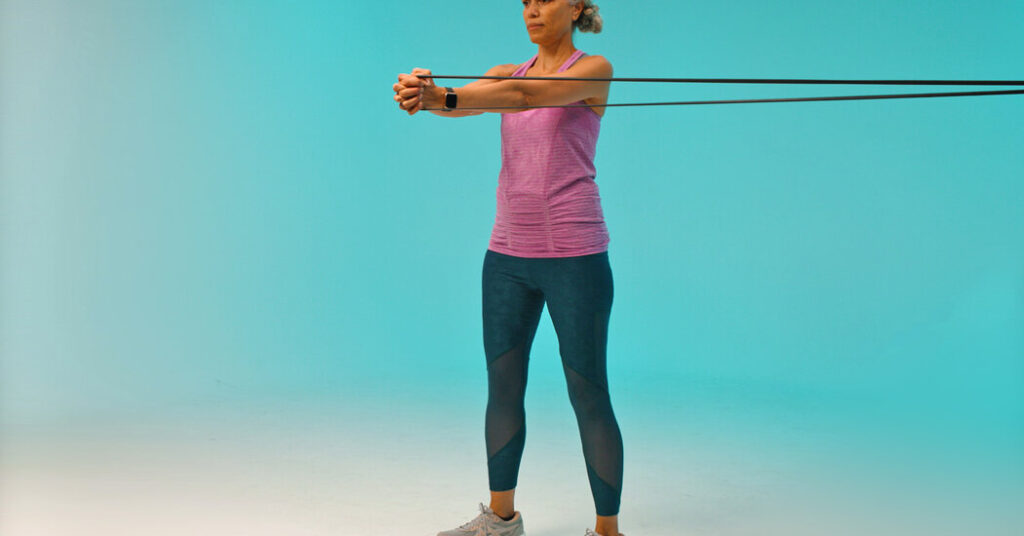
Anchor a light or medium resistance band to a sturdy object, like a door frame or a stair railing, at chest height. Grab the band with both hands and stand about an arm’s length away. Position your body with one side toward the anchor, then extend your arms away from your chest. Keep your hips stable and your arms straight, with a slight bend in your elbows. Twist through your trunk and rotate away from the anchor as far as you can without letting your feet turn. Slowly return to center, keeping your arms extended and your core braced.
For more of a challenge, step farther away from the anchor or hold the fully rotated position for two to three seconds.
Pallof Press
Repetitions: Eight to 10 repetitions per side
Targets: Deep core muscles and spinal stability
Anchor a medium resistance band to a sturdy point at chest height. Stand sideways to the anchor point, about an arm’s length away, with the band held in both hands at your chest. Keep your feet shoulder-width apart, your knees slightly bent and your core braced. Slowly press the band straight out in front of your chest, arms fully extended. Resist the pull of the band toward the anchor and keep your hip bones pointed forward. Hold the pressed position for two to three seconds, then bring it back to your chest.
Shin Box Rotation
Repetitions: 30 seconds
Targets: Hip external and internal rotation
Sit on the ground with your knees bent and your feet flat on the floor in front of you. Place your hands on the floor, slightly behind you for support. Without lifting your hips, rotate both knees to the left until your legs form 90-degree angles. The bottom of your left foot should lie next to the top of your right thigh. If your legs don’t touch the floor, you can lean back slightly while keeping your back straight. Pause, then rotate back through the center. Repeat on the other side, lowering your knees to the right. Move slowly and with control, allowing the movement to come from your hips, while keeping your core engaged.
To make it more challenging, lift your hands off the floor. If your back rounds or you lose your balance, put your hands back on the floor.
Banded Wood Chop
Repetitions: Eight to 10 reps per side
Targets: Thoracic spine mobility and deep core strength
Anchor a light-to-medium resistance band at a sturdy point at head height. Stand with your feet shoulder-width apart, knees slightly bent. Grab the end of the resistance band in both hands and bring your hands up to one side of your head. Rotate your torso as you bring the band diagonally down and across your body toward your opposite hip. Keep your hips relatively still and focus on rotating through your mid-back and core, rather than swinging your arms. Slowly return to the starting position and repeat.
Standing Rotational Press
Repetitions: Eight to 10 per side
Targets: Shoulder strength, core, and hip mobility
Stand with your feet slightly wider than shoulder-width apart. Hold a kettlebell or dumbbell in your right hand at shoulder height, with your elbow bent and the weight close to your body. Rotate your hips and shoulders to the left and press the dumbbell toward the ceiling. Allow your right heel to lift so you can pivot on the ball of your right foot as you turn. You can keep your left hand on your hip or hold it out to the side to counterbalance the weight. Reverse the movement slowly, bringing the dumbbell back to your shoulder and returning your right heel to the floor.
Rotating Medicine Ball Slam
Repetitions: 30 seconds
Targets: Upper body strength, rotational power
Hold a medium-weight medicine ball at your chest with both hands. Shift your weight to your right foot as you raise the ball to your right shoulder. Swing the ball overhead, extending your arms as you rotate to the left through your shoulders and hips, slamming the ball into the ground in front of your left foot. Your right foot should pivot as you shift your weight into your left foot. In the end position, your hips should be facing your left foot and your hands should be angled toward the ground. Pick the ball up (or retrieve on the bounces) and repeat on the other side, flowing back and forth.
On-set trainer: Amanda Katz
The post 7 Moves to Build Rotational Strength appeared first on New York Times.