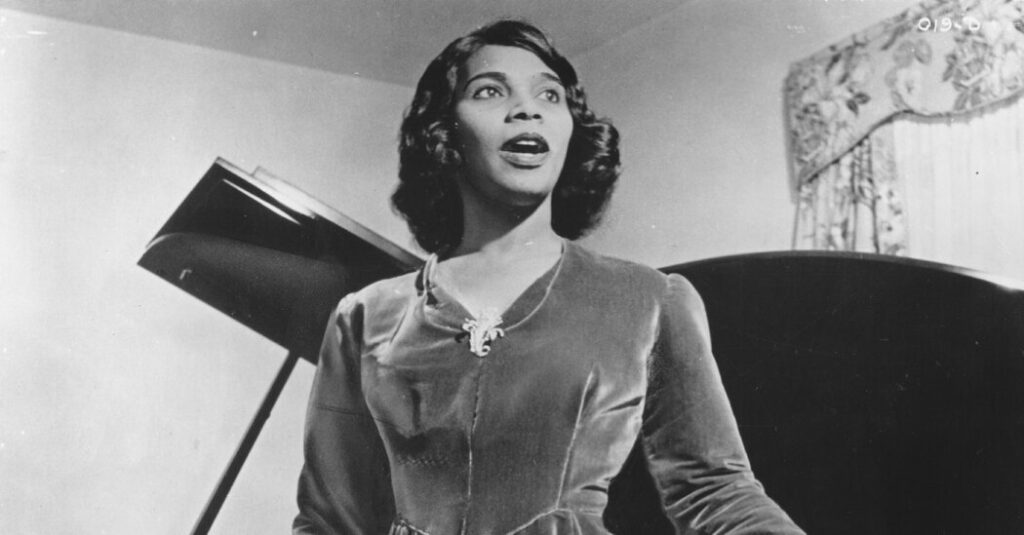
Something extraordinary took hold of Marian Anderson when she entered a New York studio on a summer day in 1941 to record the wrenching spiritual “Crucifixion.” She had grown up singing spirituals at her Black Baptist church in Philadelphia. But this one had special meaning. During Anderson’s childhood, ministers in churches like hers often likened the horrific lynchings of Black Americans to crucifixions.
Whatever possessed her that day in 1941, Anderson sang “Crucifixion” with an uncanny blend of anguished emotion and magnificent vocalism. A believer, Anderson clearly identified with the text, which focuses on Jesus’ reaction to the charges against him and the punishment he suffered: “Dey crucified my Lord/And he never said a mumblin’ word.”
That is, Jesus said not a single “mumblin’ word” in his defense. “Not a word,” the spiritual continues, sung on a sinking melodic refrain repeated three times for emphasis.
The arrangement by John C. Payne that Anderson favored calls for a slow, steady tempo. But, with her sensitive accompanist Franz Rupp, Anderson takes it so slow that you wonder how the music does not turn limp and lose any sense of direction. Yet her singing is so mournfully, tremulously intense you hang on every moment.
We learn more in the remaining two verses: “Dey pierced Him in the side,” and “He bowed his head and died.” Still, he said “not a word.” With the last repetition of this phrase, Anderson, like a jazz singer, lets her voice slide down to a final, chilling low note, resolutely sustained, as if she cannot bear to let it go, but must.
Though it lasts only four and a half minutes, this is one of the most profound vocal recordings of the 20th century — and I had never heard it until I began immersing myself in Anderson’s music.
When Henry Louis Gates Jr. invited me to write about Anderson for “Significations,” a series of books about major Black figures he’s editing for Penguin Press, I thought I understood the essentials of her awesome artistry, pathbreaking career and inspiring life story. Yet, I was struck over and over by the gaps in my knowledge.
Anderson (1897-1993) won renown as a true, rare contralto with a rich, resonant low range who could also soar into the soprano sphere. Yet from the start, just being an excellent singer was not enough. Her ambition was to became a “fine artist,” as she always put it, and “a credit to my race in every way possible.” That took tenacity and endurance.
The mezzo-soprano Betty Allen once said that Anderson was “the mother of every Black singer,” the one who “made everything possible.”
“She opened all those doors that had been closed,” Allen said, “all the hotel rooms that wouldn’t come open for us to stay in, all the halls that people said we couldn’t sing in, you were now able to sing in.”
But acquiring a reputation as a pioneer can sometimes overshadow an artist’s achievements. Something like this happened to Anderson. How many classical music devotees today know of her piercing, vocally melting 1950 recording of Mahler’s “Kindertotenlieder” with Pierre Monteux conducting the San Francisco Symphony? I’ve become obsessed with it. Then there are her recordings of Schubert, Schumann and Brahms lieder, Bach and Handel arias, Scandinavian songs in the original languages — all marvelous.
And, of course, her overwhelming accounts of spirituals, which W.E.B. DuBois called sorrow songs. Anderson ended every recital with a group of them, to demonstrate that they merited a place on any program of European art songs.
Today Anderson is surely best known for one short concert on Easter Sunday, 1939. After Anderson was barred from appearing at Constitution Hall in Washington by its owners, the Daughters of the American Revolution, because of her race, activists pushed to have her sing instead on the steps of the Lincoln Memorial, a concert broadcast live on national radio. Anderson, who had long been reluctant to speak out forcefully about segregation, was wary. As the date approached, she feared that this “affair,” as she called it, had morphed into a civil rights demonstration and would come to define her. To a large extent it has.
More than 75,000 people, Black and white, gathered before the memorial and around the Reflecting Pool. The cultural historian Scott A. Sandage has written that the modern civil rights movement “came of age” that day, noting that Anderson’s concert was “the first black mass action to evoke laudatory national publicity and earn a positive place in American public memory.”
It’s telling that the longest work she performed on this 30-minute program was “O mio Fernando,” a challenging, still little-known aria from Donizetti’s opera “La Favorita.” After opening the concert with “America,” she went right into the Donizetti, which had become Anderson’s unlikely go-to piece to demonstrate her vocal technique and dramatic flair.
This Italian aria must have mystified most of those in the crowd, and many radio listeners too. Anderson had sung to acclaim in the major halls and capitals of Europe. That day, with this seven-minute aria, she was going to show why she had become famous and wealthy. Newspaper reporters observed that many in the crowd, however uncomprehending, seemed mesmerized by Anderson’s brilliant singing of Donizetti’s music, replete with arching melodic lines, daring leaps, fleet runs, even a final trill.
In her letters and memoir (1956), Anderson reiterated that it was artistry that drove her as she pursued what, for a Black woman of that era, was an improbable career as a concert singer. In her early teens she had an epiphany about the nature of true artistry when the noted Black tenor Roland Hayes, 10 years her senior, sang a recital at her church. Hayes, who had studied and performed in Europe, included lieder, especially Schubert, on his program.
Though his listeners were impressed by his voice, few had any idea what he was singing about in German. Neither did Marian. She didn’t care. She simply imagined what the songs were about, she said in her memoir. She was entranced by the music, not just its subtle, complex beauties, but also surely by the subliminal stirrings, the sense that below the often cheerful surface of a Schubert song are hints of sadness, longing and loneliness. Artistry may be an elusive quality to define, but for Anderson, Hayes’s singing embodied it. She had to find out more, to probe this music’s secrets.
She tried to educate herself the traditional way by showing up at a musical academy in Philadelphia at about 17. A snippy, young receptionist told her, “We don’t take colored.” In that moment, Anderson was hit with the “full realization of what it could mean to be a Negro,” she recalled nearly 50 years later to a journalist friend, Emily Kimbrough. “I tell you the shock was the most terrible I’ve ever had.”
Instead, Anderson took private lessons, sometimes supplemented by funds collected at church for her education. Her drive to become a fine artist took her to London in 1927, then to Germany and Austria, to study with master coaches and musicians, and to learn about this music in the lands where it was created. Anderson spent most of the early 1930s in Europe, studying and concertizing with increasing success. “Marian fever” gripped Scandinavia.
Keeping the pursuit of artistry paramount led to the most distressing personal and professional breakup of her life, in 1935. Since the early 1920s, Anderson’s regular accompanist had been Billy King, a Black pianist, voice coach and church choir director in Philadelphia. King had cultivated a network of Black churches and colleges in the South where he and Anderson toured in the 1920s. When Anderson started performing in theaters like Carnegie Hall, Billy remained her partner.
But early into her sojourn in Europe, with King back home, Anderson was paired with Kosti Vehanen, a Finnish accompanist and composer. Vehanen went with Anderson on extended tours, even to the Soviet Union. He introduced her to Scandinavian songs and brought her to Sibelius’s home outside Helsinki to sing his songs to him. By 1934, Anderson was a client of the powerful manager Sol Hurok.
King, fearing that Anderson would continue with Vehanen, lashed out in bitter letters, arguing that she would be making the mistake of her life to bring a white pianist to accompany her in America. “What do you think the Negro press will do to you?”
But artistically Anderson had moved to another level. So she made the “difficult, even painful decision” to keep Vehanen as her regular accompanist. She knew it would be “open to misunderstanding” and that “some of my own people might be offended.” But she trusted they would respect her artistic choices, and this is largely what happened. Vehanen, who worked with Anderson until 1940, was at the piano for the Lincoln Memorial concert.
Her artistic core and sure dramatic instincts also got Anderson through one of the most high-pressure debuts in opera history, when in January 1955 she became the first Black singer to perform in a production at the Metropolitan Opera, as Ulrica, a supporting but crucial role in Verdi’s “Un Ballo in Maschera.” Rudolf Bing, the company’s general manager, knew the time had come to make this move, well aware of the reaction he might get from stodgy, prejudiced patrons.
Though she was nearly 58, had no experience in opera, and shared the stage for her debut with luminaries including Richard Tucker and Zinka Milanov, Anderson held her own and then some, as a live recording of a later performance suggests. She also brought uncommon dignity to Ulrica, a fortune teller, a seer, a character who easily slips into caricature.
A striking photo from late 1954 shows Anderson in rehearsal with the Met chorus during Ulrica’s one big scene, when she summons her fearsome powers, arms outstretched. Anderson is surrounded by white faces. The image almost proclaims that Marian Anderson has arrived, and that the Met, opera in America, even America itself will have to change.
But it was a bittersweet triumph, come too late. “I wanted to sing in opera,” she told Kimbrough in 1960, but “they wouldn’t accept it, or me.” Still, “Other Negroes will have the career I dreamed of, because this is one more barrier that’s been let down.”
One of the most touching details I found appears on the 1943 marriage certificate Anderson filed with Orpheus Fisher, her longtime partner, an architect, for a small private wedding ceremony near their home in Danbury, Conn. For her occupation, she used a single word: artist.
Anthony Tommasini is the former classical music critic of The New York Times. His book, “Voice of a Century: The Life and Artistry of Marian Anderson,” comes out on Sept. 8.
The post Marian Anderson’s Ambition Was Always Clear: To Be a ‘Fine Artist’ appeared first on New York Times.