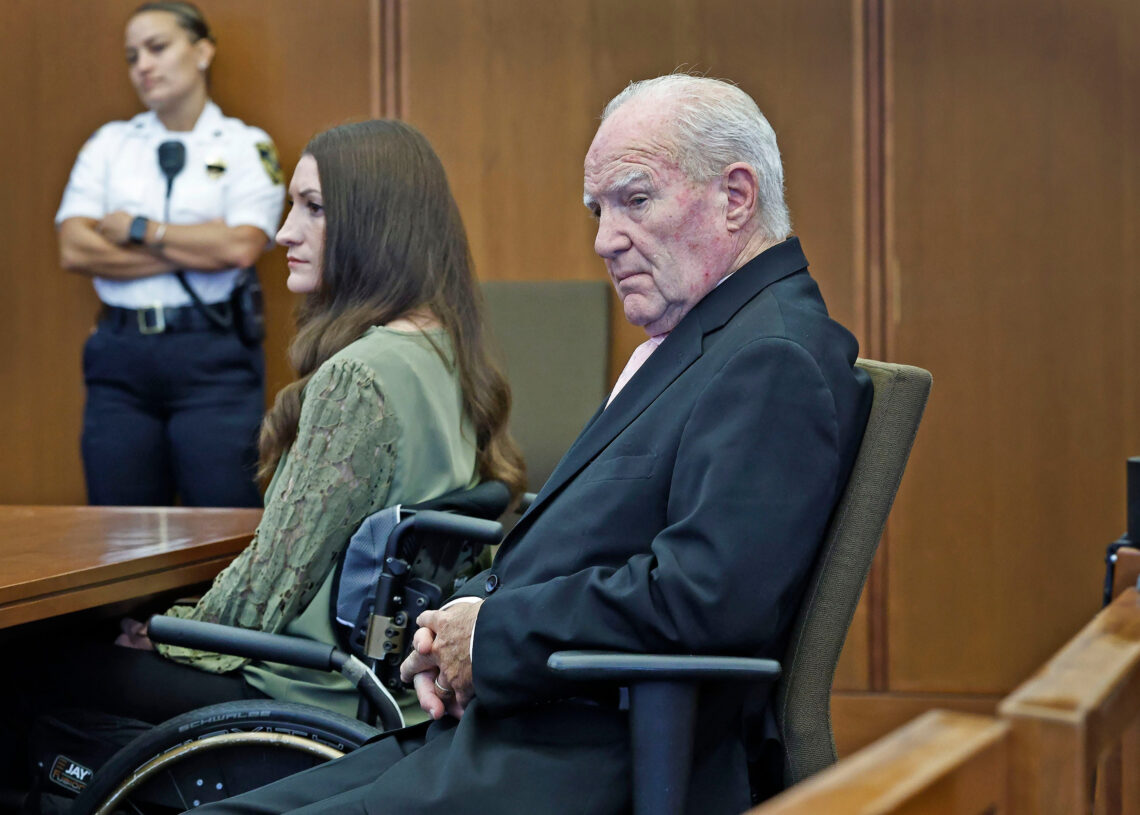
The high-profile trial of Lindsay Clancy ended in a mistrial Friday after a Massachusetts jury could not reach a unanimous decision in the triple-murder case.
Judge William Sullivan dismissed the jury shortly after 2 p.m., thanking them for their service after deliberations hit nearly 40 hours in a trial that stretched more than six weeks.
Clancy’s case captured the public’s attention for the nature of the crimes and became a cultural touchpoint, putting postpartum mental health issues in the spotlight. She has admitted to killing her three children — Cora, 5; Dawson, 3; and Callan, 8 months — and the jury was tasked with deciding whether to accept her insanity plea.
Prosecutors must now decide whether they want to try the case again.
The trial was plunged into chaos for several hours Friday after Sullivan said he was going to declare a mistrial, and Clancy’s defense attorney rushed to block that from happening.
At issue were the actions of a lone juror who Clancy’s defense argued was not following orders from the judge in regard to reasonable doubt.
Attorneys for Clancy submitted an emergency petition to the Massachusetts Supreme Judicial Court, asking it to order Sullivan to further scrutinize the juror or prevent them from continuing to deliberate until the judge can determine that the person is able to follow the court’s instructions.
They said the higher court’s involvement was needed to prevent “an avoidable mistrial of a case that is so time and labor intensive and that has captured so much public attention.”
Hours later, the appeal was denied, clearing the way for the mistrial.
Plymouth County District Attorney Timothy Cruz said in a news conference that a decision on whether his office would retry the case would not be made Friday. Prosecutors in such cases may review how the trial unfolded and speak to jurors before making a decision on a retrial.
If the prosecution decides to try Clancy again, the trial would need to effectively restart, with a new jury selected to hear the case.
“Our priority has always been to fight for Cora, for Dawson and for Callan,” Cruz said. “Children were murdered, and it’s our job to seek justice.”
What happened Friday morning
Earlier Friday, Sullivan declined to remove or further question the juror that the defense said was holding up a not-guilty verdict. After jurors for the third time this week said they were unable to come to an agreement, Clancy’s attorney Kevin Reddington asked for the jurors to be sent back to deliberations.
But Sullivan objected, moving to bring the case to a conclusion.
“Over the defendant’s objection, I’m going to declare a mistrial at this point,” Sullivan said.
But before Sullivan brought the jury back to the courtroom, Reddington made a dramatic appeal for the court to halt proceedings.
Reddington was then given an hour to petition a higher court. He cited a Massachusetts law that gives the state’s Supreme Judicial Court “general superintendence,” and the ability to prevent and address issues in lower courts when there is no other option available.
“What I’m asking for is time to file a single justice appeal for this travesty,” Reddington said. “That’s what I’m asking for.”
Tensions flare over juror
On Thursday, a jury foreperson sent a note to the judge indicating that a juror had acknowledged doubt in the case but was refusing to apply it to the verdict. The note was the first public indication that the jury was being held up by a lone juror.
Sullivan called the jurors into the courtroom one-by-one Thursday, swore them in and asked them to affirm that they were able to carry out their duties in accordance with the law.
He then brought the jurors together to read them instructions that spell out their obligations, and the meaning of reasonable doubt: a legal standard that requires jurors to be fully convinced of guilt based on evidence if they convict.
Reddington argued that the juror should be removed for failing to comply with the judge’s orders.
“If we come back here in a half an hour with a mistrial because of a juror that has just spurned the instructions of this court, it’s a shame,” he said on Thursday.
On Friday morning, Reddington pressed Sullivan to question the juror further, pointing to the rare decision by the foreperson to alert the court about the state of deliberations.
The foreperson is the juror tasked with leading the jury and announcing its final verdict.
“I have never seen a situation like this where a foreperson on the jury is so courageous as to speak on behalf of 11 jurors and indicate that juror number — which I will not mention — and I quote, ‘has made statements acknowledging doubt, but refuses to apply it to the verdict as the law states,’” Reddington said.
But Sullivan declined to further question the juror, saying his inquiry of all the jurors on Thursday was enough.
“This is not a case that there’s any indication that the juror has refused to deliberate, or has indicated that they would not follow the law, or that they’re physically suffering. There’s no note from the juror that indicates that the juror cannot or will not be able to continue deliberating,” Sullivan said. “So I’m not going to do a further inquiry of this juror, over the defendant’s objection.”
Case ends in mistrial more than three years after killings
The trial centered on the events of Jan. 24, 2023.
After spending the day with her children, Clancy asked her now ex-husband to pick up dinner because she was too tired to cook. He was gone less than an hour, and in that time Clancy took her three children to the basement of their home and strangled them to death one by one using exercise bands.
She then went to the second floor of their home and made an attempt on her own life, using a knife to slice her neck and wrists, swallowing pills and jumping from their window. She is paralyzed from the waist down after sustaining a spinal injury in the fall.
The trial focused heavily on Clancy’s mental state on the day the killings happened. She would later tell her husband that she heard a voice telling her to kill her children and herself, a claim that formed the basis of her insanity defense. The trial included detailed accounts of her mental health struggles from people in all areas of her life, including friends and care providers.
During the trial, expert psychiatric witnesses were split on whether she suffered from bipolar disorder and postpartum psychosis.
Dozens of witnesses testified across roughly three weeks of testimony between July and August.
At a news conference after the mistrial Friday, Reddington said he was representing a “fantastic, wonderful individual” who he further described as brave.
The post Lindsay Clancy murder trial ends in mistrial despite dramatic appeal from defense appeared first on Washington Post.