A military court in a Russian-occupied region of Ukraine sentenced four soldiers on Monday to prison terms of up to 12 years for the gruesome murder of a self-avowed American Communist from Texas who had spent a decade as a mercenary and propagandist for Moscow.
The killing proved embarrassing for the Kremlin because the victim, Russell Bonner Bentley III, 64, who moved to the Donbas region of Ukraine in 2014 after Moscow started a separatist conflict there, had been a regular guest on state television, extolling Russia’s case in his Southern drawl.
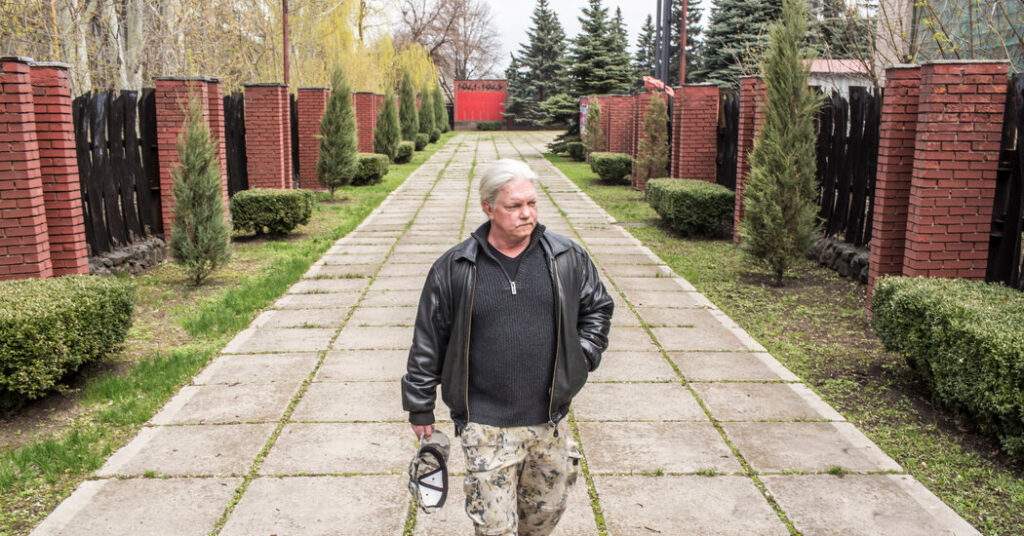
Mr. Bentley, who called himself the “Donbas Cowboy,” disappeared in April 2024 after going to survey the aftermath of an artillery strike in downtown Donetsk, the city in the eastern region where he lived. Two of the convicted soldiers had found him preparing to film the scene and suspected he was an American saboteur, according to an investigation cited in court.
When the men demanded identification, Mr. Bentley explained that he was working for Russia’s state-run Sputnik news agency, the court heard. The two soldiers drove him to their command post, where he was detained, beaten and tortured to death, investigators said.
The perpetrators then put him in a car and blew it up, trying to make it look like an artillery strike, and the next day two other men burned the corpse, according to the investigation.
The Donetsk Garrison Military Court convicted the soldiers under the Russian criminal code and sentenced two of them, Maj. Vitaly Vansyatsky and Lt. Andrei Iordanov, to 12 years in a penal colony, while another, Sgt. Vladislav Agaltsev, received an 11-year sentence, according to the official Tass news agency. The three were also stripped of their military ranks. A fourth soldier was sentenced to 1.5 years in prison for helping to cover up the crime.
In addition, the court awarded Mr. Bentley’s widow, Lyudmila Bentley, a local English teacher whom he married in 2017, the equivalent of more than $65,000 in civil damages, Tass reported. Ms. Bentley has denied all interview requests.
Mr. Bentley called himself a Communist and became something of a folk hero in the Donbas, according to Western news media, including Texas Monthly and Rolling Stone, which interviewed Mr. Bentley during his years in the region and described his life in the United States and after he moved to the occupied territory. One of his trademark phrases was “I hate Nazis.”
In the United States, he had been a marijuana legalization activist and carried out a quixotic campaign for the U.S. Senate from Minnesota in 1990, garnering almost 30,000 votes. He was imprisoned after a conviction for felony marijuana trafficking, according to a profile in Texas Monthly magazine.
He later grew convinced from reading pro-Russia social media posts that the government in Kyiv was a den of Nazis, and he decided that he wanted to fight them, according to several profiles of him in Western news outlets.
He emigrated from Round Rock, Texas, a town just north of Austin, in December 2014, the profiles said. Using the call sign “Texas,” he fought for Russia’s Vostok Battalion, which accepted foreign fighters, for three years, and then decided that, at his age, he was better suited for the information wars. He became a Russian citizen in 2020.
At the time of the full-scale Russian invasion of Ukraine in February 2022, he was producing a flood of posts about the conflict brimming with disinformation. In a YouTube post later deleted by the platform, he extolled Russian soldiers as liberators.
In a separate post on Vkontakte, the Russian equivalent of Facebook, quoted by Rolling Stone, Mr. Bentley wrote that he was “heading west with the Liberators of Ukraine.”
“We may stop in Kyiv, we may stop on the English Channel,” he said. “We may liberate the USA.”
Milana Mazaeva contributed reporting.
Neil MacFarquhar has been a Times reporter since 1995, writing about a range of topics from war to politics to the arts, both internationally and in the United States.
The post 4 Russian Soldiers Sentenced to Prison for Killing Texan Who Fought for Moscow appeared first on New York Times.