In late summer, when almond husks split open, workers at Creekside Farming in Madera gear up machinery to shake the trees. Tractors zoom around, fallen nuts are collected, and trucks cart off the bins of almonds.
The whole process relies on diesel fuel, which has grown extremely expensive in recent months, said farm owner Jay Mahil, whose family has been growing wine grapes, citrus and other crops in the Central Valley for four generations.
The national average price of diesel hit a new record high of $5.85 per gallon Friday, while California’s average climbed to about $7.71, according to AAA motor club.
The oil product undergirds much of the global economy, and California, a major player, is no exception to the pain caused by ongoing supply chain disruptions stemming from the U.S. war with Iran.
The higher fuel costs are squeezing businesses across various industries in California, which has massive trucking and agricultural sectors that rely heavily on diesel to power equipment.
Mahil said his fuel costs are up 40% from this time last year.
“These higher costs come at the worst time for us, “ Mahil said. “These are highly inundated time frames.”
Mahil keeps a close eye on prices. When there’s an occasional slump or dip in the oil market, he orders several truckloads of fuel. But other businesses usually have the same idea, and the fuel depots often run out those days.
“We are running a little leaner right now, with less oil in the tanks,” Mahil said.
California diesel prices set a new record earlier on in the war, at around $7.75 in April.
Greg Dubuque, general manager for a trucking fleet based out of Montebello, noted that the cost to fill his trucks in California has gone from around $1,200 in April to $1,800.
“It’s a dramatic impact, especially for us smaller companies,” he said.
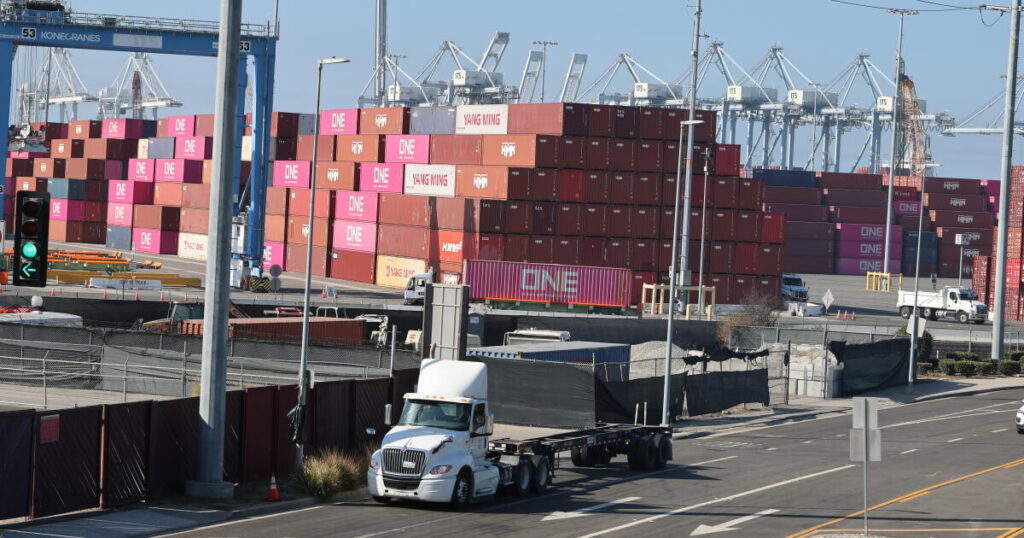
Gene Seroka, executive director of the Port of Los Angeles, said more than two-thirds of cargo moving in and out of the port is carried by trucks. And of the some 1,200 trucking companies that do business at the port, more than 50% are small to medium-sized companies that are seriously struggling with prices, Seroka said.
“It’s difficult for companies to absorb such an energy shock as we’ve seen over the past six months,” Seroka said.
The turmoil in the Persian Gulf region is forcing cargo away from the Suez Canal and onto a longer route around the southern tip of Africa, creating longer transit times that burn more fuel and drive costs up further, Seroka said.
Increased diesel prices are pushing up the cost to transport food. Frozen and refrigerated goods, such as fresh produce, are most sensitive to price increases because diesel is typically used to power both cold storage and transportation.
Nick Vyas, supply chain expert and professor at USC Marshall School of Business, said that while companies try to absorb some of the cost increase, grocery prices are starting to tick up in stores.
Though grocery costs may decrease slightly once fuel costs stabilize, they are unlikely to return to pre-conflict baselines as retailers adjust to higher prices, Vyas noted, pointing to sustained increases in food costs post-pandemic.
With American refiners funneling the fuel oil into international markets, the domestic supply has dwindled, driving up prices. Diesel prices jumped 7 cents overnight, 24 cents in the past week, 48 cents in the past month and $2.14 compared with this time last year, according to AAA.
Kandace Redd, a AAA spokesperson, said the organization’s past research shows that consumers are most likely to drive less, combine errands, and reduce shopping or dining out to cope with record pump prices.
Diesel prices in California are typically above the national average as the state faces cost pressures from higher taxes and environmental standards, Vyas said. Because around 40% of goods imported in the U.S. pass through the San Pedro and Long Beach ports, California’s energy costs also expose the rest of the nation’s supply chain to these increases.
Larger companies are better poised to absorb some of the shock of increased prices through higher profit margins and the ability to buy in bulk, Vyas said. Mom-and-pop businesses, such as small trucking fleets or family farms, are hit harder.
“When you’re a large national truckload carrier, the J.B. Hunts and the Swifts and the Werners of the world, they do a lot of hedging on fuel,” meaning they establish advance agreements to purchase fuel at a fixed cost, Dubuque said.
His smaller fleet of 40 trucks, on the other hand, is generally stuck paying the price at the pump.
Dubuque is taking several steps to try and mitigate the impact. This includes explaining the rising cost of doing business to his customers, avoiding refueling in California where possible and using alternative fuels to power air conditioning in trucks overnight.
But as the manager of a smaller company, he is nervous about how long these strategies will work if diesel prices don’t start dipping.
A similar disparity is seen when it comes to the impact of rising diesel prices on consumers, Vyas noted. For low-income households, any uptick in grocery prices will stretch already strained budgets, while wealthier consumers may not notice the change.
Economist Christopher Thornberg has a more optimistic outlook on the impact of rising fuel prices on the average consumer. He pointed out that fuel prices have been notably low in recent years. He said the current diesel spike is not exceptionally high when put in the context of inflation-adjusted averages over the last two decades.
“Sure, it’s a shock from where it was six months ago, but from a long-run perspective, once you control for price growth, it’s not a big deal,” he said.
Inflation-adjusted diesel prices have reached higher than the current $5.85 national average per gallon. The 2008 peak of $4.74 a gallon is equivalent to $7.20 in today’s dollars, while the more recent 2022 peak of almost $5.82 would be about $6.56 today.
And while certain industries like trucking remain reliant on diesel fuel, alternative energy sources and increased domestic oil production have made the American economy as a whole less sensitive to fluctuations in global fuel prices compared to past energy crises, he noted.
Nonetheless, news of a new record high in national diesel prices is likely to disturb consumers and carry political ramifications for the current administration, Thornberg said.
AP-NORC polling shows that around two-thirds of Americans disapprove of Trump’s handling of the economy. The continued surge in diesel and oil prices is unwelcome news for the Republican Party heading into November’s Midterm Elections.
The Associated Press contributed to this report.
The post U.S. hits diesel fuel milestone as prices slam California economy from trucks to crops appeared first on Los Angeles Times.