A US Army commander wrote in a new opinion article that a recent combat training exercise against Ukrainian soldiers showed that armor like infantry fighting vehicles and tanks can still survive and make a difference on battlefields swarming with drones, but troops have to be able to adapt, to flexibly change how they move, hide, and fight.
During the simulated battle, his troops saw how persistent drone surveillance exposed their movements and put their combat vehicles at risk. But the soldiers also learned and adapted, the commander said.
On Friday, Capt. Allan W. Watson, the commander of Blackhawk Company, 2nd Battalion, 7th Cavalry Regiment, wrote an op-ed in Task and Purpose about an April exercise. The exercise, held at Hohenfels Training Area in Germany, pit Watson’s soldiers against Hohenfels’ dedicated opposition force, the 1st Battalion, 4th Infantry Regiment, with support from the Ukrainian Unmanned Systems Force’s 412 Regiment.
The Ukrainian unit, known as “Nemesis,” brought real combat experience fighting with and against drones to the training, presenting a demanding test for American soldiers. Reconnaissance drones tracked their movements, and US forces didn’t have the counter-drone capabilities they wanted, Watson wrote.
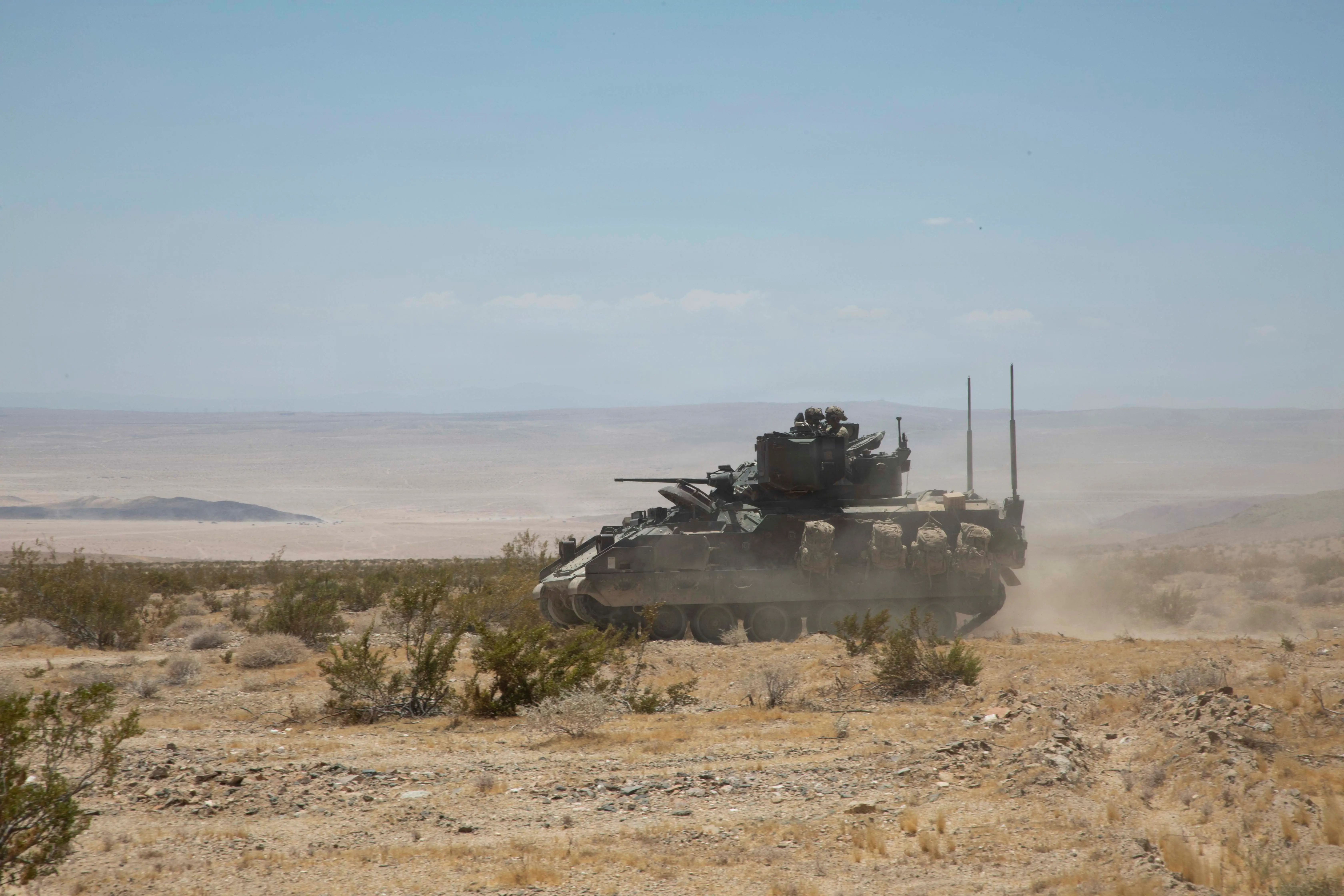
Watson’s soldiers responded by changing how they used their armored vehicles. They hid their Bradleys in gullies and among the trees, leveraged the terrain to mask their maneuvers, avoided predictable routes that they knew the Ukrainian hunters expected them to try, and deliberately considered how the force looked to overhead drones.
“More than once,” he wrote, “I found myself standing sideways in the turret of our Bradley, barking orders as our platoons traversed 40-degree slopes, finding new routes to an objective.”
“The enemy still found us,” Watson wrote in the op-ed. But “even with drone reconnaissance, the enemy had to use traditional ground reconnaissance and infiltration techniques. While a drone could identify us from above, only troops on the ground could exploit the information.”
Throughout the fight, the US forces lost Bradleys and tanks, which Watson said was expected in a high-pressure event like this, an exercise meant to resemble a real armed conflict.
For Watson, those losses didn’t condemn his armored assets to irrelevance; rather, the training exercise demonstrated that armor still provides tremendously valuable mobility, protection, and firepower as long as it is put to use with the drone threat in mind.
“Our armor did not make us more vulnerable,” he wrote, “it made us mobile, protected, and dangerous.”
Officials and top war watchers have debated the value of armored vehicles against drones and uncrewed systems since the beginning of the Ukraine war, as reports from the front and video footage of drones blowing up tanks and armor across the battlefield circulated online.
The asymmetric threat raised concerns that the proliferation of cheap drones, both surveillance and attack, had made heavy armor too vulnerable, making it less relevant for future fights.
Watson’s account of his experiences paints a more complicated picture, acknowledging that uncrewed systems represent a growing threat to armored combat vehicles but emphasizing that the threat hasn’t yet made them obsolete. The debate goes on.
Read the original article on Business Insider
The post A US commander says facing Ukrainian hunters helped his troops figure out how to use armor in a drone-heavy fight appeared first on Business Insider.