With much of the world’s ire currently focused on social media influencers at the U.S. Open, Naomi Osaka, the Japanese tennis star, took aim with the measured power of an easy overhead slam, and told them to get a clue.
“If you come to a sporting event, you have to respect the sport,” Osaka said Thursday night after her second-round win. “And I feel like it’s common courtesy to read up on the sport, especially the etiquette.”
On Monday, influencers disrupted Osaka’s first-round match against Anastasia Zakharova and the chair umpire admonished them. Fan videos of the incidents were widely distributed online, propelling a wave of criticism from tennis fans who see young, attractive narcissists shooting self-promotional videos and yearn for the U.S. Open’s more tranquil days.
They’d most likely have to go back to 1892 to find them.
Compared with most other tennis tournaments, the U.S. Open has long been characterized as crowded, rowdy, loud and expensive, a quartet of adjectives that also reflects the city that hosts tennis’s blockbuster event.
Ever since the tournament moved from the more staid West Side Tennis Club in Forest Hills, Queens, to nearby Flushing in 1978, most tennis people — fans, tournament officials and even players — have reveled in the raucous atmosphere, the sport’s version of a three-week Super Bowl in Las Vegas.
The Open has largely come to been seen as the tournament for noisy, alcohol-saturated New Yorkers, bellowing from the high-altitude seats in Arthur Ashe Stadium all the way down to the tiny court below, often at midnight. It’s considered authentic and charming, the people’s tournament, and many players have thrived on the energy.
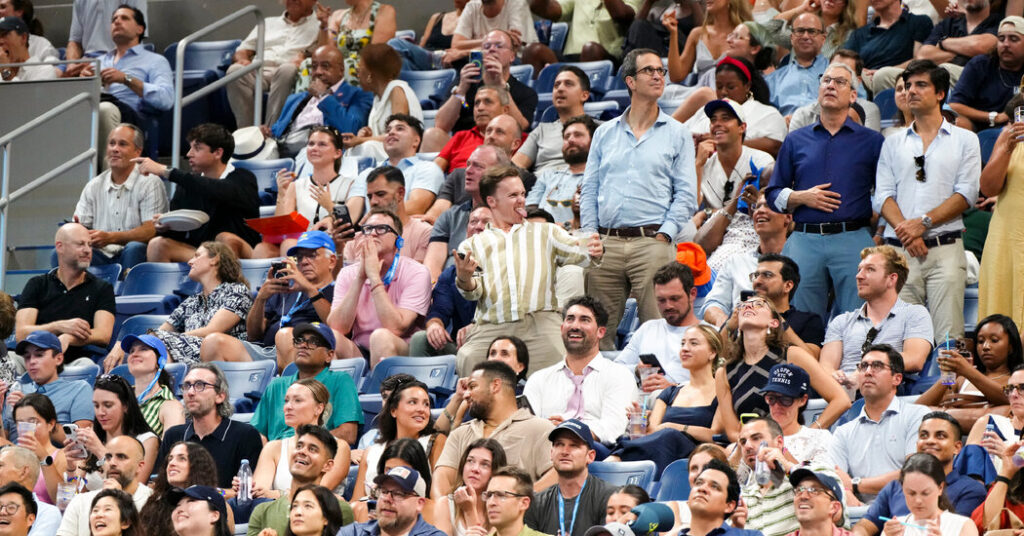
But when the loud fans are down in the lower bowl of the stadium, closer to the players, where they might shine their ring lights toward the court to make content for their feeds — that is different.
On Wednesday night, the U.S. Open reacted by posting a message on video boards and also sending it directly to ticket holders, asking fans to refrain from disruptive activities, including making noise, taking flash photos and using ring lights. It also warned fans that they might get a public dressing down from the chair umpire if they didn’t oblige.
“The U.S.T.A. is always striving to grow tennis in this country and bring new audiences into the sport,” Brendan McIntyre, a spokesman for the United States Tennis Association, said in a statement. “The U.S. Open is our greatest opportunity to do so, and we welcome newcomers to our event.”
Although the influencers — about 100 were invited by the tournament itself — are still roaming the grounds with their ring lights and tripods seeking the most iconic backdrops, and are still in the stadiums, they may have received the message and chilled out. Since the two incidents on Monday, there have been no reports of influencers disrupting play or being publicly scolded by umpires.
But the social media stars are only a symptom of a larger issue that concerns many longtime fans: the massive growth of the U.S. Open.
In recent years, attendance has mushroomed. Last year saw a record 1.14 million visitors and the celebrity quotient, always high, seems to have skyrocketed. With this has come many new patrons who seem more focused on buying $23 Honey Deuces and taking selfies than the actual tennis. Perhaps, traditional fans fret, the Open has become too loud, too crowded, too expensive and yes, overrun by influencers.
“Things are changing,” Adrian Mannarino, a veteran French player, told Eurosport after losing his second-round match on Wednesday. “People are now allowed to move around in the crowd during the points. It smells like weed on the court, there’s noise everywhere. It’s actually becoming a bit of a zoo.”
Those kinds of critiques often come after losses. But fans have also been expressing concern about some fellow spectators. And yet the U.S.T.A., which does often respond to mounting criticism, continues to cram more people into the grounds each year.
With tennis becoming more popular — it has grown every year since the pandemic, with a record 27.3 million participants in the United States in 2025 — more and more of these so-called newcomers want to be a part of the Open. Naturally, this includes influencers.
Some were clearly not aware of the protocol that prohibits fans from yelling, talking or moving during play. Many of these rules, however, have changed over time, and what was once unacceptable behavior — cheering an unforced error or a double fault — is now commonplace.
On Thursday, Osaka also mentioned that it was not just the influencers who were being disruptive. “The umpire, she told everyone to be quiet more than I’ve ever heard an umpire tell a crowd to be quiet,” Osaka said.
And for decades, spectators have moved around freely in the upper reaches of the enormous Ashe Stadium — seats so distant from the court that players can barely see and hear the fans anyway.
But the players can see and hear the influencers.
“I think a lot of people of a certain age these days have less awareness of time and place,” said Shweta Bowles, a financial services director from Queens, who was attending her 20th U.S. Open with her husband on Thursday. “The game has become so popular and people want to come who may not know that you don’t stand up and take videos in the middle of a point.”
Ubaldo Scanagatta has seen all sides of the sport. He is a reporter for Ubitennis, covering his 45th Open this year. He has also served as the director of a professional tour stop in his native Florence, Italy, and he played in college.
“The audience has broadened and the newcomers are less educated than the old-comers,” he said. “In French there is a word, ‘parvenu.’ They don’t know. But it’s New York, so it’s loud. And we love coming to New York.”
So do the influencers.
The post Quiet on the Court! As U.S. Open Grows, the Crowd Gets Rowdier. appeared first on New York Times.