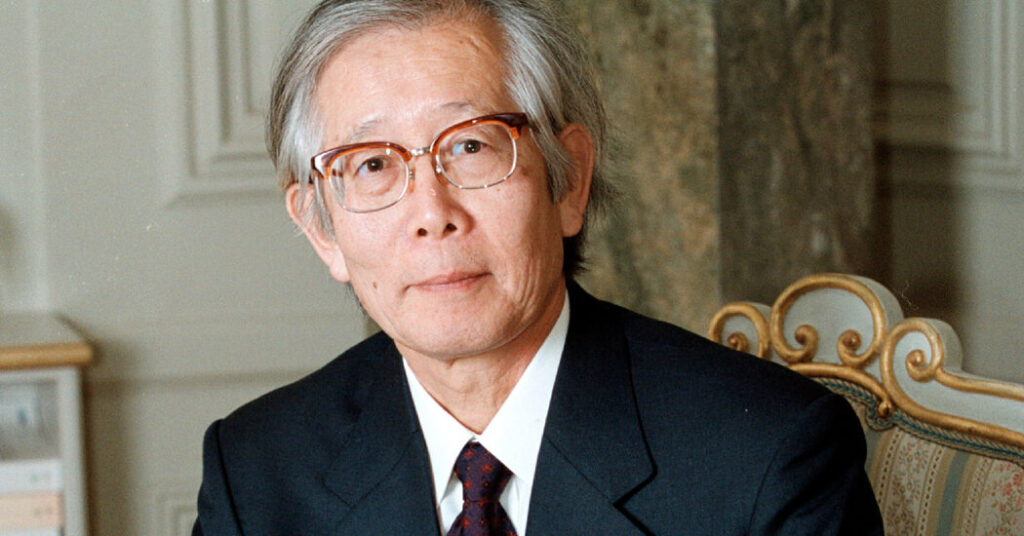
Hideki Shirakawa, a Japanese chemist who shared the Nobel Prize in 2000 for the discovery of plastics that can conduct electricity, a breakthrough that had many commercial applications, including making new types of semiconductors and inexpensive solar panels, died on Aug. 24 in Yokohama, Japan. He was 90.
His death, at a hospital, was from liver cancer, according to the University of Tsukuba, where he was an emeritus professor.
The initial discovery of plastics that can conduct electricity was the result of a mistake.
One day in 1967, Dr. Shirakawa and other scientists were in a laboratory at the Tokyo Institute of Technology (now the Institute of Science Tokyo) working on synthesizing polyacetylene, a type of organic polymer.
Organic polymers are long chains of molecules with central strands of carbon atoms that have alternating single and double bonds of shared electrons between the carbon atoms. Polyacetylene is made by adding a catalyst to acetylene to create those bonds. Though polyacetylene had first been synthesized in 1958, chemists had not studied it much.
Whether it was an error in the instructions or an error in reading them, someone accidentally added 1,000 times too much catalyst to the reaction to create the polyacetylene. Instead of getting a black powdery substance, as expected, the result was a silvery film that looked more like metal than plastic. Dr. Shirakawa was intrigued by the result and began studying the unusual material to better understand its properties.
Seven years later, during a conference at the institute, Dr. Shirakawa met Alan MacDiarmid, a chemistry professor at the University of Pennsylvania who had also been studying metallic-looking films made of polymers. Dr. MacDiarmid invited Dr. Shirakawa to come to Penn for one year to collaborate on their research.
The two scientists exposed the silvery-film polymer to iodine vapor, which oxidized it. Aware that oxidation can change the optical properties of film, they asked Dr. Alan Heeger, a physicist at Penn whose specialty was understanding the macroscopic properties of matter, to analyze it.
Plastics are normally stable compounds and do not conduct electricity, which makes them good insulators on wiring, for example. But Dr. Shirakawa and C.K. Chiang, one of Dr. Heeger’s postdoctoral students, measured the conductivity of the oxidized film anyway and found something completely unexpected: Its conductivity had increased 10 million times.
The electrical surge was so sudden and so violent that Dr. Shirakawa hinted in his Nobel biography that the experiment damaged the equipment they were using to measure it. The oxidation had changed the normal properties of the polymer by removing some of its electrons, a change known as “doping,” allowing the remaining electrons to migrate freely just as they do on a copper wire.
The scientists had discovered electricity-conducting plastic, and they announced their findings in a 1977 article in the Journal of the Chemical Society, Chemical Communications.
It took some time for the scientific community to develop products based on their discovery. But by 2000, when the three scientists shared the Nobel in Chemistry, the conductive plastics were being used to protect electronics and photographic film from static electricity and to make new kinds of light-emitting diodes. New products were also in development, including innovative types of solar panels and TV screens.
Hideki Shirakawa was born in Tokyo on Aug. 20, 1936. He was the third of five children of Hatsutarou Shirakawa, a doctor, and Fuyuno Shirakawa, the daughter of the chief priest of a Buddhist temple. The family moved for his father’s work and because of World War II before eventually settling in Takayama, his mother’s hometown.
In junior high school, Hideki and the other students were asked to write essays about their aspirations. In his Nobel biography, Dr. Shirakawa recalled, “I wrote something about my wish to be a scientist in the future and to conduct research on plastics useful for ordinary people.”
His ambition was perhaps not surprising, as postwar Japan was then undergoing a boom in the production of products made from plastic — a sign of Japan’s rapidly stepping into a more modern society.
Much to his surprise, the day after his Nobel win was announced, a copy of the essay he long thought lost appeared in every Japanese newspaper. “I was deeply impressed with the great power of the Nobel Prize,” he wrote.
He did all his advanced studies at the Tokyo Institute of Technology, receiving a doctorate in 1966. That same year, Dr. Shirakawa married Chiyoko Shibuya. She survives him, as do their sons, Chihiro and Yasuki.
After many years at the Tokyo Institute of Technology, where he began as a research associate, he was hired in 1979 by the University of Tsukuba’s Institute of Materials Science. He retired from scientific research at the university in 2000.
A year later, Dr. Shirakawa was appointed the head of a new national commission to re-energize Japanese science by developing a strategy for Japan to win 30 Nobel Prizes in the sciences over the next 50 years. At the time, he found the mission daunting.
“The figure is way too high,” he told The New York Times in 2001. “In the last 50 years, we’ve only had six.”
One of the problems, he explained, was that “Japanese culture is based on rice farming,” and in rice farming, water must be shared, and teams of people have to work side by side. “All of this has meant that uniqueness had to be suppressed.”
That characteristic was opposed to what is necessary to be successful in science, Dr. Shirakawa said in an interview with the Nobel Institute after the prize was announced. “A good scientist,” he said, “has to have a personality that is curious and asks, ‘Why?,’ and asks, ‘What happened?,’ and has an interest in everything.”
The post Hideki Shirakawa, Who Helped Turn a Lab Error Into a Nobel, Dies at 90 appeared first on New York Times.