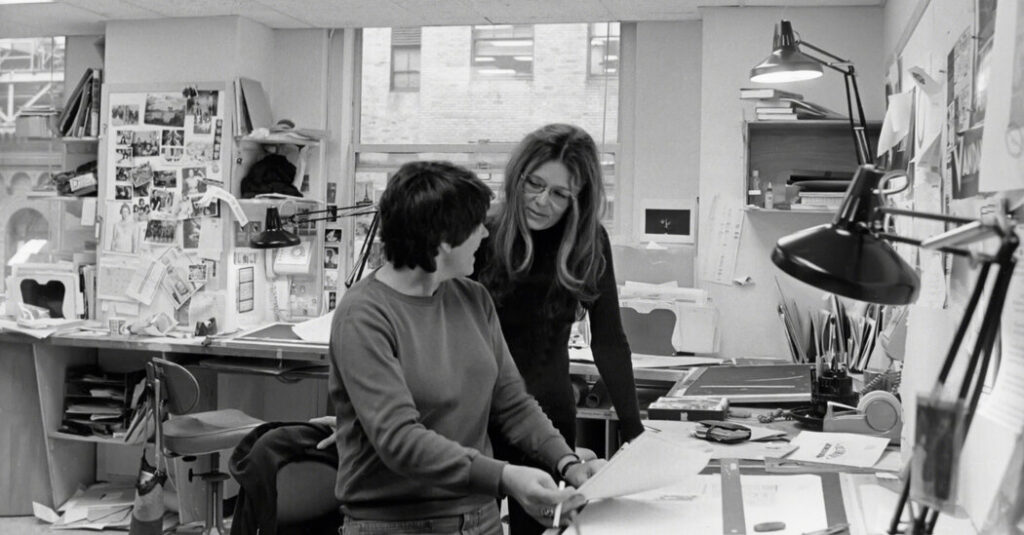
When Gloria Steinem started Ms. magazine in 1971, most women’s magazines concentrated on how to keep a house and how to attract a husband. Her publication took a very different focus: liberation.
The magazine, the first owned and operated by women, made the discussion of issues like abortion, domestic violence and equality unavoidable — and revolutionized a generation of women’s writers and publishers.
“The one element that is the foundation of this magazine and makes it different from others is that it simply considers that women are human beings,” Ms. Steinem said of Ms. magazine in a 1973 BBC interview. “That doesn’t sound very revolutionary, but it is, because the other magazines are still arguing about it.”
In some ways, the publishing world is still arguing about exactly what it means to be a women’s magazine. Legacy publications like Glamour, Marie Claire and Teen Vogue have either ended their print runs or withered, while feminist blogs like The Hairpin and Feministing have shuttered.
But the DNA of Ms. magazine inspired a new generation of outlets, said Emily Ramshaw, the chief executive of the nonprofit newsroom The 19th, which focuses on women and politics.
Ms. Steinem “spent her life and career insisting that women were not a niche audience, that our experiences were not side dishes to the main event and that gender-based journalism could be both rigorous and unapologetic,” Ms. Ramshaw said.
Ms. Steinem, who died on Wednesday at 92, didn’t start out as a trailblazer. She began her career as a freelance writer, penning articles for traditional publications like Esquire, Vogue, Cosmopolitan, Glamour and McCall’s. She famously went undercover as a Playboy bunny for a 1963 investigation in Show magazine that exposed the exploitative conditions the women worked under.
She occasionally wrote for The New York Times, including a 1965 article on the plight of women in network television and a 1966 profile of Mary Lindsay, the wife of the then-may of New York City, John Lindsay.
But it was at New York magazine that Ms. Steinem honed her voice. Invited by the editor Clay Felker to join a new magazine he was starting, Ms. Steinem became a founding contributing editor in 1968.
She wrote a weekly column, “The City Politic,” where she proved herself a sharp cultural and political observer. She took on subjects like the turning sentiment against President Richard M. Nixon during the Vietnam War, Ed Koch as congressman and a tense New York City in the wake of the assassination of Martin Luther King Jr. She was among other top-tier writers of 1960s New York, like Tom Wolfe, Nora Ephron and Jimmy Breslin.
Trump Administration: Live Updates
Updated
- Trump Administration Moves to Drop Protections for More Wetlands
- Kushner and Witkoff will head to Russia and Ukraine in an effort to revive peace talks.
- U.S. diesel prices set new high.
But at New York magazine, “I was still the girl writer, and the guys there, whom I loved, their advice about feminism was, ‘Don’t get involved with those crazy women,’” she said in a 2015 profile in The New Yorker.
She didn’t pay attention. She co-founded Ms. magazine with a team of other feminists.
“I realized as a journalist that there really was nothing for women to read that was controlled by women,” she explained in a 2011 documentary.
Ms. magazine first came to life as a 32-page insert in New York magazine’s December 1971 edition. Mr. Felker helped fund it. A preview issue the next month sold out in eight days, selling 300,000 copies.
The first full issue, published in July 1972, featured Wonder Woman on the cover. It included an article from Ms. Steinem on how women voted, an essay from the activist Johnnie Tillmon on welfare and a petition supporting the legalization of abortion called, “We Have Had Abortions” that was signed by 53 prominent women, including Ms. Steinem, Billie Jean King, Nora Ephron and Susan Sontag. It was a radical act at the time, when abortion was illegal.
“It was a game-changing moment where people started to talk about abortion in a much different way,” said the writer Jessica Valenti, who was an intern at Ms. magazine in the early 2000s and now writes a Substack newsletter about abortion rights.
The magazine quickly found an audience hungry to talk about issues that had for so long been shrouded in shame or secrecy. Letty Cottin Pogrebin, a founding editor of the magazine, recalled in an interview on Wednesday receiving “an overwhelming avalanche” of reader mail in those early years.
Ms. Pogrebin described Ms. Steinem, her longtime friend, as someone who hated the spotlight but who was forced into it to forward a movement.
“She happened to be this remarkable combination for a remarkable historical moment,” Ms. Pogrebin said. “She was smart, she was articulate, she was funny, she was gorgeous. She made feminism sexy.”
The magazine had its detractors. The prominent “60 Minutes” correspondent Harry Reasoner quipped that the women would “run out of things to say” in six months. (He later apologized.) Advertisers balked at its content and some libraries banned it. There were newsstand owners in the South who refused to sell it when it featured Black women on the cover. The magazine also faced criticism from inside the feminist movement — there were those who felt it wasn’t radical enough; others saw a lack of diversity in its pages.
Ms. magazine, which has published work from writers like Alice Walker, Maya Angelou and Angela Davis, has seen its popularity wane in the decades since it was founded. It is now owned by the nonprofit Feminist Majority Foundation, which still prints four issues a year and publishes online.
Ms. Steinem and the other early contributors remain an inspiration, according to Kathy Spillar, Ms. magazine’s executive editor for the past two decades.
“The magazine’s founding editors and contributors did not simply add women to the existing news agenda,” Ms. Spillar wrote in a tribute to Ms. Steinem. “They changed the definition of news.”
The post How Gloria Steinem and Ms. Magazine Transformed the Publishing Industry appeared first on New York Times.