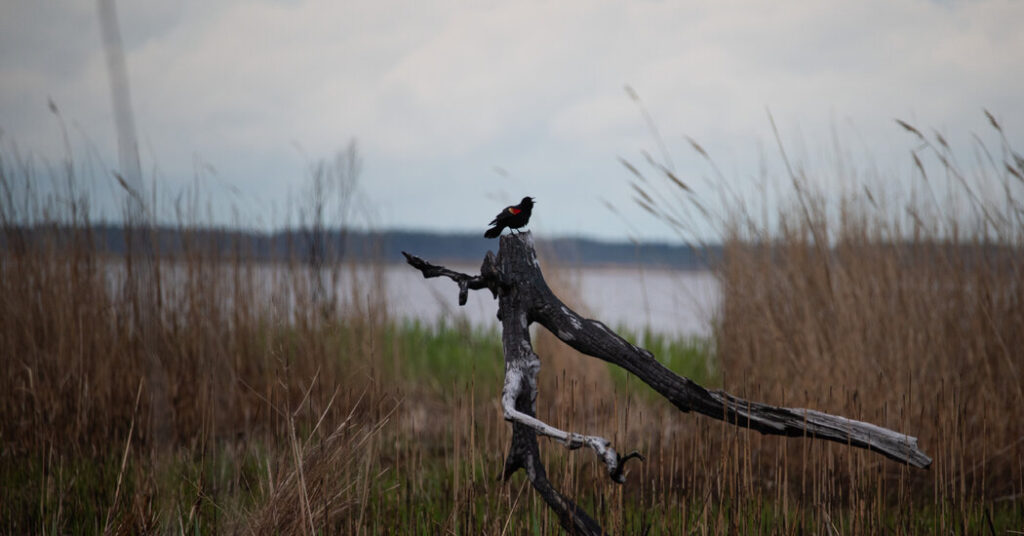
The Trump administration on Friday took another step toward stripping federal protections from millions of acres of wetlands, which help filter drinking water for many communities and provide critical habitat for birds, fish and other wildlife.
The proposed rule from the Environmental Protection Agency and the U.S. Army Corps of Engineers would significantly narrow the definition of “waters of the United States,” or WOTUS, that are protected from harmful pollution under the Clean Water Act of 1972.
The new version is more sweeping than an initial proposal released in November, which would have removed federal protections from fewer wetlands nationwide. The plan would deliver a victory to farmers, ranchers and rural landowners who have chaffed at the protections, calling them an infringement on their property rights.
“Under President Trump’s leadership and the Army’s ‘Building Infrastructure, Not Paperwork’ initiative, we are overhauling sclerotic government overreach to remove friction from our economy,” Adam R. Telle, the official overseeing the Army Corps of Engineers, said in a statement.
President Trump said on Thursday that he was appointing Mr. Telle to take over as the acting Army secretary, replacing Daniel P. Driscoll, who resigned after clashing repeatedly with Defense Secretary Pete Hegseth.
The Clean Water Act requires companies and individuals to obtain a permit from the E.P.A. before releasing pollutants into the nation’s waterways. They must also receive a permit from the U.S. Army Corps of Engineers before discharging any dredged or fill material, such as sand, silt or construction debris.
A Supreme Court decision in 2023 had set the stage for the Trump administration’s proposal by curtailing the E.P.A.’s power to police wetlands. In the majority opinion in Sackett v. E.P.A., Justice Samuel A. Alito Jr. wrote that the Clean Water Act allowed the agency to regulate only wetlands that abutted a “relatively permanent” body of water.
But Justice Alito did not explicitly define a “relatively permanent” body of water. The absence of a clear definition caused confusion for farmers and landowners, who were unsure whether they needed a permit before building on their properties near lakes and streams.
In the proposal released in November, the Trump administration defined a “relatively permanent” body of water as one that flowed either every day or during the “wet season.” The proposal on Friday would define it instead as one that flowed every day except for temporary interruptions like droughts lasting less than 30 days.
That change may sound highly technical, but it could have far-reaching consequences, potentially stripping federal protections from 94 percent of U.S. wetlands, according to a preliminary analysis by the Natural Resources Defense Council, an environmental group.
“Finalizing this proposal would be declaring open season on the nation’s waterways,” said Jon Devine, the director of freshwater ecosystems at the Natural Resources Defense Council.
The initial November proposal could have removed protections from 81 percent of U.S. wetlands, Mr. Devine estimated. He added that very few wetlands abut other bodies of water that flow every day, with the exception of a handful of coastal wetlands influenced by tides.
Brandon Farris, the executive vice president of the Steel Manufacturers Association, an industry trade group, praised the new proposal. He said in a statement that it would end “regulatory whiplash” for companies that have invested billions of dollars in building new steel mills near waterways.
Representatives for other industry groups that supported the November proposal, including the American Farm Bureau Federation and the National Association of Home Builders, did not immediately respond to requests for comment.
The E.P.A. and the Army Corps of Engineers will solicit public comments on the proposal for 30 days. Then they will work to finalize it, likely within the next year.
The post Trump Administration Moves to Drop Protections for More Wetlands appeared first on New York Times.