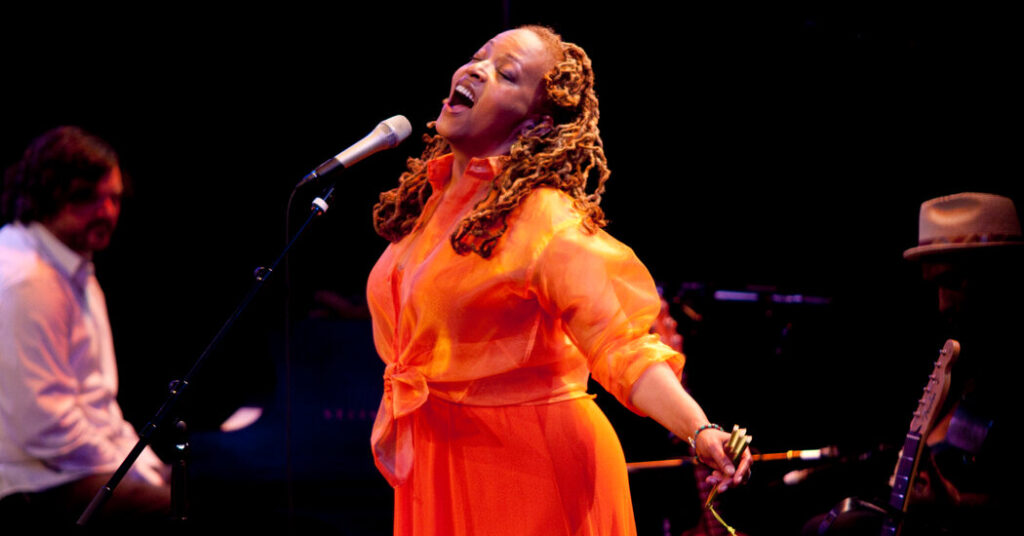
There is a quality of almost holy slowness in Cassandra Wilson’s music that belies the speed and force with which it changed jazz history.
Wilson’s was a voice that felt almost totally private, and yet somehow open to the listener: expressed without any unwilled labor, staggeringly lovely, robust but not satisfied. A guitarist as well as a vocalist who composed about half of the songs she recorded, Wilson represented a new kind of self-directed expression in jazz, and when she released her two wildly successful Blue Note albums in the mid-1990s, they almost seemed to announce the end of neo-traditionalism. On “Blue Light ’Til Dawn” (1993) and “New Moon Daughter” (1995), a commitment to blues tradition and a wider North American songbook sit at home in the ethic of a jazz musician, committed, moment-to-moment, to remaking sound.
Speaking to those who worked with Wilson, it becomes clear how much of that vision was hers. They describe a creativity that bordered on stubbornness, a slowness to take on new ideas, and then, the tendency to gather things she loved deeply to her. “It could be a challenge to persuade her to move on something that, you could see, it would be great if she did it,” Brandon Ross, a guitarist whose textured sound complemented Wilson’s voice over a lifelong partnership, said on Wednesday. “But once she decided that she was going to do it, she was all in. She would actually discover this way to inhabit this thing that was just personal, not calculated.”
After an upbringing on the jazz scene in Jackson, Miss., she moved to New Orleans and then to New York, where she developed meaningful musical relationships with two alto saxophonists and composers: Henry Threadgill, whose famed New Air trio recorded with Wilson; and Steve Coleman, the central figure in the M-BASE collective, of which Wilson was a co-founder. Her string of late 1980s and early ’90s records, with bands that usually included the guitarist Jean-Paul Bourelly and the bassist Lonnie Plaxico, innovated through funk-driven, prismatic music putting ancient rhythm into new vessels.
As her star rose, Wilson embraced jazz standards too, notably on the widely popular “Blue Skies” (1988). But it was only after signing to Blue Note Records in the mid-90s and starting a brief but transformative creative partnership with the producer Craig Street — then a neighbor in her New York apartment building who mostly worked in construction at the time — that she made the two records that would open the door to a new kind of postmodernism in jazz.
Street, speaking on the day of Wilson’s death, invoked Dolly Parton. “When you think about somebody like Dolly, she could sing a ‘moon in June’ lyric, corny as could be, but you believed that she believed what she was singing,” he said.
But that feeling could not be forced. “There were even times when there was full-on rebellion,” Street said. “It was like, ‘There is no way this is going on my record!’ And then it would turn around.”
Wilson became jazz’s first great popular postmodernist, bringing the warped alto of Sade and the open-landscape interiority of Joni Mitchell into a blues-based expression. People called it jazz.
And she did claim the lineage proudly. Wilson was influenced by the vocalists of the generation immediately before hers — especially Abbey Lincoln, who became a friend, and Betty Carter — but she also inhabited her own singular form. Arrestingly low, her voice came across in an accent that could sometimes sound Southern and cozy, sometimes almost trans-Atlantic — often both at once. A contralto, the least common range for a singer, her intensity was a lot like that of Bessie Smith, Marian Anderson and Nina Simone, but also far more serene.
This affect was especially powerful given her commitment to vulnerability. On “Glamoured” (2003), she frankly chronicled unrequited desire, especially on the half of the album that was original compositions (“Sleight of Time” and “I Want More” among them).
Ultimately, so much of Wilson’s unhurried expression connects back to Jackson, where she was born and spent her final years. When Wilson sings, whether it is on her tribute albums to Billie Holiday and Miles Davis, or on her own originals, what we hear is a lot like the experience of moving through the Mississippi Delta itself, through haunted cypress and elms. It takes its time, full of slow life, awake but almost dreamlike.
Her covers of blues songs by classic figures like Muddy Waters and Robert Johnson often allowed some of the widest space for her expression, despite paying homage to well-trodden forms. “It’s a funny thing, people always ask me about the impact of blues on my life, and it’s difficult to describe to people — because when you’re born in Mississippi, the minute you come out of the womb, there’s blues,” she said in a 1995 TV interview. “It’s something that’s in the air; you walk out of the house and blues just comes up and slaps you in the face.”
Even as she pranced past the borders of familiar idioms, the warmth of Wilson’s voice and her purposeful pacing made experiments feel like inevitable destinations. Particularly in partnership with Street, she took M-BASE’s hybridizing approach and fused it with the popular repertoire to set a new standard for contemporary jazz. Street’s production work with artists including Lizz Wright and Meshell Ndegeocello further spread that impact to a generation of heirs.
“Jazz practitioners are not natural entertainers,” she wrote in a 2016 essay. “We are musicians who carry the legends and lore of an art form that is constantly evolving while also retaining a steadfast connection to its genesis. I follow this path to pay respect to my elders, homage to the ancestors, and to present uniquely inspired performances for my audiences.”
Rejecting the idea that her success had affected her relationship to the art form, she wrote: “My means are modest because my calling is paramount. I will always seek the truth and never lose my courage to express what matters. I own what I create in the marketplace. The marketplace does not own me.”
Wilson, so in possession of herself and her craft, could lead a listener wherever it struck her to go. There is an old TV broadcast, available on YouTube, of Wilson and her band playing “Redbone,” one of her most convicted and infectious originals, in 1995. She invokes orishas alongside biblical figures as she ad libs, giving herself something to use in conversation with the band, finally singing: “Little redbone girl’s going to go to heaven / Because she believes in her gods.”
The post Cassandra Wilson Led Jazz Into the Future With Warmth and Creative Conviction appeared first on New York Times.