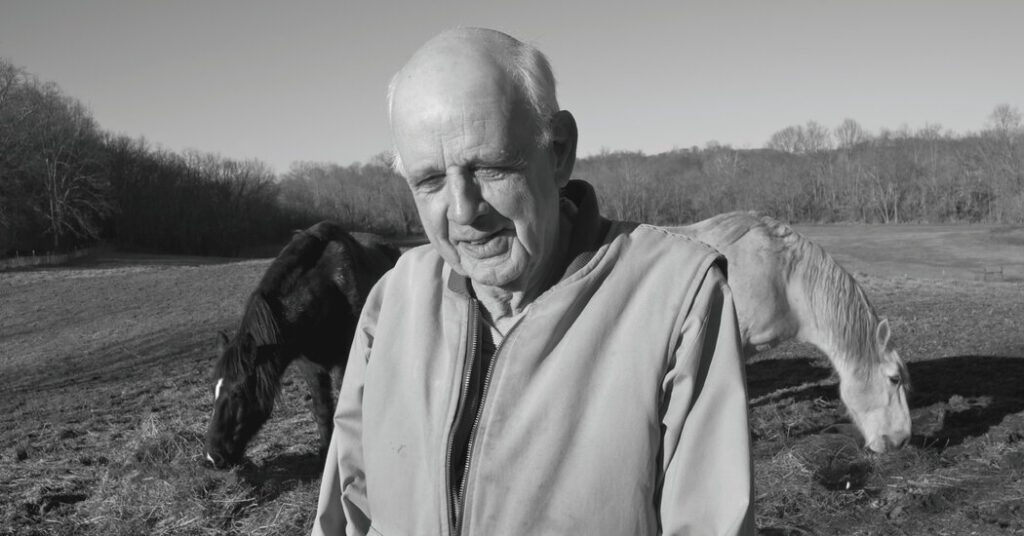
A great mentor gives us the confidence to look ahead to our own work while we still feel that gentle hand at our back, always there to help move us along. I’ve felt Wendell Berry’s literary hand between my shoulder blades for such a majority of my life that, after his death on Monday at the age of 92, it’s a shock to wake up into a day without him in this world. The only words I want to read right now are his. “Manifesto: The Mad Farmer Liberation Front,” for a start, advises me this morning to ask the questions that have no answers. To invest in the millennium.
…Plant sequoias. Say that your main crop is the forest that you did not plant, that you will not live to harvest. Say that the leaves are harvested when they have rotted into the mold. Call that profit. Prophesy such returns.
The manifesto further instructs me to put my faith in humus, listen to carrion, expect the end of the world and laugh. To swear allegiance to my better self with the courage of insurrection:
As soon as the generals and the politicos can predict the motions of your mind, lose it. Leave it as a sign to mark the false trail, the way you didn’t go. Be like the fox who makes more tracks than necessary, some in the wrong direction. Practice resurrection.
Wendell and I grew up a generation apart but joined in a culture that puts great stock in neighborly civility. We rural folk are mostly polite. It helps us to get along, get invited back, and sometimes sneak mutiny in the door. Even in the fanciest company. Even in church. This is the power of Wendell Berry. He was a welcoming, funny, gentle-spoken man who knew what was right — unfailingly, it seems to me. He could deliver it on the page with such lyrical self-possession, the reader might take a while to register the volley of interior explosions. You’re left with fresh truth and some reckoning on your hands, and a clear sense that it was a gift.
As a writer he distinguished himself early, first as a Stegner fellow at Stanford and then on the faculty of New York University, acclaimed by the literati but uneasy with the growing distance between himself and his home. His academic peers warned him against leaving the cultural capital; they surely thought a Kentucky farmer-poet would be doomed as a literary nobody.
It turned out, becoming “somebody” meant something different to Wendell than it did to them. “The Long-Legged House,” his first book of essays, from 1969, argued for the part of our humanity that rests in belonging. Without the people and place that made us, we risk losing our whole selves. A farm in Kentucky was the God’s honest truth of Wendell Berry, the writer and the man. “What I stand for is what I stand on,” he said, and spent the rest of his life proving it.
It’s a well-beaten path for rural kids: Go out and seek your fortune. I followed it myself, lured away from Kentucky by some combination of embarrassment for the homely and the shine of what’s generally called opportunity. Yet having entered its temple, I found nothing worth saying until I could claim the place I’m from, as a cultural capital of its own surprising kind. I have a handful of writers to thank for lighting my circular path home, but mostly Wendell Berry.
People who live and work in land-based economies are well accustomed to being called backward by the more urbane, and Berry’s work has sometimes borne this slight. But he was the opposite of backward; he was prescient. “The Unsettling of America” (1977), his seminal text on the dangers of our estrangement from the land that feeds us, is more urgently true today than when he wrote it five decades ago. If any readers still doubt that a farmer could have much to tell them, it’s their loss.
His essays, the Sabbath Poems, the Port William novels — “Hannah Coulter,” “Jayber Crow,” “The Memory of Old Jack,” all quiet on the surface — are lakes of sleek astonishments. The possibilities of life in a small place are a mirror to the world, because let’s face it, every place is its own kind of small. It’s a universal clemency to find delight in what we have instead of craving what we don’t, and likewise, a balm to any existential dread to consider that “the fragment of the earth/that is now me” is just passing through: “It is on its way/from having been a tree,/a school of fish, a terrapin,/a flock of birds. It will pass/through all those forms again.”
Who doesn’t want to be a flock of birds someday? Returning here to “Manifesto,” we can all use instruction on how to “Be joyful/though you have considered all the facts.”
His novels walk the unpaved roads between birth and death with an aching blend of human comedy and grace. His poems hold the sacred in the palm of their hand. In service of what might be taken for simplicity, his logical currents are clear and complex; his essays contain multitudes. One of his most famous, “Why I Am Not Going to Buy a Computer,” challenges our devotion to technological fundamentalism — not because Berry was a Luddite, or failed to appreciate his wife, Tanya, as an editor, typist and invaluable partner. Nor did he oppose a tool that helps us do good work. Rather, he saw danger in the conviction that new things are always better than old things. (If you’re a mortal human, you might think on that.) He saw the waste of endlessly buying solutions to problems we don’t have, and tragedy in an elusive happiness built on constantly changing out our possessions and selves: a damaging doctrine for those who can’t afford it, and also for those who can.
Most of all, he had the rare vision to see a thing, any thing, not just at the moment of acquisition but through its whole passage from mineral extraction, the mess of manufacture and transport to the consumer and beyond, to the desecration we call “landfill.” He nudged us to do the same, and to have the courage to ask, “Is my need important enough to inflict this injury on the world?” He didn’t say do, or don’t. He just said to look. Widen your gaze, and look again.
I can’t remember a time when I didn’t know about Wendell Berry. My grandmother talked about “that fellow that doesn’t like a tractor” when I was young enough to picture a noble draft horse versus our noisy John Deere, and heartily agree that less is more. He and my father — coincidentally both named Wendell — worked together to help preserve some beautiful, threatened parts of Kentucky, in their shared belief that such wild places are sacred. When I saw him soon after my father died, Wendell told me, “They come back to us.”
It’s the truest, kindest counsel I’ve ever known for grief, perfectly rendered in his poem “The Loved Ones.” In those first days we are sodden with deprivation and the loss itself: accident, illness or final decline. It’s only with time that “the loved ones we call the dead” return as their full selves into our memories and dreams, and then:
We feel they have been near us when we have not thought of them. They are simply here, simply waiting while we are distracted among our obligations. At last it comes to us: They live now in the permanent world. We are the absent ones.
I’m taking that counsel today. He’ll come back to us. He is here now, in these words. His poem “Stay Home” promises:
I will be standing in the woods where the old trees move only with the wind and then with gravity. In the stillness of the trees I am at home. Don’t come with me. You stay home too.
A giant tree has surrendered to gravity. No, not surrendered. Accepted. I’ll take Wendell’s instruction to stay here, in these fragments of the earth that are still me, and use them while I can, to nurture a place, a family, a spiritual trust, a neighbor. To call that home, and carry on.
The post Wendell Berry’s Message to Readers: All We Need Is Here appeared first on New York Times.