This spring, the Southeast was on fire. Ninety-five percent of the region was in severe drought, and in parts of Georgia and the Carolinas what was burning was what’s called the “blowdown” from Hurricane Helene — the fires tearing through landscapes heavy with trees felled a year and a half ago and left to bake into ready fuel, waiting for a spark.
This is not a climate fable; it is a pattern. Disaster intervals are collapsing, with one catastrophe following another in such quick succession that one bleeds into the next and the old metabolism of disaster recovery fails to keep pace. Climate scientists sometimes talk about whiplash: conditions of extreme drought followed by conditions of historic rainfall, for instance, with flooding made worse because the dirt and soil has been baked into a surface as unwelcoming to water as concrete.
Wildfires often denude hillsides, leading to lethal mudslides when storms come; fires can even be fed by heavy rains, as happened in Europe this summer, when spring precipitation nurtured new vegetation which baked under the continent’s historic heat waves and then burned. When rains hit desert, you can get achingly beautiful floral superblooms in Death Valley or lethal flash flooding in the Grand Canyon. This summer we got both. When decades of glacier loss is followed by an unusually hot summer in the Himalayas, you can get landslides that feel like a magnitude 5.2 earthquake.
Cosmic anomalies now arrive serially, disrupting paradigms as reliably as they do landscapes. When a thousand-year storm hits the Texas hill country and the floodwaters drown 139 people and the entire grounds of Camp Mystic, it might look like an act of God, even when the waters overwhelm something long known to locals as Flash Flood Alley. When another flood hits 12 months later, it suggests a very different calendar of grief — and recovery.
Disasters of this scale used to scar communities for generations, if not centuries. Rebuilding could unfold over decades, too: new infrastructure, new patterns of development, perhaps new evacuation routes and emergency-response units. When truly scarring cataclysms struck, survivors built whole new worlds in their wake. This work was difficult even in stable circumstances. But increasingly, weather extremes are arriving not only as crises but premonitions, with future disasters following now within a generation, often within years, and sometimes, unnervingly, within months.
“Nobody really knows what real recovery looks like,” says Juliette Kayyem, a former assistant secretary at the Department of Homeland Security under Barack Obama and now a disaster-management scholar at Harvard’s Kennedy School. “But the whole apparatus was built on the assumption that disasters were random and rare and that recovery was one and done.”
This, she says, is the original sin of recovery — that we don’t recognize what the disaster itself is telling us. A true thousand-year flood doesn’t reveal much about what new resilience must be built over the next decade, since you only expect to see something like it again 10 centuries from now. That it might come again before the next census or town council election is such an unnerving prospect that we resist it almost magnetically, preferring to believe our suffering was freakish and improbable. And in the immediate aftermath of disaster, public attention and collective ambition are pulled perversely backward, toward restoration, as much as pushed forward, toward adaptation.
For years, one promise of rapid decarbonization was that it might allow us to secure a stable climate, familiar and comfortable by the standards of the past, into which we might innovate and adapt to build a more hospitable world. Today the green transition is proceeding at inspiring speed and we have flattened the curve of global carbon emissions. But warming isn’t slowing, at least not yet. Instead it’s accelerating, drawing the world quickly past temperature thresholds we once called the dividing line between livable futures and a much darker world.
Perhaps that bright line was a projection of hyperbole and panic, since ecosystems are not ruled by neat binaries and humans will find ways to adapt to the jaggedness of warming, often by normalizing its recurring brutality. But it is no longer possible to dream of a world unperturbed by what was once called catastrophic global temperature rise. And it is no longer sufficient to see disasters only as tragedies, or policy failures, or even a shameful form of carbon comeuppance. They are opportunities, too: not simply to defiantly restore what was damaged or destroyed but to better prepare for, and protect against, a world we once hoped to avoid even imagining.
Just think of a recent disaster — the Palisades fire; Hurricane Helene. The immediate playbook of recovery is familiar, even for those watching from afar: search-and-rescue, clearing debris, restoring some basic public services and temporarily standing up others. “But when Anderson Cooper leaves town, it’s not as sexy,” Kayyem says. “It’s not all the madness, with the cops and the firefighters, and it’s not the child reunited with the mother or the dog reunited with the senior citizen. It’s just the really difficult stuff, which we didn’t take seriously before, because we all figured disasters were random and rare. We figure we’ll just throw a lot of money at the problem, get the community back on its feet and move on.”
Perhaps some local group will rally for new flood barriers, or a county official will press a weather-hardening initiative for local homes. But once you’re out of immediate danger, the recovery often grows rudderless against an ocean of contrary currents. Insurance payments frequently reward rebuilding in precisely the same spot, and for homeowners the highest priority is typically to return as quickly as possible — even if that means not waiting for new codes and building guidelines, let alone paying more to implement them. The tax base has a status quo bias, too, since localities expect certain revenue to stream from certain places, which happens only if the community returns to form. Local transportation and social services, too, were designed to serve the needs of the old community.
And then there are the more human factors, also understandable: coping and nostalgia, bureaucratic sclerosis and the effective veto power of victims over the terms of their own rebuild, the basic desire among individuals and communities to be made whole again. The layouts of streets and parks, the operation of public services, the locations of homes and what they looked like — ideally it would all be as it had been, with the disaster itself lingering more like a bad dream than a crucible in which a new community could be forged.
In an age of serial disaster, that’s no longer enough, even when it can be achieved. One problem is that there is rarely someone truly in charge — no “recovery czar,” Kayyem says. “But you need someone to own this, because the communities don’t really have the capacity. They don’t have the access to federal authorities. They don’t have the right training and perspective.” Emergency response was professionalized decades ago, she says. Recovery, though, is a different story. “Nobody owns it, nobody really wants to own it, and nobody seems to have all that clear an idea of what it needs.”
Sometimes local leaders will invoke a “new normal” when describing the scale of the challenge ahead. Never mind that it was precisely “normal” that has been revealed as vulnerable, the intuitive measure of success is how quickly visitors can return without noting signs of calamity at all. “The idea that you would be required only to recover from the disaster already behind you but not adapt to the next one — it’s insane,” Kayyem says. “Just insane.”
But for decades, this approach to recovery was required by a federal law called the Stafford Act, with FEMA disbursing most of its funds for projects that altered nothing about the structures that had been destroyed. Buildings were supposed to look the same, built with the same materials in the same place and put to the same purpose. The law has been reformed several times over the last couple of decades, with some recovery money set aside for new resilience and guidelines softened to allow communities to rebuild in different ways, and different places, rather than being bound by what had stood before. But the impulse to restore persists.
When New Orleans rebuilt its levees after Hurricane Katrina, they were not sufficient to prevent flooding in the case of a Category 5 storm. Nearly eight years since the Camp fire tore through Paradise, Calif., only 40 percent of the destroyed homes have been rebuilt, and many of the surviving structures still bear some of the same hazards — wood-shingle roofs, overgrown brush and piles of dead leaves, slack power lines — that doomed their neighbors. The homes being rebuilt now in the Palisades and Altadena have been exempted from a number of local codes and regulations in order to speed recovery on what’s been called a “like-for-like” approach to rebuilding. Their neighbors in equally vulnerable neighborhoods like Brentwood and Beverly Hills have spent much of the past 20 months fighting new responsive requirements tooth and nail — though the updated guidelines, called Zone Zero, were finally adopted in August.
These are only one kind of recovery story. There are encouraging ones, too, both big and small. In 2013, Kayyem tells me, a tornado powered by 200-mile-per-hour winds tore through Moore, Okla., the third in less than 15 years, flattening more than a thousand homes and killing several dozen people. In rebuilding, the town added not a binder full of new requirements but just two pages’ worth — then stood proud as the new buildings survived a tornado two years later. The Houston area has emerged from at least three 500-year storms in five years with better flood maps and perhaps more honest insurance policies, more defensive infrastructure and much greater willingness among voters to actually spend on that stuff. In New York, nearly 15 years after Hurricane Sandy, flood barriers are going up around Lower Manhattan — and though the system isn’t perfect, it was built much more quickly than the Second Avenue subway.
The big question is how to ensure devastated communities get on one of these paths rather than the other. In 2024, Kayyem convened a task force at the Kennedy School to ask exactly this question, examining almost 3,000 recoveries from billion-dollar disasters between 2000 and 2017, identifying 625 of what they called “leading” recoveries — in which local economic activity exceeded pre-disaster levels for a period of at least five years — and 1,259 of what they called “lagging recoveries,” where battered communities never got back to base line.
The most important measure of success, they found, is not speed — how quickly you can distribute disaster relief, bring people back and conjure at least the illusion that everything is back to normal. It’s resilience — how effectively you’ve managed to protect the community against future risk. In successful recoveries, they found, more money had been invested in resilience ahead of time by local officials who seemed to understand the risk. After impact, money was distributed more quickly and more flexibly, often thanks to ready-to-use blueprints and sometimes because leaders had stocked money away in anticipation of a coming disaster.
These are local lessons, which is part of the point. Federal response predominates in the national imagination — think of George W. Bush and Katrina, Barack Obama and Sandy, FEMA and Helene — but the actual work is increasingly falling to local communities. Partly that’s because real recovery lasts longer than the federal attention span. Partly it’s because it depends on local knowledge as much as domain expertise. And partly it’s because disasters are now frequent enough that they have begun to overwhelm the federal government’s ability to respond — America’s 20th-century institutions running up against 21st-century weather.
In the five years before Hurricane Katrina struck in 2005, the National Oceanic and Atmospheric Administration tracked an average of 5.4 “billion-dollar disasters” each year, inflicting an average of $39 billion in damages. In the last five years, the country has averaged 23.2 such disasters each year, totaling $140 billion in damages each year. Even before President Trump returned to office, promising to radically overhaul and possibly eliminate FEMA, liberals would tell you that the federal government was simply not capable of handling so much catastrophe and that the old system of centralized response was no longer fit for purpose. It’s not yet clear what FEMA will look like come January 2029. But almost invariably, it seems, local communities will have to learn to do more.
Disasters are always opportunities of a kind. In 2007, Naomi Klein described what she called the “shock doctrine” — the pattern by which, in the age of globalization and neoliberal financial capitalism, crises were exploited to push through predictably right-wing policy responses, ranging from austerity to privatization. Her focus wasn’t climate disaster, but it was easy enough to connect the dots: In the aftermath of Hurricane Katrina, for example, the New Orleans public school system was liquidated, with education turned over to charter schools. Emergency response was largely handed off to for-profit contractors, earning the derisive description “Disaster Inc.”
In 2024, Sarah Labowitz and Katie Mears, writing for the Carnegie Endowment for International Peace, proposed an optimistic inversion: “Adaptation through shock,” they called it. “We know the world will look dramatically different 100 years from now,” they wrote. “It’ll be hotter, the oceans will be higher and the most productive farmlands will be further north. Many of the places where we live won’t be recognizable or even exist, and hundreds of millions of people will have moved.” But we also know, they wrote, that “disasters are moments when change happens in communities: Resources flow, and decisions, big and small, are made to rebuild, to elevate, to harden or to say goodbye.” Everyone allows themselves to contemplate new futures, if only briefly — to ask what of the old order should be preserved. And what should not.
What Labowitz and Mears imagine is a recovery framework that begins from that premise: Disaster is a trial through which communities must pass, ideally transformed positively by the experience. Recovery could be much more ambitious than stanching the blood loss from an immediate wound.
It could mean designing and building a whole new world, one that makes the protection of people and promotion of human flourishing a higher-order goal than restoring the value of real estate. This could mean more focus on food-aid programs or providing generous direct-cash transfers to those whose livelihoods have been directly affected. It might also mean much more consideration to move people out of harm’s way rather than straining to return them into communities marked once already by climate disaster, perhaps by subtly redesigning neighborhoods, or in some cases through what’s been called, almost always in scare quotes, “managed retreat” from whole regions.
In the case of the Palisades or Altadena, for instance, it could mean a new street map that does not follow the wind paths flowing down from nearby mountains, or purchasing a few strategically located lots to be rebuilt instead as firebreaks. It could mean buying out homeowners at pre-fire prices to enable relocation, or forward-looking revisions to insurance policies so that rebuilding in the same place is not rewarded. For now, recovery tends to anchor you in the zone of exposure, and migration tends to be in the opposite direction. That is, toward risk — invariably underpriced, as we learn again with each disaster. And then forget.
Look at the burn scars in Lahaina or Spokane, or the path of destruction Helene cut through seven states, or the fact that unspectacular thunderstorms now routinely deliver more than a billion dollars in local damage, and you might assume that money would be the chief challenge in recovery — and that ambitious recovery might fail because of pinched budgets.
In fact, the money isn’t such an obvious problem, Labowitz says, since, in general, federal disaster funding flows quite freely and abundantly. In Trump’s second term, FEMA has been far more partisan in its distribution of funds, with nearly 40 times as much money sent to red and purple states wrecked by Hurricane Helene than to California in the aftermath of its fires. But over the last decade, the federal government has distributed $558 billion in disaster relief. . If we’re going to be spending all that money, she says, we should try getting a bit better at it.
“Why are we spending so much money?” Labowitz asks. “It’s because it’s the right thing to do. There’s something kind of beautiful and moral about it that we collectivize risk in a big and rich country,” she goes on. “It’s beautiful — the government helps you after a disaster. But we should be thinking about the money that we spend on disaster recovery in terms of what we could get for it. Not just in rebuilding what was there before, but preparing for the next disaster, too.”
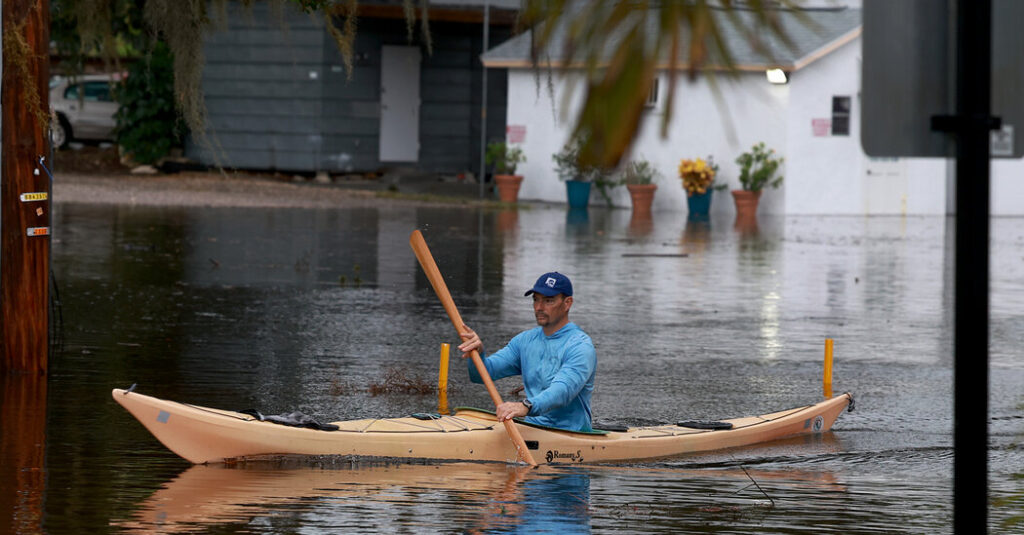
Top photos: Hurricane Ian (2022): Johnny Milano for The New York Times; Hurricane Idalia (2023): Joe Raedle/Getty Images; Hurricane Debby (2024): Ricardo Arduengo/Reuters; Hurricane Milton (2024): Chandan Khanna/Agence France-Presse — Getty Images.
David Wallace-Wells is a staff writer for the magazine who explores climate change, technology, the future of the planet and how we live on it.
The post In an Age of Perpetual Climate Disaster, Rebuilding Is the Wrong Goal appeared first on New York Times.