On a recent Saturday night at Ego’s, a popular Austin karaoke bar, the room went quiet as two young women stepped onto the stage.
The lyrics to Ella Langley’s “Choosin’ Texas” flashed across the screen in changing colors, but few in the crowd were looking. They knew the words by heart.
At the song’s chorus, the room exploded into song.
“As soon as that riff comes in, everybody loses their minds,” said Harrison Anderson, a musician and D.J. who hosts Thursday night karaoke at Hole in the Wall, another Austin venue.
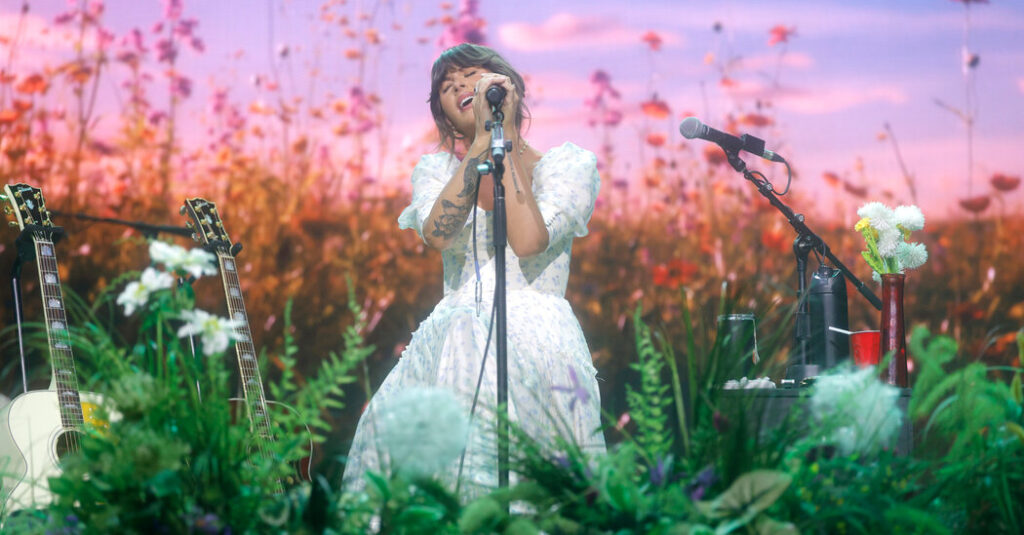
Days earlier, the Pinnacle, a Nashville live music venue, was packed with some of country music’s biggest behind-the-scenes figures. They erupted into applause for Ms. Langley, who had taken home yet another music award, while someone performed a cover of “Choosin’ Texas.” Ms. Langley shared her gratitude for the award remotely.
Nashville is singing along to a song about choosing Texas. Nobody seems to mind.
“Choosin’ Texas” has spent 20 weeks at No. 1 on the Billboard Hot 100, claiming the longest run ever atop the chart for a non-holiday song.
Ms. Langley, who is notably not from Texas — though a co-writer, Miranda Lambert, is — has tapped into the mythology of the Lone Star State, as well as an age-old musical rivalry with Tennessee.
The song arrives at a moment when the calling cards of Southern culture — its music and fashion, even its college football traditions — have spread far beyond the region. Among those cultural exports, the image of Texas has emerged at the forefront.
“It’s like this perfect storm with this song,” said Leslie Fram, a former Country Music Television executive who now works with musicians and artists in Nashville. She added, “The audience wants authenticity.”
There’s just one wrinkle: Texas has spent more than a century insisting that it isn’t really Southern.
“Southerners can be very strict about who is Southern, but grudgingly include Texas because almost everything about them is Southern,” said Beverly Keel, a former music journalist and publicist who now oversees the media and entertainment college at Middle Tennessee State University. And, she added, “Texas and Tennessee, from my perspective, have always been friendly rivals.”
Texas has long straddled South and West, said Glen Sample Ely, a Texas historian and author of “Where the West Begins: Debating Texas Identity.” East Texas was shaped by slavery and the cotton economy, while farther west, the arid landscape and demands of frontier defense more closely resembled the American West.
But after the Civil War and Reconstruction, Texas increasingly emphasized its Western identity, distancing itself from Confederate defeat and elevating the Alamo and the frontier as foundational myths. (It was, at one point, its own country, a distinction some Texans still embrace.)
“The key to its identity is branding,” Mr. Ely said.
Today, the Texas brand has traveled far beyond state lines, becoming shorthand abroad for country music and American culture. In Tokyo, a well-known bar and restaurant goes by the name Little Texas.
“You’re kind of talking about the Confederacy versus cowboys, and you can see which one would travel well versus the other,” said Jamal Khadar, writer and host of the British radio show “Reimagining Country.”
Texas has its own music charts and its own music scene, often showcasing the “red dirt” genre that originated in Oklahoma. But the business of country music has always run through Nashville, even as the cowboys and open roads came from Texas.
That has meant generations of the state’s biggest stars — from Willie Nelson and Waylon Jennings to Miranda Lambert and Kacey Musgraves — have looked to Nashville to expand their careers. But it also often meant coming home to Texas, whether to record or build a business.
“Nashville is the producer but Texas is the product,” Mr. Khadar said.
In Nashville, it was clear Ms. Langley, a rising star, had a bona fide country hit on her hands with “Choosin’ Texas.” It invoked familiar symbols from both states — Memphis blues, Jack Daniel’s whiskey, Interstate 40 drives and two-stepping — alongside a simple, contagious melody and a familiar story of heartbreak.
The surprise for some, however, came when it went beyond — with its traditional twangy lamentations, steel guitar and country music trappings.
“It was having a kernel of authenticity with a native Texan in there in the writing room invoking that mythology and grandeur and culture of Texas, in order to tell a story,” said Dwayne O’Brien, a founding member of the band Little Texas who teaches at Belmont University in Nashville. And, he added, “country music is now pitching an even bigger tent than it ever has before.”
That sense of Texas exceptionalism may also help explain the song’s popularity. In the Lone Star State, it has become something of a regional rallying cry. In early August, Matthew McConaughey, another beloved Texas export, performed a bluegrass-style cover of the song on “The Tonight Show.” Gov. Greg Abbott of Texas put it atop his end-of-summer playlist.
“One of the oldest tricks in the book in country songwriting is to mention different states and cities,” said Alan Richard, the author of the Southern American music blog “Soul Country.” “For marketing purposes, it’s always good to mention Texas or California or some humongous place.”
He added, “People find themselves in songs like that.”
What that means for the song’s place in country music’s history is harder to settle.
“I can’t tell you the last time I can think of a very traditional country song also going No. 1 pop,” said Paul Kingsbury, the senior director of editorial research at the Country Music Hall of Fame and Museum.
“We’ll have to mention it — it’s so big,” he added. “But exactly how we’re going to treat it? No, we don’t know right now.”
The post ‘Choosin’ Texas’ Is a Southern Hit. Just Don’t Call Texas Southern. appeared first on New York Times.