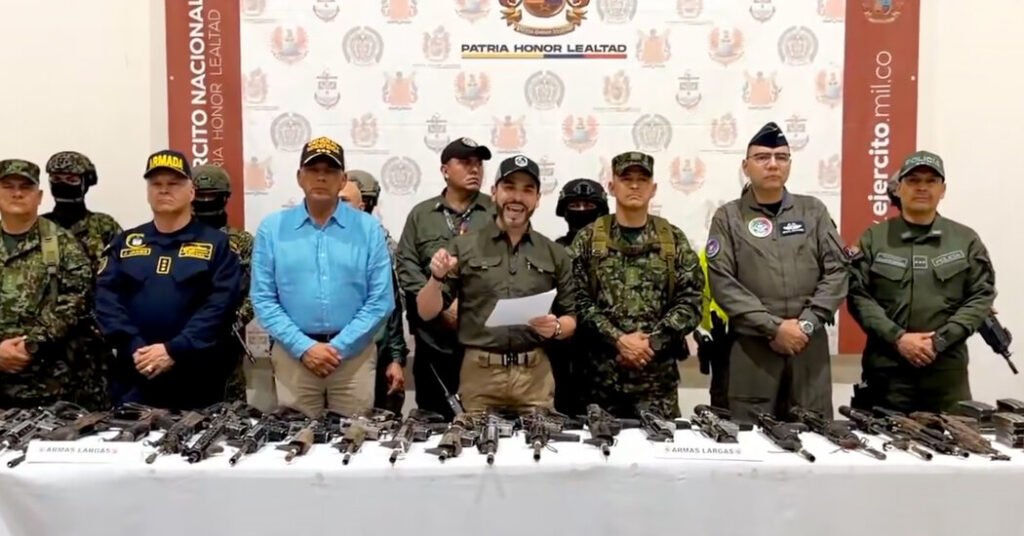
Colombia’s leader sits at a desk surrounded by military and police officials, presenting what he describes as evidence of a successful military operation. But the rows in front of him are not boxes of seized cocaine or weapons. They are dead bodies.
Wearing the same dark green as the military officials with him, President Abelardo De La Espriella can be seen in a video posted Wednesday morning on his X account walking beside white body bags said to hold the remains of rebels.
The video was an especially stark expression of a political tactic increasingly visible across the Americas: leaders who campaign on law and order using images of alleged criminals as a spectacle of state power.
Experts say the imagery reflects a regional trend of treating people labeled terrorists as enemies who do not merit the protections of due process. They pointed to the Trump administration’s designation of drug traffickers as terrorists and its military strikes in the Caribbean, which have killed at least 223 people, as part of that shift.
President Trump has publicized videos of immigration raids, sometimes accompanied by popular music. President Nayib Bukele of El Salvador has made images of prisoners part of his security strategy, releasing videos of inmates being shaved and marched into prison.
“When the U.S. is behaving like this, it makes it easier for everyone else to fall into that behavioral trap,” said Elizabeth Dickinson, the deputy director for Latin America for the International Crisis Group. “It’s not just: He did something bad, but he is a bad person and therefore deserves whatever punishment we assign.”
Adam Isacson, a director at the Washington Office on Latin America, a research institute, said, “It’s trying to get people excited about not just statistics about the homicide rate, but actually about these visuals in almost a cartoonish or pro-wrestling kind of way to appeal to people’s basest instincts.”
But that imagery carries particular weight in Colombia.
During decades of armed conflict, the military’s practice of measuring success by enemy casualties produced one of the country’s darkest human rights scandals: Soldiers killed nearly 8,000 civilians, then cast them as guerrillas killed in combat to inflate their body count.
The legacy of that scandal in the early 2000s, known as the “false positives,” remains deeply embedded in Colombians’ memory.
“Colombia has a long history of almost glorifying violence and the violent deaths of criminal leaders,” Ms. Dickinson said. “There’s a performative aspect of what’s happening here. And it really does mark a shift and a return to times past.”
For communities that have lived through decades of violence from both armed groups and the state, the images send two messages at once: that the government is capable of defeating criminals, but also that a new era of mass violence could be emerging.
Mr. De La Espriella, a right-winger backed by Mr. Trump, called the operation a “lethal blow” to the group’s territorial control and the most successful military operation in Colombia in the past 12 years.
“The time when you could move through Colombia with safe passage from a government that played freeze tag with you is over,” he said. “The determination to eradicate you — because you are a cancer — is absolute.”
Mr. De La Espriella said that 23 people had been killed and six captured, including aleader of a dissident rebel group who was known by the alias “Tigre.” He described him as the group’s third in command.
The president said the group had recruited children and attacked members of the army and navy during this year’s presidential elections. He also said that one child recruit had been rescued and placed in the care of the country’s child welfare agency.
The photographs, Colombian security experts said, are intended to demonstrate the government’s zero-tolerance approach.
“It is not just a punishment in terms of law and order, it is a moral punishment,” Ms. Dickinson said. “The celebratory aspects of their deaths plays into that narrative about this being an existential good versus evil conflict. It’s hard to overstate how powerful these images are.”
In 2016, Colombia forged a peace deal with the Revolutionary Armed Forces of Colombia, or FARC, the country’s largest rebel group, ending a 50-year conflict with the Marxist guerrilla group. But dissident factions that rejected or later abandoned the agreement, among other groups, continue to operate in parts of the country.
During the height of the conflict, the government sometimes released photographs of the bodies of major guerrilla leaders, including images in which the dead were presented alongside senior government officials.
But an image of the president himself alongside bodies represents something different, said Jorge Restrepo, director of the Conflict Analysis Resource Center, a Colombian research group.
“It feels novel in this post-conflict period,” he said.
The identities of the dead have not been disclosed, and the operation has not yet undergone the investigations required after a military action resulting in deaths. By displaying the bodies as defeated “terrorists,” the government collapsed distinctions between combatants and civilians, adults and children, and legal and illegal uses of force, Mr. Restrepo said.
The post Colombia’s New President Poses With Dead Bodies in Show of Force appeared first on New York Times.