When the Australian geologist and engineer Arnold Dix was approached by the Nepal authorities to help find those who could be trapped in hydropower project tunnels after a major flood last week, he knew there were several pressing challenges.
First, rescuers needed to locate the projects and their entrances, because everything had been “removed” by the force of the flood, Mr. Dix.
“It took us the better part of a day or two, just to figure out where the power stations used to be and also to develop a plan as to how might we save people if they survived,” he said.
Hundreds of workers have been missing in the tunnels since last Wednesday, when a glacial collapse sent tsunami-like waves of water mixed with rock and debris through two river valleys, killing more than 1,300 people and leaving more than 4,000 missing in Nepal and neighboring China.
Nepal has built a robust hydroelectric industry, harnessing the fast-flowing waters in the Himalayas to generate electricity. Those projects require both manual and engineering work to construct tunnel systems deep into the earth. Many hydropower projects have been constructed along the Bhotekoshi and Trishuli Rivers, which bore the brunt of the flooding.
Mr. Dix and his team’s efforts were focused on the Trishuli 3A hydropower project.
Mr. Dix’s team relied on engineering drawings of the structures underground, satellite imagery and old charts to try and identify any potential “Goldilocks zones” — a term Mr. Dix used to describe a small subterranean area “where a human being could have survived.”
This information would guide rescuers on where to start looking. Most of their efforts have been focused in the project’s cable tunnel — which runs from the underground powerhouse to the transmission grid, he said.
Mr. Dix is now en route to Kathmandu from Australia to help with rescue efforts on the ground. He has advised on major underground rescue operations around the world, including a tunnel collapse in the Himalayas three years ago, when 41 workers were rescued after being trapped for 17 days.
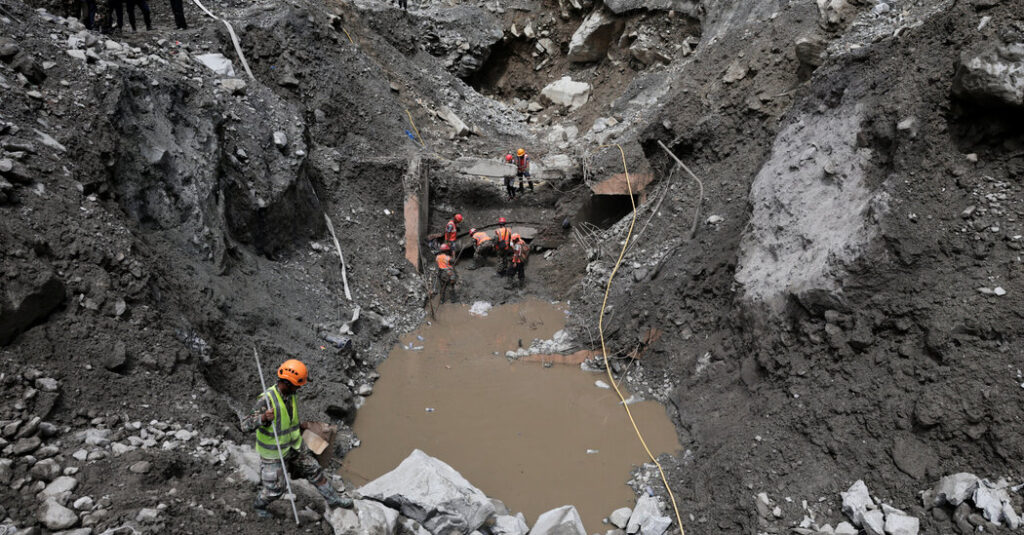
This operation has been slow and difficult work, he said. Rescuers have had to dig through mud and use explosives to blast through rocks “the size of cars.” Once inside the tunnel, they were faced with water that needed to be drained, he added.
“We had to dig a huge drainage canal back to the river — the new river which is now not where it used to be — because we were worried that the tunnel was full of water, and it would drown us, or maybe drown people who were ahead of us in the tunnel,” Mr. Dix said.
Rescuers then were able to create a small gap along the top of the cable tunnel through which they could crawl, calling to any survivors.
Those immense efforts paid off on Friday.
Mr. Dix said rescuers heard the “faint sound of someone in Nepalese acknowledging” their calls.
A short time later, at least two workers were found alive. They have been flown to Kathmandu for treatment. One is in a critical condition.
One of the rescued, Sanjay Sah, is a mechanical foreman and the other, Kabir Maharjan, is a mechanical supervisor, according to a list seen by The New York Times. Both were employees of the Nepal Electricity Authority, according to the list.
More than 40 people were thought to be inside the tunnel, according to two people briefed on the rescue operations, including a senior Nepali Army officer. Rescuers also heard other voices in the tunnel, the people said, kindling hope that more people could be saved. It was not clear how many were still alive.
“I was in tears, of course,” Mr. Dix said of the moment he found out the good news.
For both survivors, challenges remain, he said. “They don’t know what’s happened; they’ve been cut off from the world the whole time, they’ve been trapped in the dark for more than a week,” he said.
“They’re going to find out that thousands of people have died, including their friends and colleagues,” he added.
There will be no rest for Mr. Dix. Once he arrives in Kathmandu on Friday evening, he will put what he has leaned from this rescue “into strategies about how we might go and help other power stations.”
He said the efforts of the rescue team were extraordinary, adding, “we’re performing miracles out there.”
Anupreeta Das contributed reporting.
The post Inside the Nepal Tunnel Rescue Operation appeared first on New York Times.