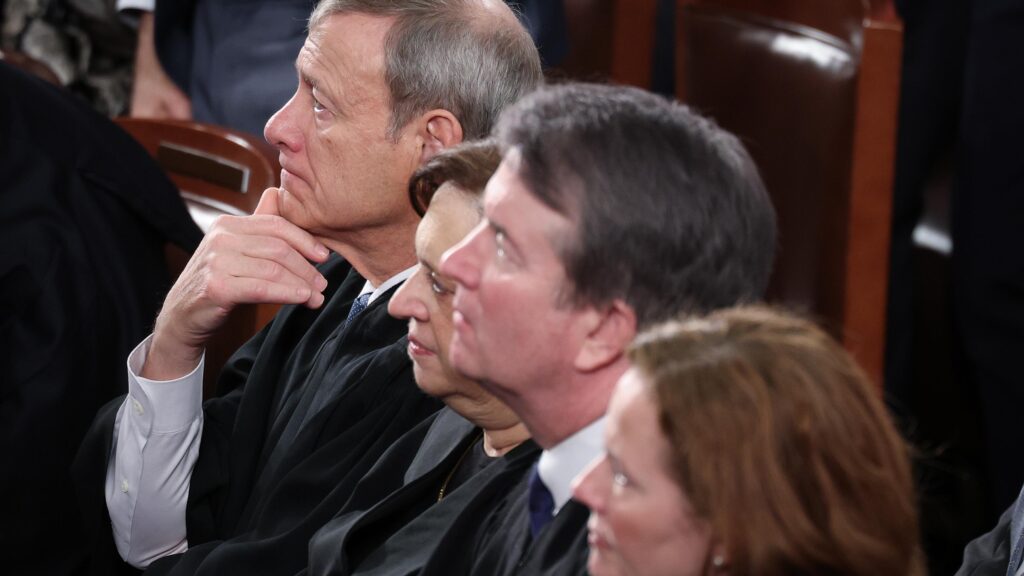
The House of Representatives on Wednesday struck down a Republican-led attempt to permanently limit the Supreme Court to nine Justices, with lawmakers voting largely along party lines.
The attempt to preserve the makeup of the country’s top courtwas already a long shot: GOP Rep. Andy Biggs of Arizona’s proposal was a constitutional amendment that required two-thirds of the chamber to approve. Even if the proposal had passed the chamber, it faced similarly long odds in the Senate and would have then needed to be ratified by 38 of the 50 U.S. states. But the attempt fell at the first hurdle in the House, with a 212-206 vote.
Still, the effort has put the Supreme Court—which Democrats have recently targeted over the conservative leanings of its decisions—firmly in the spotlight ahead of the November midterms. The Supreme Court may have bucked President Donald Trump’s agenda in tariffsand birthright citizenship, but it equally handed him victories in federal elections, his attempts to remake the capital, and his Administration’s enforcement of a robust anti-immigration agenda.
The GOP has argued against “packing” the court, whose current 6-3 conservative set-up often benefits Trump and his allies.
But Democrats claim the conservative-led court’s latest rulings show it’s pandering to politics instead of law. Rep. Jamie Raskin of Maryland dismissed the proposal to cap the number of Supreme Court judges as “another partisan power grab by MAGA, our colleagues who fear for the results in the November election.”
Democrats’ criticisms coincide with signs of negative public opinion about the Supreme Court, with a July 2026 Washington Post-Ipsos poll showing that 46% of Americans believe the court is ruling on Trump’s policies based on ideology rather than the law.
The conservative Justices have denied that the court’s decisions are politically motivated.
“I think, at a very basic level, people think we’re making policy decisions, we’re saying we think this is how things should be, as opposed to what the law provides,” said Chief Justice John Roberts at an event in May. “I think they view us as purely political actors, which I don’t think is an accurate understanding of what we do.”
The past few months have nonetheless seen Democratic lawmakers proposing other ways to revamp the court in an attempt to weed out partisan politics and rein in judicial powers. Here are some of those efforts:
Ongoing discussions over court size
The U.S. Constitution does not state how many Justices make up the Supreme Court, and the number of seats has changed over time, from as few as five Justices to as many as 10. Since 1869, however, the court has had nine authorized seats for Justices.
In 1937, President Franklin D. Roosevelt tried to expand the court by up to six Justices after the incumbents struck down parts of his New Deal agenda, but lawmakers decisively thwarted this.
Since 2021, some Democrats have attempted to increase the number of Justices. In April that year, four Democrats introduced a bill envisioning a 13-Justice Supreme Court, claiming it “would restore balance to the nation’s highest court after four years of norm-breaking actions by Republicans.” Former Vice President Kamala Harris, who lost to Trump in the 2024 presidential election, also said that Democrats should have a “real conversation” about changing institutions, including “expanding” the court.
As recently as May, Rep. Al Green of Texas filed a bill to increase the number of Justices to 13.
“I think that we are in a position now that calls for some significant actions taken by the Congress, and we ought to expand—and 13 is a pretty good number,” Rep. James Clyburn of South Carolina said in an interview with NBC News last month. “A baker’s dozen would be a good number to have on the court. And I would hope we would get people on the court who will follow the constitutional underpinnings of this great nation of ours.”
Proposed term limits
In July, Sen. Sheldon Whitehouse of Rhode Island and his fellow Democrats in the upper chamber proposed to limit new Justices’ active terms to 18 years.
Per Whitehouse’s bill, the next President would nominate two new Supreme Court Justices in the first and third years after a presidential election.
The bill also states that only the nine most recently appointed Justices on the bench would rule on cases under the Court’s appellate jurisdiction. A Justice will spend about 18 years participating in those cases, after which the Justice would be limited to hearing original jurisdiction cases and performing other duties.
“Term limits and regular appointments would make the Court more representative of everyday Americans and help restore the Supreme Court to the proper independent body it was created to be,” Whitehouse said.
Multiple polls, dating back to at least 2014, show broad public support for Justices’ term limits.
Other ethics concerns
Beyond debates over judicial tenures, some Supreme Court Justices have been hounded by ethics controversies.
Clarence Thomas and Samuel Alito have faced allegations of conflicts of interest and questions over financial disclosures, including accepting undisclosed luxury trips and other gifts—claims they have disputed.
Democrats have since introduced a handful of bills in hopes of restoring confidence in the judiciary. One bill sought to ban federal judges from receiving gifts valued over $50 in an instance or $100 in total per year per source save for specific exceptions, and a bill also seeks to require Justices and other members of the judiciary—as well as their spouses and children—to put certain assets in blind trusts.
The Supreme Court has also been accused of “abusing” what is called the “shadow docket”—the docket which the Trump Administration has resorted to in seeking emergency relief in cases challenging the President’s agenda. The Trump Administration has applied for dozens of emergency appeals before the Supreme Court, and the court has, in most cases, ruled in the Administration’s favor. Rep. Raskin has introduced a bill that would require the Supreme Court to issue public legal justification for certain orders issued from this docket.
Sen. Chris Murphy of Connecticut introduced a bill in July mandating an ethical code of conduct for the Supreme Court, appointing an Ethics Investigations Counsel, and requiring Justices to publicly disclose why they decided to recuse themselves from a case. The bill aims to strengthen enforcement of the court’s previous ethics code.
The post How Democrats Are Pushing for a Supreme Court Overhaul appeared first on TIME.