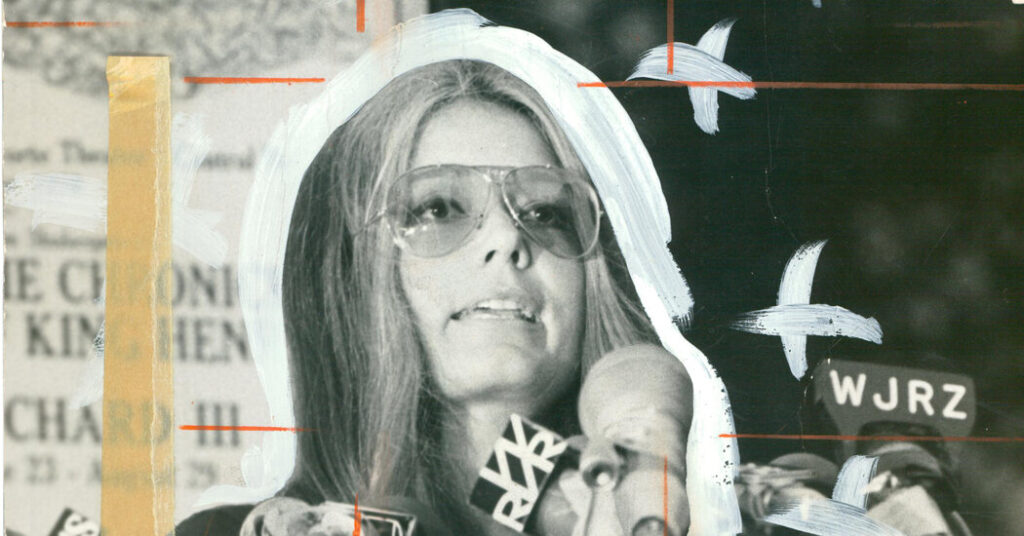
When Gloria Steinem was 22 years old and a recent graduate of Smith College, she found herself sitting in a doctor’s office in London, asking for an abortion. Not long before, she had slipped off her engagement ring, tucked it under her fiancé’s pillow and, in her words, fled. She was headed to India on a fellowship, leaving behind the comfortable domestic life expected of her, and walking into a future that must have looked awfully fuzzy even without an unwanted pregnancy blurring her path forward.
This was 1957, and elective abortion was illegal in both the United States and Britain (not to mention much of the rest of the world). Ms. Steinem managed to find a doctor who agreed to help her anyway. She dedicated her 2015 memoir to him, recalling what he told her: “You must promise me two things. First, you will not tell anyone my name. Second, you will do what you want to do with your life.”
By the time Ms. Steinem died this week at the age of 92, she had done more than anyone could have possibly imagined with her life. Among her biggest accomplishments was enabling millions of other women to do what they wanted with their lives.
At the core of that work was reproductive freedom, as she called it: the right to have sex for pleasure without shame and to say no without grave consequence, to use contraception to prevent unintended pregnancies, to have access to safe and legal abortion, to have children by choice in safety and with support. She, and the second-wave feminist movement of which she was a part, succeeded in many of those aims. Premarital sex has been largely stripped of its stigma. Contraception is legal in the United States and enjoys widespread use and strong public approval. Pregnant women and mothers still lack adequate support, but millions have had access to parental leave, workplace protections and a level of spousal help that was virtually unheard-of when Ms. Steinem was young. Perhaps the pinnacle of those efforts was the 1973 Roe v. Wade decision, which affirmed abortion as a constitutional right of American women.
In the years after Roe, women flooded into colleges and the work force. Millions were able to do what they wanted with their lives. They became doctors and lawyers, artists and entrepreneurs, dedicated mothers, aunties and friends. Some became famous for their accomplishments, but most were regular women — you see them at the grocery store, at church, at work, maybe in the mirror every day — whose lives were made better because they were able to choose their own paths. They married for love or loved staying single, cared better for the children they had and chose to have more when they were ready, left abusive relationships, made their own money, made their own mistakes, made their way.
This should have been Ms. Steinem’s legacy. But we all know what happened as Roe hit middle age.
Today, abortion is banned entirely, or almost entirely, in 17 states. In such states, women have died of preventable pregnancy-related causes; others have not received adequate treatment and wound up hemorrhaging, getting deadly infections or losing their reproductive organs. After Texas banned abortion, rates of sepsis among women hospitalized for miscarrying in their second trimester shot up by more than 50 percent.
These are the statistics it’s possible to know (many anti-abortion states are doing little or even refusing to track the damage their bans have caused). More insidious is the damage to women’s lives that doesn’t show up in these numbers. What happens when women can’t do what we want with our bodies — and, by extension, our lives?
We have a sense of that, thanks to a study that compared women who were turned away from getting an abortion with those who were able to get the procedure. It found that women who are refused abortions are more likely to be reliant on public assistance, to be poorer, to remain tied to abusive partners and to face life-threatening complications. It also found that all their children — most women in the United States who have abortions are already mothers — end up worse off.
Maybe early 20s Gloria Steinem would still have become the feminist trailblazer Gloria Steinem had she married her college boyfriend and had a baby. She also may have joined the millions of women whose dreams were deferred or defeated by our patriarchal society. Ms. Steinem came to the feminist movement first as a journalist covering an event in New York, in which women talked about their illegal abortions and demanded the right to choose what they did with their bodies. Had Ms. Steinem not had an abortion herself, would she have been in that room? Would she have so viscerally related to the feminists’ cause?
Today’s young American women were born into a world of unfinished feminism. We have freedoms our great-grandmothers couldn’t have imagined, but also fewer rights than we did just a handful of years ago. We live in an era not just of abortion bans, but of overt misogynists in positions of power: the gleeful woman-haters of the manosphere, the anti-feminists of the MAGA right who espouse a politics of “your body, my choice,” a president accused of sexual misconduct many times over and the men in his orbit who endorse the idea that women shouldn’t have the right to vote.
What does it mean to “do what you want to do with your life” — as that doctor told Ms. Steinem all those years ago — when our country’s most powerful people are working to ensure that women can’t even do what we need, let alone what we want?
Here, Ms. Steinem’s own life is instructive. She was born in Toledo, Ohio, in 1934, a time when doing what you want with your life was not a directive generally given to women. She did it anyway — with lots of help, and eventually within a movement that reshaped the world.
Young women today were told that our lives would be ours, and are collectively stunned to find that promise being broken. That betrayal will rack up real casualties. But it is not an end to a feminist movement of which Ms. Steinem was, in her own telling, something of a reluctant figurehead.
Gloria Steinem is dead. But as long as women believe that we should be able to do what we want with our lives, feminism will live on.
Jill Filipovic is a journalist, a lawyer and an author who writes at jill.substack.com.
The Times is committed to publishing a diversity of letters to the editor. We’d like to hear what you think about this or any of our articles. Here are some tips. And here’s our email: [email protected].
Follow the New York Times Opinion section on Facebook, Instagram, TikTok, Bluesky, WhatsApp and Threads.
The post Gloria Steinem Died With Unfinished Business appeared first on New York Times.